Why The Betta Fish Drowns Without Air -The Scuba Diver
The Reverse Drowning
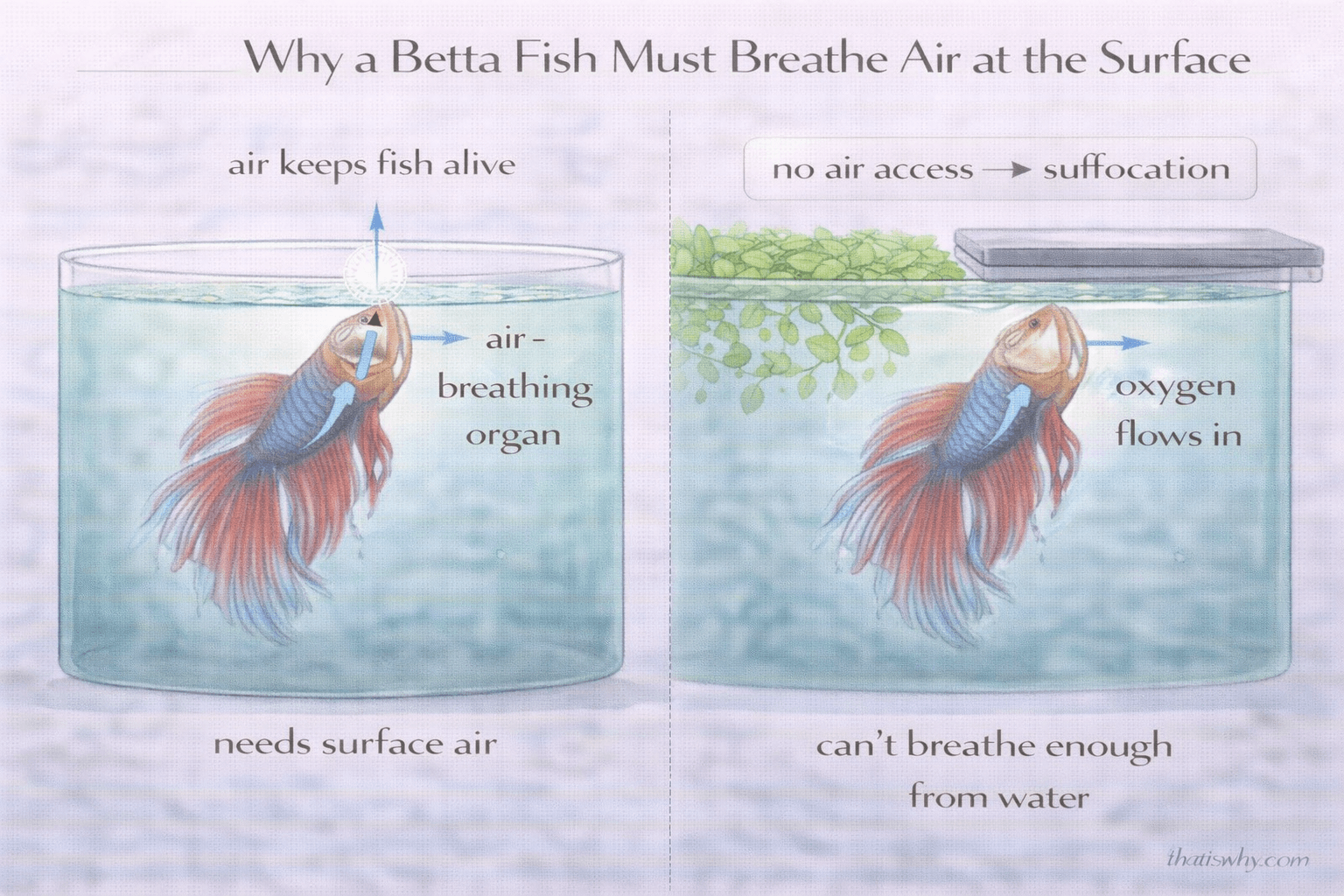
Can a fish drown? Yes. Betta fish (Siamese Fighting Fish) are “obligate air breathers,” meaning they must access the surface to breathe atmospheric air. They possess a specialized organ called the Labyrinth Organ, which functions like a primitive lung. If a Betta is trapped underwater and cannot reach the surface, it will suffocate and drown, even in water that is full of oxygen.
That is the biological fact, but it sounds like a lie.
We are taught in school that fish breathe water. They use gills to extract oxygen from the liquid. If you take them out of the water, they die. The Betta fish breaks this rule, it has gills, but they aren’t enough, so to survive, the Betta must swim to the surface every few minutes, open its mouth, and take a gulp of atmospheric air.
It is a fish that thinks it’s a dolphin. It lives underwater, but it is tethered to the sky.
The Scuba Diver
To understand this, you have to stop looking at the Betta as a fish. Think of it as a Scuba Diver.
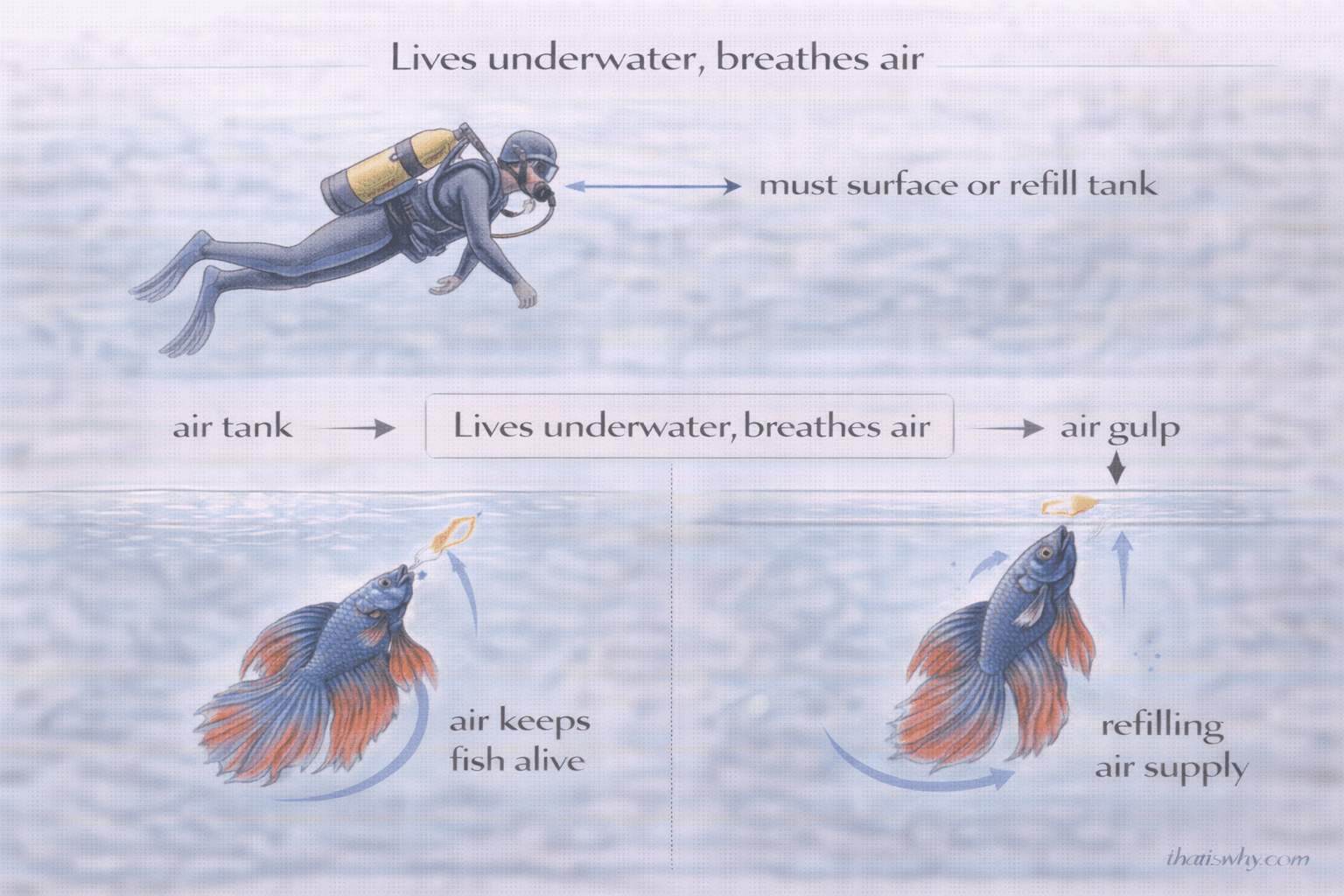
Most fish are submarines. They process the water around them to breathe like Goldfish surviving cold winter low oxygen by making alcohol. They never need to surface. The Betta is different, it is carrying a limited supply of oxygen on its back (or rather, in its head). Every time it darts to the surface and gulps, it is refilling its tank.
It traps a literal bubble of air inside a specialized chamber. As it swims back down, it slowly drains the oxygen from that bubble into its bloodstream. When the tank runs empty, the fish starts to panic. It has to surface again. If you block the surface with a lid or a plant, you are cutting the diver’s air hose. The water becomes a suffocating trap.
The Internal Rebreather
So, where is the tank? It’s hidden inside the fish’s head. It’s called the Labyrinth Organ, and it functions like a high-tech rebreather.
Located right above the gills, the Labyrinth isn’t a soft lung. It is a maze of thin, folded bone plates, maximizing surface area like the radiator of a car. When the Betta gulps air, it forces the oxygen into this bone maze, where it is absorbed directly into the blood.
This gear is so effective that the Betta has stopped using its “original” equipment. Most fish rely 100% on their gills. The Betta’s gills have atrophied. They are weak and they can’t pull enough oxygen from the water to keep the fish alive. The Betta has become dependent on its scuba gear. If the tank fails (no surface access), the diver dies.
Born in the Dead Zone
Why would a fish evolve to ignore the water? Because its home was a death trap.
Bettas evolved in the shallow, stagnant rice paddies of Southeast Asia. These waters are a chemical nightmare. They are hot, still, and full of rotting plants, rotting vegetation everywhere consumes oxygen and releases carbon dioxide. In these conditions, the dissolved oxygen levels drop to near zero.
For a normal fish (like a Carp), this is uninhabitable. It’s like being locked in a garage with a running car but for the Betta, this toxic wasteland was an opportunity. By bringing its own air supply (the Labyrinth), the Betta could live where no predators could follow.
The “Scuba Gear” didn’t just keep it alive; it gave it a monopoly on the habitat. It became the king of the puddle because everyone else suffocated.
The Floating Nursery
This scuba gear didn’t just save the adults; it changed how they raise their kids.
In a stagnant puddle, the deep water is a dead zone. The oxygen levels are critical. If a Betta laid eggs on the bottom, the babies would suffocate. They are born without tanks.
So, the father builds an Air Tent. He swims to the surface and blows thousands of sticky bubbles. He catches the falling eggs and spits them into this floating foam. But the air runs out. Bubbles pop. So the father spends days constantly repairing the raft, blowing new air into the structure to keep it buoyant. He is manually ventilating the nursery. He isn’t just guarding the kids; he is their life support system, keeping them suspended above the suffocation zone until they can build their own labyrinths.
Pet Store Myths
Let’s clear up a few misconceptions about keeping these divers.
Myth #1: “They like tiny cups.” We assume “puddle fish” like small spaces.
The Truth: They survive small spaces; they don’t thrive in them. The Labyrinth saves them from suffocation, but it doesn’t save them from Ammonia. In a tiny cup, their own waste burns their gills. Just because they aren’t dead doesn’t mean they aren’t dying.
Myth #2: “They don’t need a filter.” People think they are dirty.
The Truth: They need clean water. They just don’t need an air pump (bubbler). The filter is for the chemicals, not the oxygen.
Myth #3: “They fight to the death.” We think they are murderers.
The Truth: In the wild, they rarely kill each other. They flare their gills and tail to look big, and the loser swims away. They only fight to the death in a small tank because the loser has nowhere to run. We forced them into the cage match.
The Evolution of the Diver
When you watch your Betta swim to the top and take a gulp, you are watching a moment of evolutionary history frozen in time.
You are seeing a fish that is halfway to becoming a land animal. It has developed the lungs, the behavior, and the dependency on air. It is a creature that looked at the suffocating water and decided to bring its own tank.
It is an evolutionary bridge. It hasn’t quite walked out of the ocean yet, but it has already packed its bags. Your Betta isn’t just a pretty pet. It is a Scuba Diver that has forgotten how to be a submarine, living its life in the thin blue line between the water and the sky.
How We Researched This :
To explain this respiratory trick, we examined the anatomy of Anabantoid fishes (the family that includes Bettas and Gouramis). We looked at cross-sections of the Labyrinth Organ to understand how vascularized bone can function like a lung.
But we knew that just citing gill anatomy isn’t helpful. Our real job began when we asked, “What does this feel like?” That question led us to the “Scuba Diver” analogy, a simple story to make the complex reality of an aquatic animal dependent on atmospheric air feel intuitive.