Why Group of Giraffes Is Called a Tower
Have you ever noticed that some collective nouns for animals seem to fit perfectly? A “pride” of lions, a “skulk” of foxes… they just feel right.
But then you get to giraffes, and their group names are on another level entirely. They’re not just clever; they’re a two-part story. Most people only know the first part, but the second part is where the real magic is.
The name isn’t random — it’s part of a much bigger pattern in how humans name animal groups.
So, what do you call a group of giraffes? Let’s get into it.
The Status Update
Here’s the best way I’ve found to think about it. The names for a group of giraffes are like a social media status update.
A status update isn’t who you are forever; it’s a description of what you’re doing right now. Are you “at a concert” or “on a flight to Paris”? Your label changes with your actions.
Giraffe group names work the exact same way. They aren’t a fixed label. They are a real-time status update that changes based on what the giraffes are doing.
The Analogy Explained: This works because the two main names for a group of giraffes are tied directly to their state of being—stationary or in motion. The “Status Update” metaphor perfectly captures this temporary, action-based naming convention. The limitation, of course, is that a status update is a conscious choice. The giraffes aren’t posting “feeling tall today.” The names are labels we apply based on our observation of their actions.
The Two Statuses: A Name for Every Occasion
What are the two “statuses” for a group of giraffes?
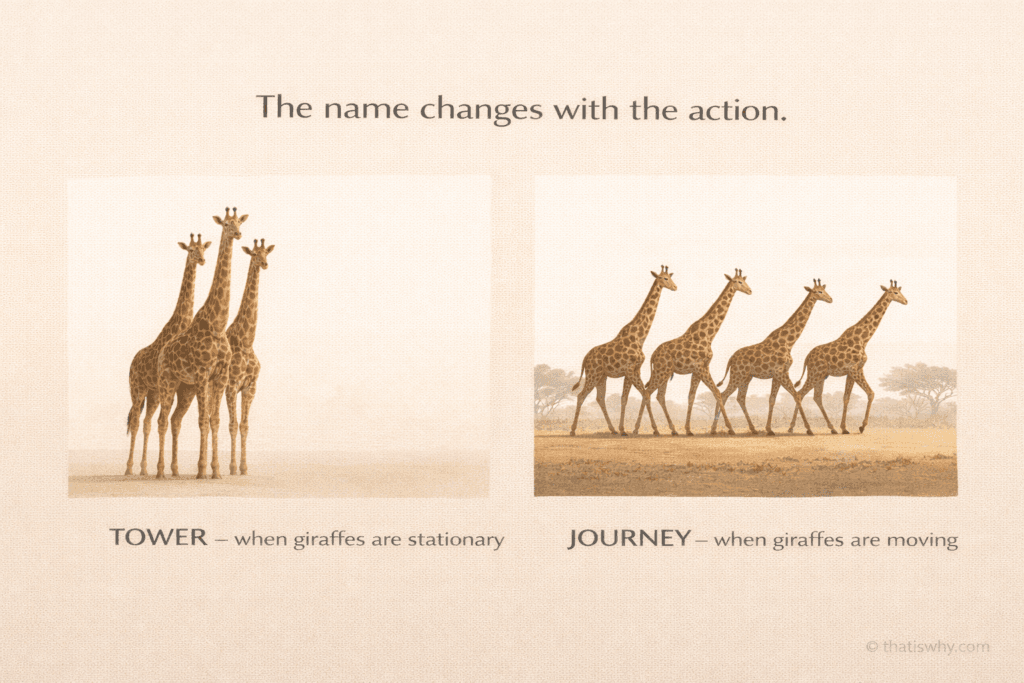
The first one is the one you’ve probably heard of. When a group of giraffes is standing still—munching on acacia leaves, surveying the plains—their status is a “tower” of giraffes. And it’s perfect, right? You can just picture it. A cluster of those impossibly long necks, standing tall and majestic against the savanna skyline. They literally look like a group of elegant, organic towers.
But here’s the cool part that most people miss. The moment that group starts to move, their “tower” status disappears. So what do they become?
They become a “journey” of giraffes. Isn’t that fantastic? The name isn’t just “a herd” or “a pack.” It’s a word that beautifully captures the sense of purpose and graceful, long-strided movement as these massive animals travel across the vast African plains. They aren’t just walking; they are on a journey.
Verbs in Disguise
Keep in mind what’s so cool about a name like “journey” is that it isn’t really a noun at all. It’s a verb in disguise.
Think about it. The word “journey” isn’t describing what the group is; it’s describing what the group is doing. It’s a name that captures an action, a process, a movement. It’s a verb pretending to be a noun. This is such a rare and poetic feature of our language, where we are so impressed by an animal’s action that we make the action itself their name.
Seeing Verbs in Disguise Everywhere
And this is where language gets really fun. This “verb in disguise” trick isn’t just for giraffes.
Think about geese. On the ground, they’re a noisy, chaotic “gaggle.” That name is pure sound, a perfect description of the noisy chaos they’re making. But the moment they take to the sky in that iconic V-formation, they become a “skein”—a word that evokes a single, elegant thread unwinding across the horizon. The name changes with the action.
But my absolute favorite example has to be otters. When a group of them are floating on their backs, holding hands so they don’t drift apart, they’re called a “raft.” It’s a perfect description of stillness. But when they’re on land, tumbling and wrestling with that boundless, joyful energy? They become a “romp.” I mean, how perfect is that? The name is the action.
A Few More Giraffe Facts
Okay, before we wrap up, I have to share a couple more amazing giraffe facts that I love, because they add so much to the story.
First, how many giraffes are actually in a “tower”? It turns out, it’s totally fluid. As the San Diego Zoo explains, these groups aren’t fixed families. They’re more like loose social clubs where individuals come and go as they please, with towers ranging from a few members to several dozen.
And speaking of new members joining the group, what about the babies? A baby giraffe is called a calf. And get this for a wild fact: a mother giraffe gives birth standing up, meaning the calf begins its life with a six-foot drop to the ground! It’s a tough welcome, but they are usually standing on their own within an hour.
A Two-Part Story
So, the name for a group of giraffes isn’t a single answer, but a beautiful, two-part story.
They are a “tower” when they stand tall and still, a landmark on the horizon. And they are a “journey” when they move with purpose and grace across the plains. It’s a perfect linguistic snapshot, a pair of names that captures both the stillness and the motion of one of the world’s most incredible animals.
How We Researched This:
To answer this question, we looked beyond the simple answer. We consulted zoological resources from organizations like the San Diego Zoo and etymology guides to uncover the two distinct names for a group of giraffes and the logic behind each one. But we knew that just listing facts isn’t helpful. Our real job began when we asked, “What does this feel like?” That question led us to the ‘Status Update’ analogy—a simple story to make the complex linguistics feel intuitive.