Why Is the Blobfish Considered the Ugliest Animal?
If you’re here for this famous blobfish photo, I understand. The sagging pink face, the droopy “nose,” the permanently disappointed expression, it’s one of the internet’s most dependable visual jokes, and you probably want confirmation that yes, this is a real animal and yes, it actually looks like that.
Here’s the part that changes everything: the photo is real, but the version of the blobfish in it is not.
The Vote That Turned a Deep-Sea Fish Into a Global Punchline
In 2013, a conservation campaign did something unusual. Instead of spotlighting pandas or tigers, the Ugly Animal Preservation Society asked the public to vote for the world’s ugliest animal. Nearly 10,000 people participated, and the blobfish won decisively.
The campaign worked exactly as intended. The image spread quickly, headlines multiplied, and the blobfish became the society’s official mascot almost overnight. The photo did most of the heavy lifting: a pink, gelatinous face that appeared to be sliding off its own skull, with an expression that seemed almost human in its resignation.
The internet embraced it because the joke required no explanation.
But here is the detail almost everyone missed: the image that won the vote does not show a blobfish in its natural state.
It shows a deep-sea animal that has just been pulled hundreds of meters upward, removed from immense ocean pressure, and left structurally altered by the sudden change in environment.
What became famous was not a creature living normally in the ocean.It was a creature that had just experienced catastrophic decompression.
Once you understand what that means physically, the humor starts to look very different.
A Water Balloon Only Looks Strange After You Take It Out of the Water
Picture yourself holding a water balloon underwater in a swimming pool, where it appears smooth, rounded, and perfectly balanced because the surrounding water presses gently and evenly against every surface. Nothing droops, nothing stretches awkwardly, and nothing looks unstable because the environment itself is helping the balloon maintain its form.
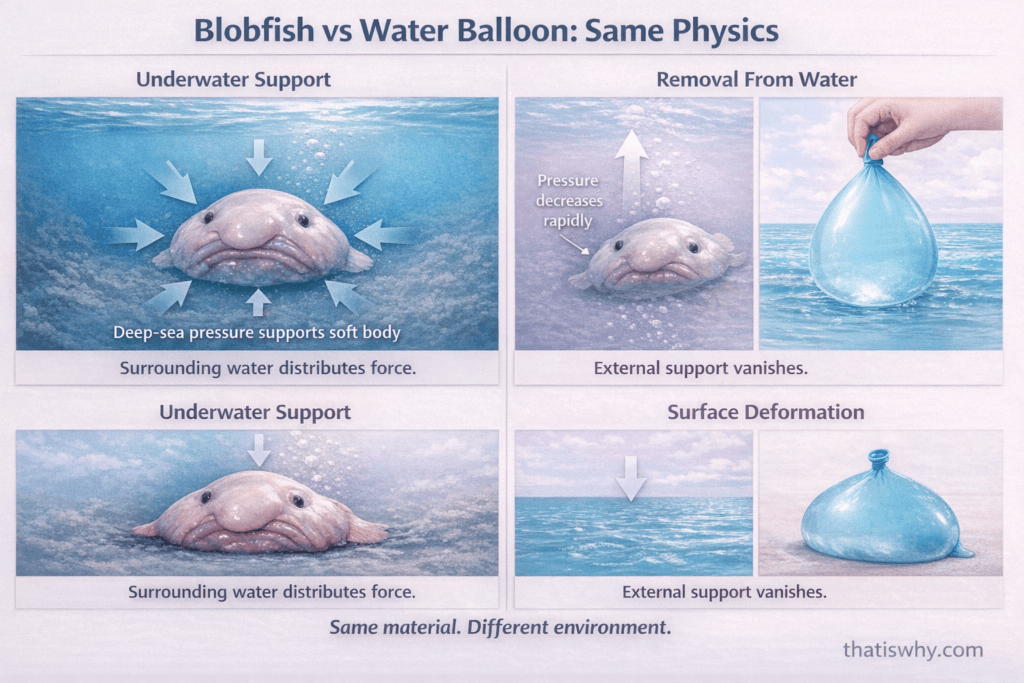
Now lift that same water balloon into the air and notice how quickly the shape changes. The surrounding support disappears, gravity begins pulling downward without resistance, and the once-symmetrical shape starts to sag and bulge in ways that feel almost disappointing compared to how neat it looked moments earlier.
The blobfish works in much the same way.
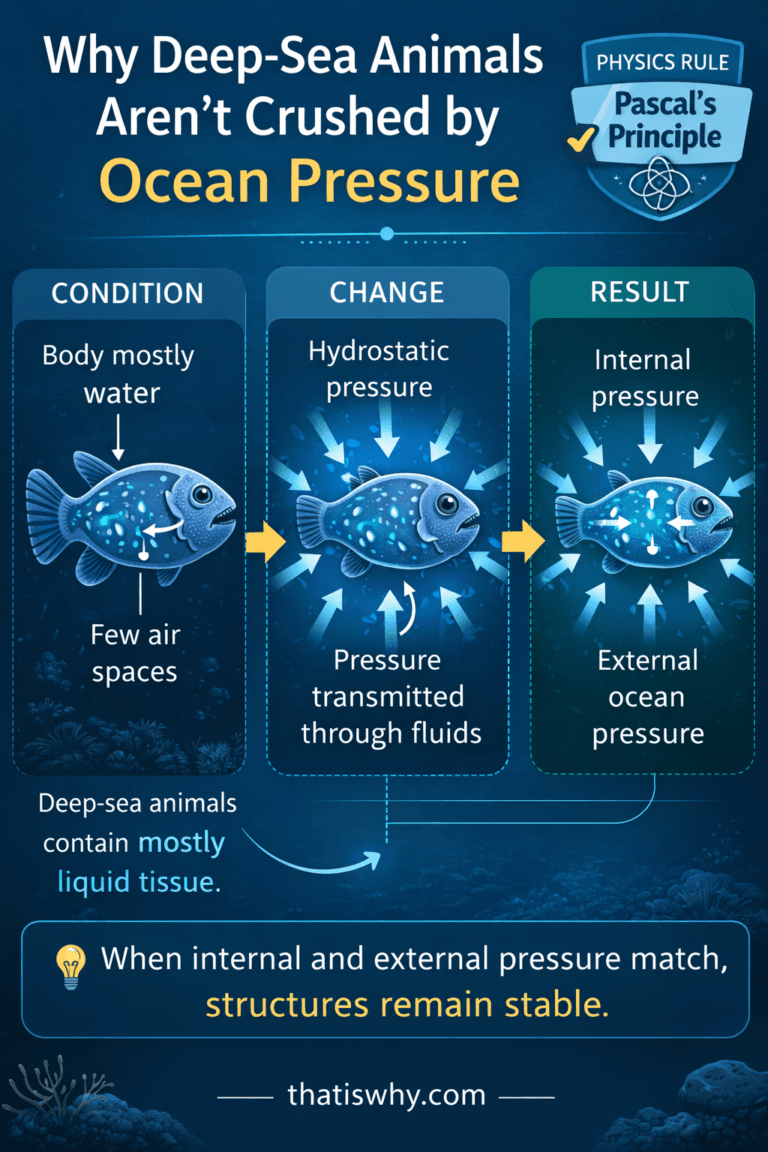
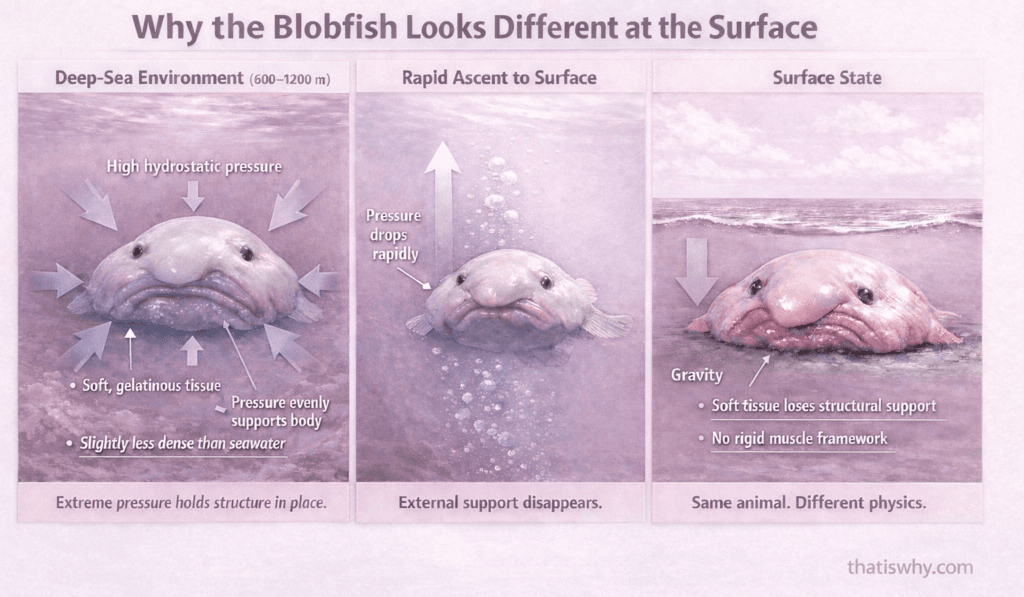
Far below the ocean surface, between 600 and 1,200 meters deep, the species known as Psychrolutes marcidus lives in a world defined by darkness and immense pressure. Down there, the ocean presses against its body from all directions with extraordinary force, and that pressure quietly holds its soft tissues in place. Nothing collapses because nothing needs to resist gravity on its own. The surrounding water distributes force evenly across its body, giving it a stable, natural shape.
In that environment, the blobfish does not resemble the viral pink caricature that circulates online. It looks like a slightly bulbous, grey deep-sea fish with a clear head, a body, fins, and proportions that make complete sense in motion. It drifts just above the seafloor, conserving energy and waiting patiently for small prey to wander close enough to become a meal.
When that same fish is dragged rapidly to the surface, the physics change in an instant. The crushing pressure that once supported every inch of its body vanishes, and its soft flesh suddenly has to contend with gravity alone. Without the ocean pressing evenly from all sides, the tissues shift and sag, creating the drooping features that made the internet laugh.
The famous “nose” in the widely shared photograph is not a feature designed to hang forward in defeat. It is soft tissue that has slipped because the environmental support system disappeared. What people interpreted as an expression is simply anatomy responding to a new set of physical rules.
Judging a blobfish by that image is like judging a water balloon for failing to hold its shape on a dry sidewalk after it looked perfect underwater. The balloon did not become flawed. It was removed from the only conditions in which its design made sense.
Once you visualize that clearly, the story begins to shift from comedy to physics.
What a Blobfish Actually Looks Like Where It Lives
If you look at a blobfish in its natural habitat, the first thing you notice is how normal it appears.
In the deep waters off Australia and Tasmania, the species Psychrolutes marcidus looks like a fairly standard deep-sea fish. Its body is grey or pale, its head is clearly defined, and its fins extend outward in proportions that feel balanced rather than melted. The face does not droop. The features do not slide. Nothing about it suggests a punchline.
It hovers just above the seafloor, conserving energy in a place where food is scarce and movement is expensive. Instead of chasing prey, it waits. Small crustaceans and other edible creatures drift past, and the blobfish simply opens its mouth and lets the ocean deliver the meal. The strategy is efficient, not dramatic, which is exactly what survival looks like in the deep sea.
Now compare that to the surface photograph.
The pink coloration is exaggerated because the protective skin layer has been damaged and the tissues have expanded. The soft flesh, no longer held in place by immense pressure, shifts downward under gravity. What appears to be a cartoonish “nose” is simply tissue that has sagged forward. The body that once looked compact and structured now appears loose and collapsed.
This is the same animal in two completely different physical environments.
Judging a blobfish by its surface photo is like judging a water balloon for how it looks after you pull it out of the pool and set it on concrete. The balloon did not change its design. The conditions changed around it.
And once you see the side-by-side comparison, the word “ugly” starts to feel misplaced.
The Real Reason the Blobfish Is Built This Way
When people first learn that the blobfish turns saggy at the surface because of pressure loss, the reaction is often the same: why would evolution design something so fragile?
The answer becomes obvious once you stop imagining the surface as the default setting for life.
Six hundred to twelve hundred meters below the ocean’s surface, sunlight disappears completely, temperatures hover just above freezing, and food is unpredictable. Most importantly, the pressure is enormous, pressing on every square inch of a body with relentless force.
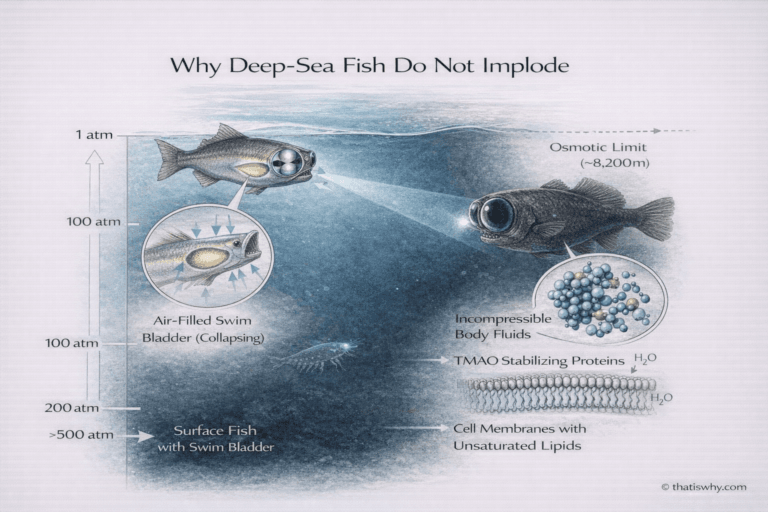
In that environment, strong muscles are expensive. Thick, rigid structures require energy to build and maintain. Gas-filled swim bladders, which help many shallow-water fish float, become dangerous because gas compresses under pressure and can expand violently if the animal rises too quickly.
So the blobfish takes a different approach. Instead of fighting the environment, it lets the environment do the work.
Its flesh is slightly less dense than seawater, which allows it to hover without constantly swimming. It does not need powerful muscles to stay afloat. It does not need a rigid skeleton to resist collapse because the surrounding pressure already presses evenly on its body. In the deep sea, being soft is not a flaw. It is efficient engineering.
A water balloon underwater does not need to be stiff because the water supports it from every side. Remove that support and the weakness becomes visible, but the weakness was never a problem in the first place. It only looks like one when we judge it by the wrong environment.
Organisms are shaped by the conditions they live in, not by how well they perform outside of them. The blobfish is not badly designed. It is exquisitely tuned for a world most of us will never see.
The Vote Was Never About Mocking the Blobfish
When the Ugly Animal Preservation Society launched its 2013 campaign, the goal was not to embarrass a deep-sea fish. The campaign was created by science communicator Simon Watt, who understood something slightly uncomfortable about human psychology: we protect what we find cute.
Pandas receive donations, tigers inspire awe and dolphins fill documentaries.
Meanwhile, species that look strange, lumpy, or unfamiliar struggle to capture attention, even when they are just as endangered. The blobfish became a strategic mascot.
The viral photo worked because it triggered a reaction instantly. People laughed, shared it, and voted. Nearly 10,000 votes later, the blobfish was officially crowned the “world’s ugliest animal,” and suddenly a deep-sea species most people had never heard of was part of a global conversation.
The campaign succeeded precisely because the image was misleading.
That sounds cynical at first, but it reveals something powerful. The joke pulled people in, and once they were paying attention, the deeper message followed: conservation should not depend on cuteness.
The blobfish is not a monster of evolution. It is a bycatch victim in deep-sea trawling operations. Its habitat is vulnerable. It lives in a fragile ecosystem that is easily disrupted. None of those facts are visually dramatic, which is why they rarely trend online.
The “ugly” label acted like bait. The science came afterward.
Seen this way, the viral photo becomes less of a punchline and more of a doorway. It forced millions of people to look at a species they would otherwise ignore.
The Three Assumptions That Made the Blobfish Famous
Myth #1: The Blobfish Is Just a Fake Internet Creature
Truth: The Blobfish Is Completely Real, but the Famous Photo Is Distorted
Yes, the blobfish is real. The species Psychrolutes marcidus has been documented by marine researchers for decades and lives in deep waters off Australia and Tasmania.
What misleads people is the image that went viral.
That photograph shows a blobfish that has been pulled rapidly to the surface, where the immense pressure of the deep sea no longer holds its soft body in shape. The sagging face and drooping features are not its natural appearance. They are the result of decompression and gravity working together.
Underwater, the blobfish looks like a normal, slightly bulbous grey fish with defined fins and a structured head. The internet-famous version is not a different species. It is the same animal outside the environment it was built for.
Myth #2: Blobfish Are Always That Pink and Droopy
Truth: The Pink “Face” Is a Surface Artifact
In its natural habitat, a blobfish appears grey or pale, blending into the dim seafloor. The exaggerated pink tone in the viral photo is partly due to damage and exposure after being brought up from depth.
The drooping “nose” is not a designed facial feature. It is soft tissue that has shifted because the surrounding pressure disappeared. If you think back to the water balloon underwater, the balloon only starts sagging when you remove the support around it. The blobfish follows the same physical logic.
The strange appearance is situational, not permanent.
Myth #3: You Could Probably Eat a Blobfish
Truth: Technically Yes, but You Would Not Want To
A blobfish is not poisonous, which means it is technically edible. However, its body contains very little firm muscle and is composed largely of soft, gelatinous tissue designed for buoyancy rather than strength.
That texture makes it unappealing as food, and it is not commercially harvested. Most blobfish reach the surface accidentally as bycatch during deep-sea trawling.
Even if you could prepare one, it would not resemble the kind of fish most people imagine on a plate.
The Blobfish Did Not Win Because It Was Ugly
When the blobfish won that 2013 vote, the internet treated it like a punchline that had finally found its crown. The face was funny, the expression looked relatable, and the whole thing felt harmless enough to share.
But the blobfish did not win because it was inherently ugly. It won because we saw it in the wrong environment.
We took a deep-sea animal built for crushing pressure and judged it under surface conditions that completely stripped away the physics holding it together. Then we froze that moment, turned it into a meme, and decided it represented the species.
If you pull a water balloon from a pool and laugh because it sags on concrete, you are not discovering a flaw in the balloon. You are misunderstanding the environment that shaped it.
The blobfish is not a failed design. It is a highly efficient solution to darkness, cold, and extreme pressure. Its softness is not weakness. It is energy conservation. Its strange surface appearance is not evolution’s mistake. It is a body responding to new rules.
The irony is that the misleading photo achieved something important. It forced millions of people to notice a species that would otherwise remain invisible on the ocean floor. The joke opened the door. The physics explains the rest.
When someone asks why the blobfish is considered the ugliest animal, the honest answer is simple.
It is not ugly ; it just looks that way when we take it out of the only place where it makes sense.
How We Researched This :
To explain this biological design, we looked at marine biology research on deep-sea fish physiology, documented observations of Psychrolutes marcidus, pressure data from 600–1,200 meter ocean depths, and the original 2013 campaign by the Ugly Animal Preservation Society.
But we knew that just citing depth ranges and decompression physics is not helpful. Our real job began when we asked, “What does this actually feel like?” That question led us to the “water balloon underwater” analogy — a simple story to make the complex physics of pressure and structural support feel intuitive.