Why The Ocean Is An Alien World (The Physics of the Deep)
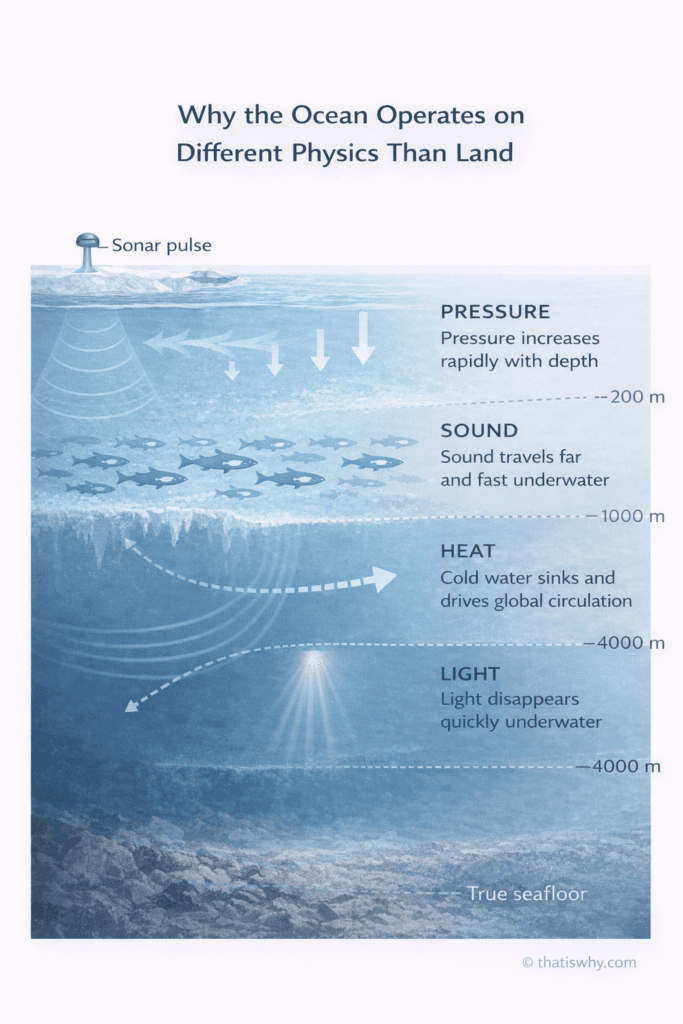
The physics of the deep ocean comes down to four forces that behave completely differently than they do on land: Pressure (which crushes air pockets), Sound (which travels 4x faster), Heat (which allows water to flow below freezing), and Light (which disappears almost instantly).
If you memorize that list, you’ll pass the test. But you won’t actually understand the ocean.
We have a bad habit of treating the sea like it’s just a flooded version of the land. We think, “It’s just water. It’s like a swimming pool, but deeper.”
That is a dangerous mistake. To really get how the ocean works, you have to stop thinking of it as a place on Earth. You need to treat it like an alien planet. In fact, NASA researchers often study Earth’s deep oceans as analog environments for alien worlds, because the extreme pressure, darkness, and chemistry mirror conditions found beyond our planet.
If you stepped off a spaceship into the deep ocean, the physics would kill you in seconds. The air in your lungs would turn poisonous. The sun would vanish. Sound would hit you like a physical blow. The ocean isn’t just wet land; it operates on a custom physics engine that creates challenges—and monsters—that shouldn’t exist.
So, let’s pop the hood and look at the four rules that run this simulation.Those rules are pressure, sound, heat, and light — four physical forces that behave so differently underwater that they reshape everything from chemistry to biology.
The Crushing Weight: Why Air is the Enemy
The first rule of this alien planet is simple: Everything is heavy. On land, we are spoiled. We live at the bottom of an ocean of air, but air is fluffy. It pushes on us with 1 Atmosphere of pressure, but our bodies push back easily.
Water is different. Water is heavy. For every 10 meters (33 feet) you dive, the ocean adds another entire atmosphere of pressure on top of you. By the time you reach the deep abyss, the pressure is over 1,000 atmospheres. To put that in perspective: Imagine having an elephant stand on your thumb. Now imagine that pressure pressing on every single inch of your body simultaneously.
The Physics Problem: The Compressibility Trap
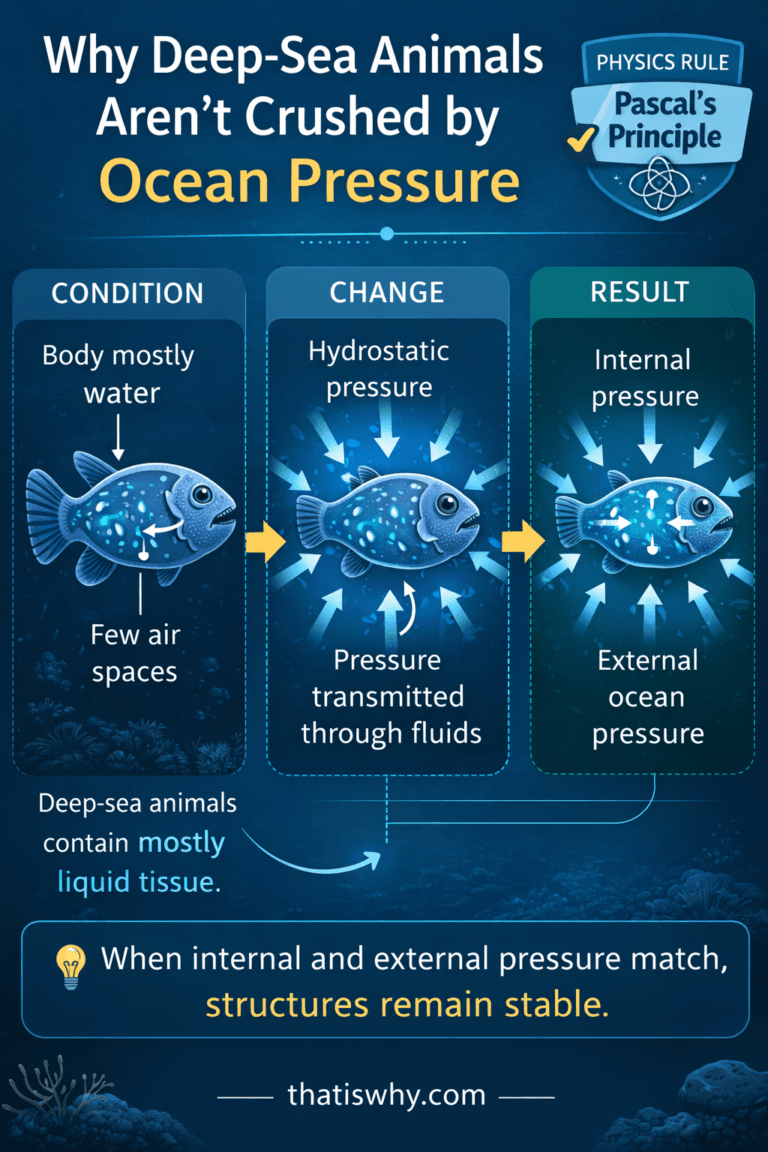
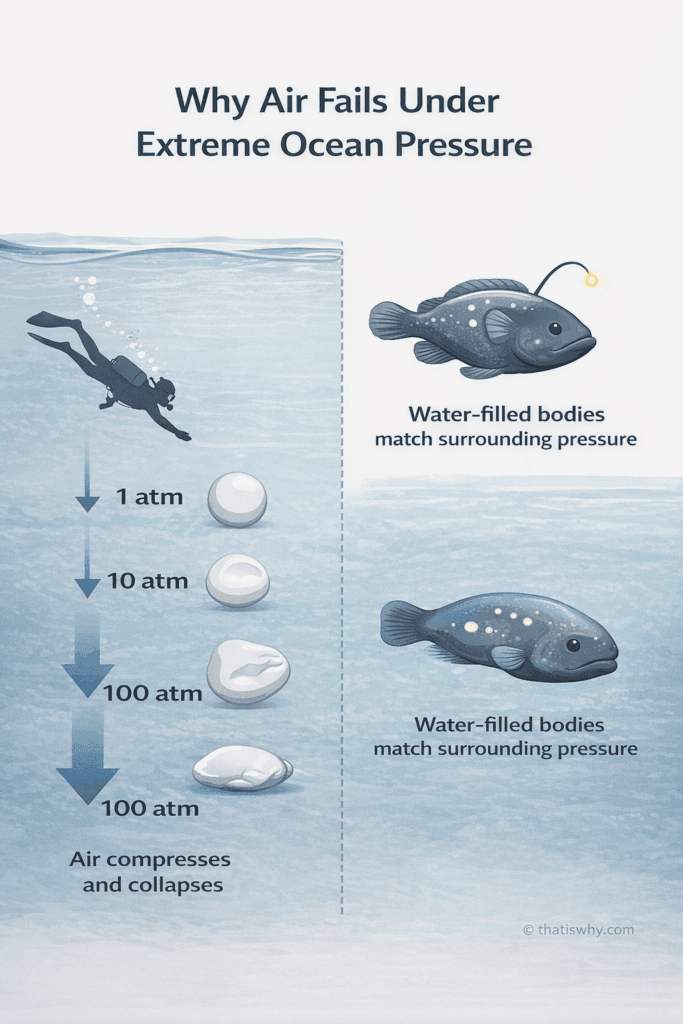
This creates a massive engineering problem. Solids and liquids (like water, bone, and muscle) are basically incompressible. You can’t squeeze them much. But gas is weak.
If you took a ping-pong ball (filled with air) down to the deep, the pressure would crush it flat instantly. But for biology, it gets worse. Under high pressure, gases like nitrogen don’t just compress; they dissolve into the blood and become toxic. So even if the weight didn’t crush your ribcage, the air in your own lungs would poison you.
The Evolutionary Solution
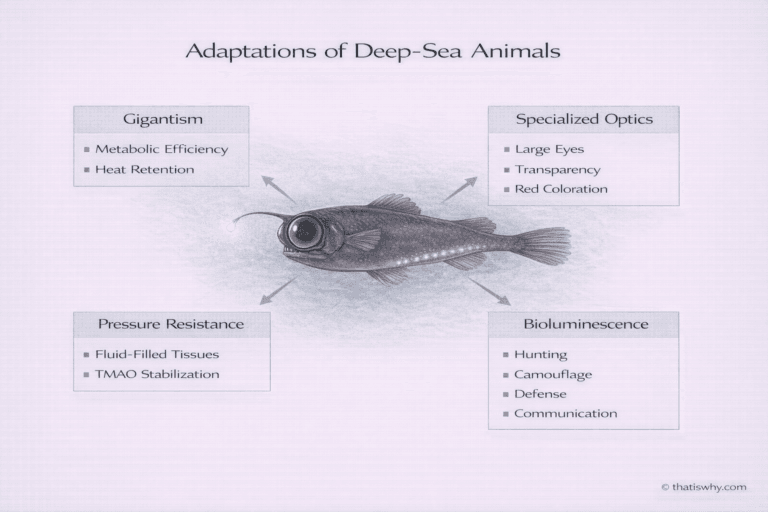
This is why deep-sea animals look so weird—often soft, squishy, and gelatinous. They had to completely ditch the air. They don’t have swim bladders or big lungs. They are built almost entirely of water and jelly, which matches the pressure around them. They don’t fight the weight, researchers at the Woods Hole Oceanographic Institution have documented how deep-sea organisms evolve soft, water-filled bodies that match the surrounding pressure instead of resisting it. They become part of it.
Read the Deep Dive: This physics rule is the single biggest reason why insects—the rulers of the land—can’t survive in the sea. Their bodies are built on air tubes, and the ocean doesn’t tolerate air. That Is Why There Are No Insects in the Ocean
The Sonic Super-Highway
On land, we trust our eyes. But if you try to use your eyes in the deep ocean, you’re blind. Light is useless down there. So, the ocean runs on Sound.
It comes down to density. Water molecules are packed 800 times tighter than air molecules, turning the entire ocean into a super-highway for noise. On land, sound fades after a few miles. Underwater, sound travels four times faster and keeps going for thousands of miles.
This creates a weird reality: The deep ocean is incredibly loud.
We imagine the deep sea is silent, but it’s actually noisy. Earthquakes rumbling thousands of miles away, ice cracking in Antarctica, whales singing across the entire world—it all travels through a special layer called the SOFAR Channel. This channel acts like a pipeline for sound. A whale can make a call in the Indian Ocean, and another whale can hear it in the Pacific.
Seeing with Ears
Because sound is the only thing that works, life adapted to “see” with its ears. Dolphins use Echolocation to build a 3D map of their world. They can “look” at a fish in total darkness and tell you its speed and size just by listening to the echo.
We humans tried to copy this with Sonar, but we’re still learning the rules. Submarine captains have to memorize these physics to hide their ships in “shadow zones”—layers where the water warps sound waves, making a massive metal ship invisible.
Each of these forces creates strange side effects. Some are so weird they deserve their own deep dive
Read the Deep Dive: But sometimes, nature tricks the machine. Discover how a massive layer of tiny fish can confuse sonar and create a “ghost bottom” that fooled the US Navy. That Is Why The Ocean Has A Phantom Bottom
The Force of Thermodynamics: When Water Breaks the Rules
We all learn the rule in grade school: Water freezes at 0°C (32°F). Except in the ocean, it doesn’t. And that exception is the engine that runs our climate.
The Salt Wedge
The ocean is full of salt, and salt changes the rules. It acts like a wedge between water molecules, preventing them from locking into ice crystals. This is called Freezing Point Depression. Standard seawater doesn’t freeze until it hits -1.8°C.
This creates a paradox: The deep ocean is filled with liquid water that is physically colder than ice.
The Engine of the World this super-cooled water is heavy. Near the poles, millions of tons of it sink to the bottom every day. This sinking motion acts like a planetary pump, driving the Global Conveyor Belt that moves warm water around the earth. Without this physics quirk, our weather patterns would collapse.
Living in the Freezer
If your blood freezes, you die. Deep-sea fish had to evolve Antifreeze Proteins. These are special molecules in their blood that bind to tiny ice crystals and stop them from growing. It’s the only reason a fish can swim in sub-zero water without turning into a popsicle.
Read the Deep Dive: But sometimes, the cold wins. If super-cooled brine leaks from the surface, it creates a deadly, sinking tube of ice that freezes everything it touches. That Is Why The Ocean Has Icy Fingers of Death.
Water is different. Water is heavy. For every 10 meters (33 feet) you dive, the ocean adds another entire atmosphere of pressure on top of you. According to the National Oceanic and Atmospheric Administration (NOAA), pressure in the ocean increases rapidly with depth, creating conditions that are fundamentally hostile to air-filled spaces.
The Force of Optics: The Death of Color
Finally, let’s talk about Light.
If you dive down, the first thing you lose is the sun. Water is a terrible window. It acts like an aggressive filter, stealing the colors of the rainbow one by one.
Red Light is the first casualty. It travels in long, lazy waves that water absorbs almost instantly. Within the first 30 feet, red light is effectively extinct. Blue Light is the survivor. Its short, punchy waves can pierce hundreds of meters down.
This means the deep ocean isn’t just dark; it is monochromatic. It is a world of endless blue.
Hacking the Spectrum Animals use this physics to disappear. If you are a red shrimp floating in a blue world, you are invisible. Since there is no red light to reflect, your shell absorbs the blue light and looks pitch black. Evolution painted millions of deep-sea animals bright red—not to make them flashy, but to delete them from the visual spectrum.
Making Fire from Water But go deeper, and even the blue light dies. Below 1,000 meters, it is pitch black. So, biology invented the lightbulb. This is Bioluminescence. Over 75% of deep-sea animals make their own light using chemical reactions. They carry lanterns to hunt, flash strobes to confuse predators, and glow to find mates. In the deep, you don’t look for the sun; you bring your own flashlight.
Read the Deep Dive: But there is one predator—the Dragonfish—that hacked this system. It invented a secret red flashlight that allows it to see invisible prey without being seen. That Is Why Deep Sea Fish Are Red
The Alien Next Door
We spend billions of dollars scanning the galaxy for alien worlds. We dream of finding planets with crushing gravity, strange atmospheres, and biology that defies logic.
But honestly? We don’t need to leave the planet to find that. We just need to look down.
The ocean isn’t just a big lake. It is a radical physics experiment running 24/7. It is a place where sound is the internet, where water flows colder than ice, and where life thrives under pressure that would crush a submarine like a soda can. The ocean doesn’t just create alien creatures in the deep; even along our shores, its physics quietly reshapes our waste, turning broken glass into smooth sea glass over decades.
Understanding these four forces—Pressure, Sound, Heat, and Light—changes how you see the world. It reminds you that “normal” is relative. The physics that keeps us alive on land is a death sentence in the deep.
To me, the creatures down there aren’t just weird monsters. They are master engineers. They are the astronauts that figured out how to survive in a universe that wants to crush, freeze, and blind them.
We didn’t have to travel lightyears to find an alien civilization. It’s been swimming beneath us the whole time.
How We Researched This
This guide serves as the central hub for our deep-dive series into Ocean Anomalies. To build it, we didn’t just collect random fun facts. We synthesized the core principles of Hydrodynamics (fluid mechanics), Acoustics (sound propagation), and Thermodynamics (heat transfer) to build a complete framework for understanding the deep sea.
We moved beyond the “Top 10 Weird Fish” approach to focus on the engine that drives the ecosystem. By breaking the ocean down into its four primary forces, we give you the keys to understand not just what lives down there, but why it has to look the way it does.
This guide is part of an ongoing effort to explain the natural world clearly and accurately. As research evolves, explanations may be updated.