Why Deep Sea Fish Are Red
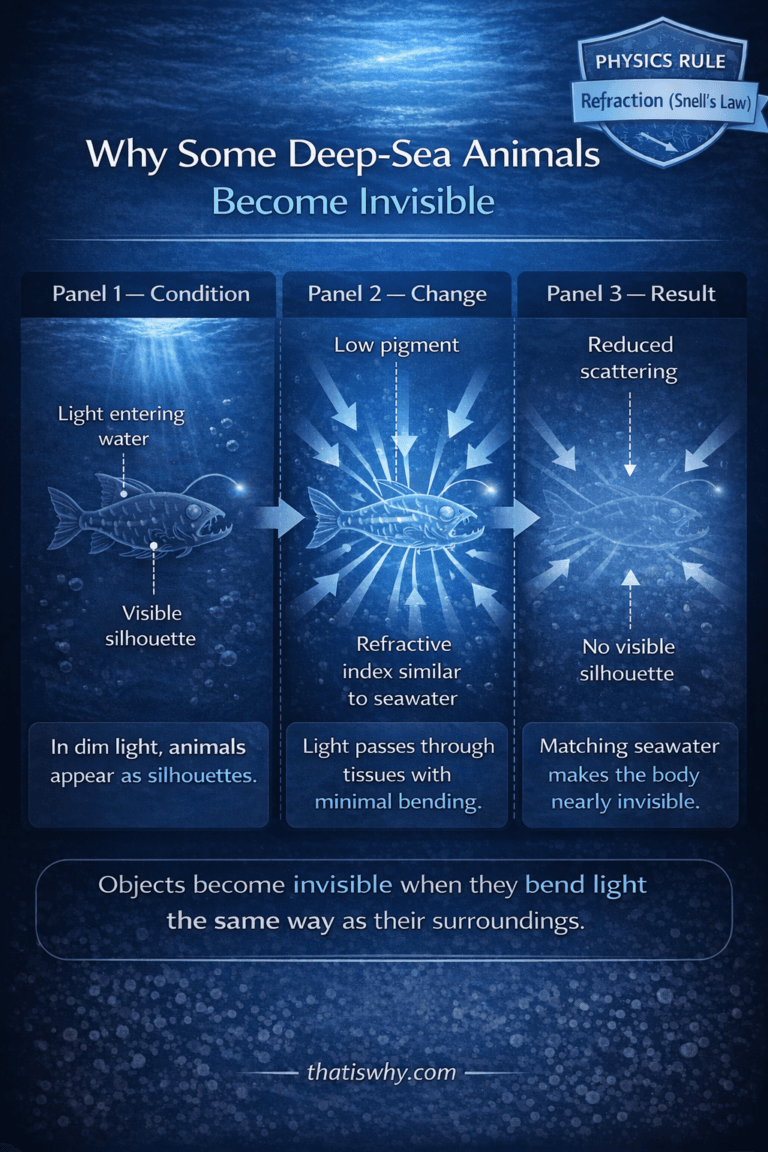
Deep-sea animals evolved red pigmentation because red light is the first color absorbed by water. In the deep ocean, there is no red light to reflect, so red animals absorb all available blue light and appear pitch black, rendering them invisible to predators.
Scientifically, it’s simple optics. Visually, it’s baffling.
The Color Paradox
If you haul a catch up from the deep and shine a flashlight on it, you’ll see shrimp and squid that are bright, screaming red. I’m talking neon. On land, being red is a death sentence—it’s the color of stop signs and strawberries. It screams, “I am here!”
So why would evolution paint a vulnerable deep-sea snack in the loudest color possible?
It seems like a massive design flaw. But it’s only a flaw if you look at it under sunlight. Down there, the rules of physics change, and that bright red suit becomes the ultimate invisibility cloak.
The Blue Nightclub
To get why this works, you have to stop thinking like a biologist and start thinking like a party promoter.
Imagine you are at an exclusive club where the DJ has killed all the lights except the deep blue strobes. It’s a “Blue Light Only” party.
You walk in wearing a crisp white suit. Bad move. The blue light hits you and you glow like a radioactive ghost. Everyone sees you. Your friend walks in wearing a blue sequin dress. She looks great—she shines bright blue, matching the vibe.
But then a guy walks in wearing a bright red tuxedo.
Under sunlight, he’d look like a walking stop sign. But in here? He disappears.
Red fabric needs red light to work. Since the club has zero red photons floating around, his suit absorbs the blue light and reflects… nothing. Absolutely nothing.
He doesn’t look red. He looks like a silhouette. He could walk right past the bouncers, and they’d barely see him.
That is the deep ocean. It’s a billion-year-old nightclub that only plays blue light. The shrimp aren’t wearing red to be flashy; they are wearing the one color that turns off the lights.
The Filter of the Deep
Why is the ocean a “Blue Light Only” club? Because water is an aggressive thief.
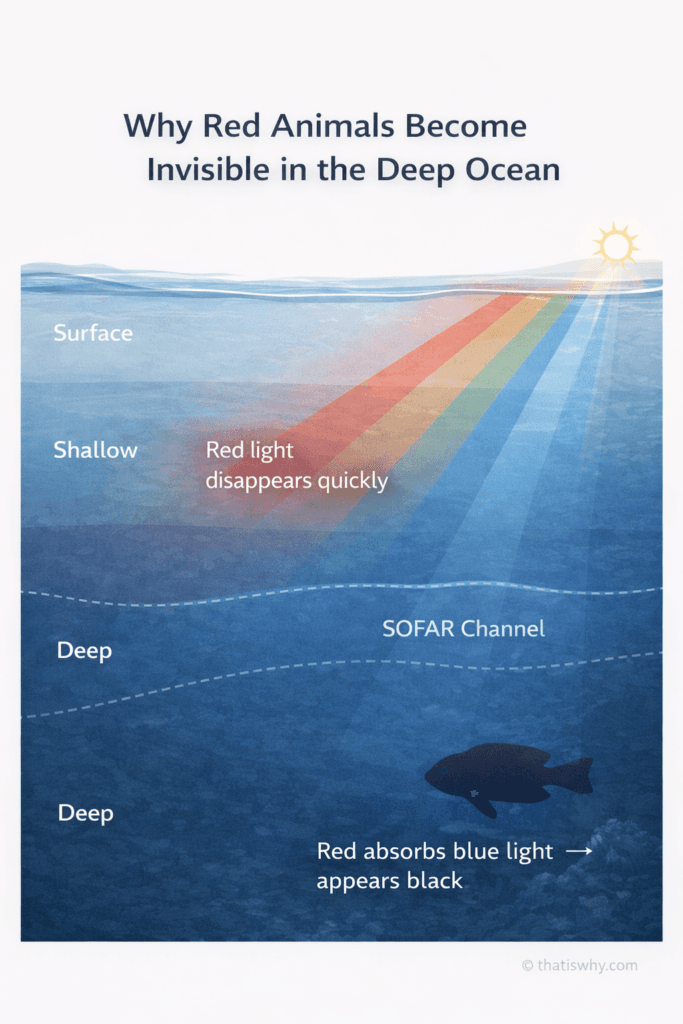
Sunlight hits the surface carrying the full rainbow, but water steals the colors one by one. Red light is the first to go. It travels in long, low-energy wavelengths that get absorbed almost instantly. Within the first 30 feet, red light is effectively extinct. It simply cannot survive the journey down.
Blue light, however, is high-energy. It punches through the water molecules and travels hundreds of meters deep.
This creates a unique physics problem for anything living down there. If you are a red shrimp at 500 meters, you are floating in a world where red light physically does not exist. The only illumination is blue.
This makes red pigment the ultimate camouflage. Because the shrimp is red, its shell is chemically designed to absorb blue wavelengths. It catches the blue photons and refuses to let them go.
In a world full of blue light, the shrimp reflects absolutely nothing. It doesn’t just look dark; it becomes a silhouette of pure emptiness. It is mathematically invisible against the black water behind it.
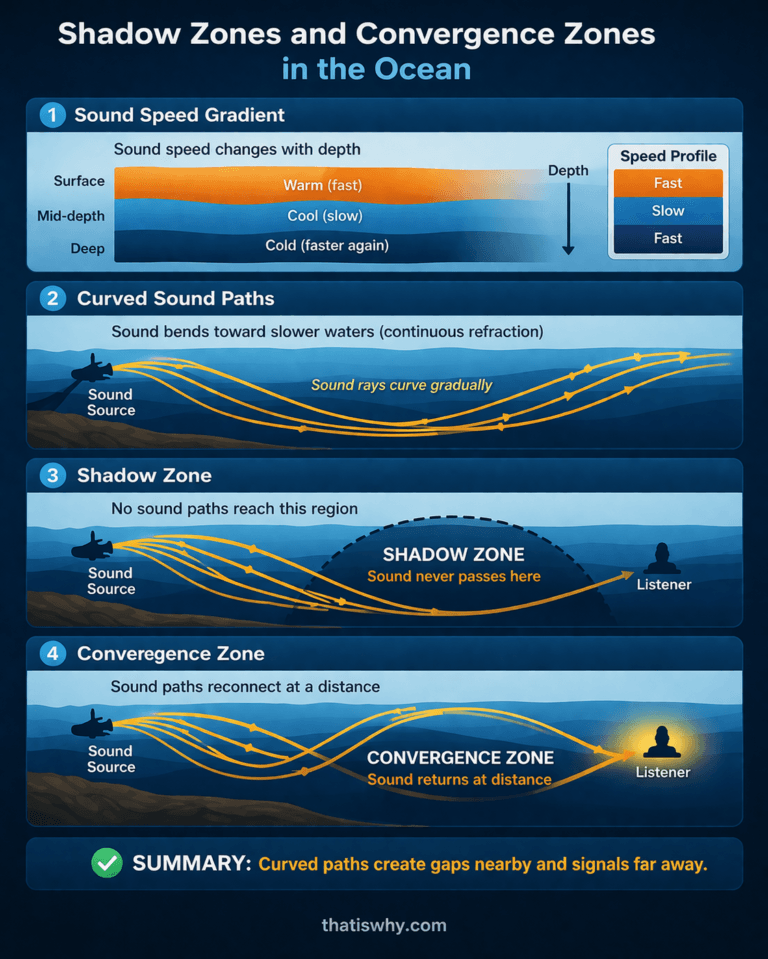
This same filtering effect is one of the core physical rules that makes the deep ocean operate so differently from life on land, as explored in our guide on Why the Ocean Is an Alien World.
The Sniper of the Deep
If the story ended there, red would be the perfect camouflage. But nature hates a perfect defense. There is always someone trying to hack the system.
Enter the Dragonfish (Malacosteus niger).
To understand why this fish is terrifying, you have to understand deep-sea vision. Almost every animal down there has eyes tuned strictly for blue light. They are literally blind to the color red.
But the Dragonfish is different. It evolved a bioluminescent searchlight under its eye that emits a secret frequency: Deep Red Light.
This gives it a superpower that shouldn’t exist. The Dragonfish swims through the dark, blasting this red beam like a flashlight. When that beam hits our “invisible” red shrimp, the physics game changes instantly. Suddenly, there is red light to reflect.
The shrimp lights up like a neon sign. The Dragonfish sees it clearly.
But here is the cruel twist: The shrimp cannot see the red light. Its eyes are still tuned for blue. It has no idea it is being illuminated.
The Dragonfish is essentially using military-grade night vision. It is walking around a dark room with a flashlight that only it can see, picking off prey that never even know they’ve been spotted.
Hacking the Spectrum
This idea—that you can make things disappear or appear just by changing the light source—isn’t limited to the ocean. We use this exact same trick to solve crimes and map the universe.
Think about a crime scene investigator. When they walk into a room, they turn off the white lights and turn on a UV or Blue Light filter. By stripping away the rest of the spectrum, they force invisible stains (like fluids) to pop out in high contrast. They are essentially doing what the ocean does: manipulating the light to control what is visible.
NASA does the same thing on a massive scale. The James Webb Telescope is basically a giant, high-tech Dragonfish. Space is full of dust clouds that block normal light, so Webb looks in Infrared—super-long red wavelengths that pass right through the dust. Just like the fish, NASA is using a specific slice of the spectrum to reveal things that are invisible to everyone else.
The Lie of the Camera
Before we finish, we need to talk about the photos.
When you Google “deep sea animals,” you see bright, vibrant reds. But you have to remember: Those photos are a lie.
Those images were taken by submersibles blasting the scene with high-powered white Xenon strobes. The submarine brought the red light down with it. In their natural habitat, without the paparazzi lights, those fish have never looked red a single day in their lives. They have lived their entire existence in pitch blackness.
And while we’re busting myths, let’s fix the big one: “The ocean is blue because it reflects the sky.”
No. The ocean is blue because water is blue. As we just learned, water acts as a filter that absorbs red light and reflects blue. If you took a massive tank of ocean water into a dark room and shined a pure white light through it, it would still glow blue. The sky has nothing to do with it. It’s just physics.
The Last One at the Party
When we haul that bright red shrimp up to the surface, it looks ridiculous. It looks like someone wore a neon tuxedo to a funeral. We think nature made a mistake.
But remember the nightclub.
We are judging the shrimp by the wrong lighting. Down in the deep, where the sun is gone and the only light is blue, that red suit is a stroke of genius.
Evolution figured out the physics of the club millions of years ago. It realized that in a blue world, red pigment isn’t a color—it’s a black hole. By painting these animals red, nature didn’t give them a warning sign; it gave them a way to delete themselves from the visual spectrum.
The red fish isn’t trying to be flashy. It’s just the only one who knows exactly how to dress for the dark.
How We Researched This
To explain this “Invisibility Cloak,” we combined the principles of optical physics with marine biology. We looked at the Visible Light Spectrum to understand exactly how water attenuates (absorbs) different wavelengths of energy, proving why red light dies first.
But knowing the physics wasn’t enough. We needed to explain why it feels so counter-intuitive to our eyes. That led us to the “Blue Nightclub” analogy—shifting the perspective from “what color is the object” to “what light is in the room.” We also dug into studies on the Malacosteus niger (Dragonfish) to confirm its unique ability to produce red bioluminescence, ensuring our “sniper” story was biologically accurate.