Why Life Can Exist in the Crushing Depths of the Ocean: The Airless Empire
Life in the deep ocean survives pressures hundreds of times stronger than at the surface. The key is not resistance but equilibrium. Most deep-sea organisms avoid air pockets and build fluid-filled bodies that match the surrounding pressure, allowing the force of the ocean to pass through them rather than crush them.
If a submarine hull fails thousands of meters below the surface, the ocean collapses it in a violent instant. The pressure difference between the inside and outside suddenly disappears, and the structure implodes.
Yet a fish drifting nearby experiences the same water without any visible struggle.
Understanding this difference begins with a simple picture.
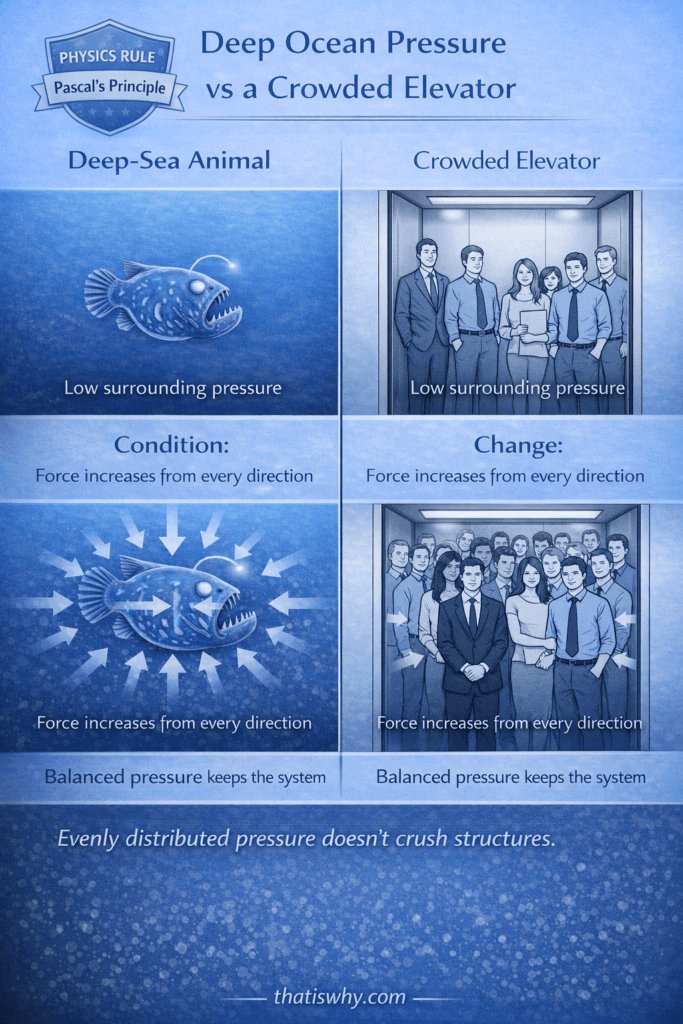
Imagine stepping into an elevator that is already completely full of people. Everyone presses from every direction at once. You feel the pressure, but nothing collapses because the force is distributed evenly across the crowd.
The deep ocean behaves in much the same way.
Pressure does not arrive as a giant weight pushing downward. It surrounds everything and presses from every direction at the same time. Living organisms survive because their bodies allow that pressure to pass through them instead of resisting it.
Once you see the deep sea this way, many of its strange adaptations start to make sense.
Some animals survive by eliminating air spaces that pressure could collapse. Others stabilize the delicate molecules inside their cells. Some adapt to chemical boundaries where shells dissolve, while others evolve new ways to see in near-total darkness.
Together, these strategies form the hidden rules of what we call the Airless Empire.
Below the surface of the ocean lies a world where survival depends on mastering pressure, chemistry, and light.
If you want to explore each of these adaptations in detail, you can read the guides linked throughout this page:
- Why whales allow their lungs to collapse when they dive → Why Whales Break Their Own Lungs to Dive
- How deep-sea fish stabilize their proteins using pressure-resistant chemistry → The Scent of Survival: Why Deep-Sea Fish Smell Like TMAO
- Why fluid-filled bodies resist crushing pressure → The Physics of Uncrushable Liquids
- Why shells dissolve before reaching the deepest seafloor → Why Shells Dissolve in the Deep Ocean
- How animals see and hunt in a world with almost no sunlight → Why the Deep Ocean Looks Like a Blue Star Field
The Three Pillars of Pressure Survival
Once you picture the deep ocean as a crowded elevator rather than a crushing weight, many of its strange adaptations begin to feel more intuitive. The water does not behave like a giant force pushing downward from above. Instead, it surrounds organisms and presses inward from every direction at once.
Life in the abyss survives by working with that reality rather than fighting it.
Deep-sea organisms follow a small set of physical strategies that allow them to exist in a place where pressure can be hundreds of times stronger than what we experience at the surface. These strategies solve the same fundamental problem in different ways: how to live in water that constantly presses from all sides.
Some animals allow their bodies to bend and compress safely. Others protect the delicate molecular structures inside their cells. Many avoid the one thing that pressure destroys most easily : that thing is air.
Together, these solutions form the foundation of survival in what we call the Airless Empire.
Mechanical Surrender — Surviving by Flexibility
Many deep-diving animals survive pressure by allowing parts of their bodies to compress instead of resisting the surrounding water.
Whales provide one of the clearest examples of this strategy. As they descend into deeper water, the air spaces inside their lungs begin to collapse under pressure. Their rib cages and lung tissues are flexible enough to fold inward without causing injury, which prevents dangerous pressure differences from building inside the body.
This ability allows whales to descend thousands of meters and then return safely to the surface.
→ Read more: Why Whales Break Their Own Lungs to Dive
Chemical Armor — Protecting the Machinery of Life
Even when a body survives pressure at the structural level, the molecules inside living cells still face a challenge.
Proteins are intricate three-dimensional structures that perform most of the chemical work inside cells. Under extreme pressure those structures can begin to distort, which would interfere with the reactions that keep organisms alive.
Many deep-sea animals stabilize their proteins using molecules such as Trimethylamine N-oxide, commonly abbreviated as TMAO. This compound helps proteins maintain their proper shape even when the surrounding pressure becomes extremely high.
→ Read more: The Scent of Survival: Why Deep-Sea Fish Smell Like TMAO
Fluid Equilibrium — Becoming Part of the Ocean
The most fundamental strategy for surviving the deep ocean is surprisingly simple.
Deep-sea organisms avoid empty spaces inside their bodies.
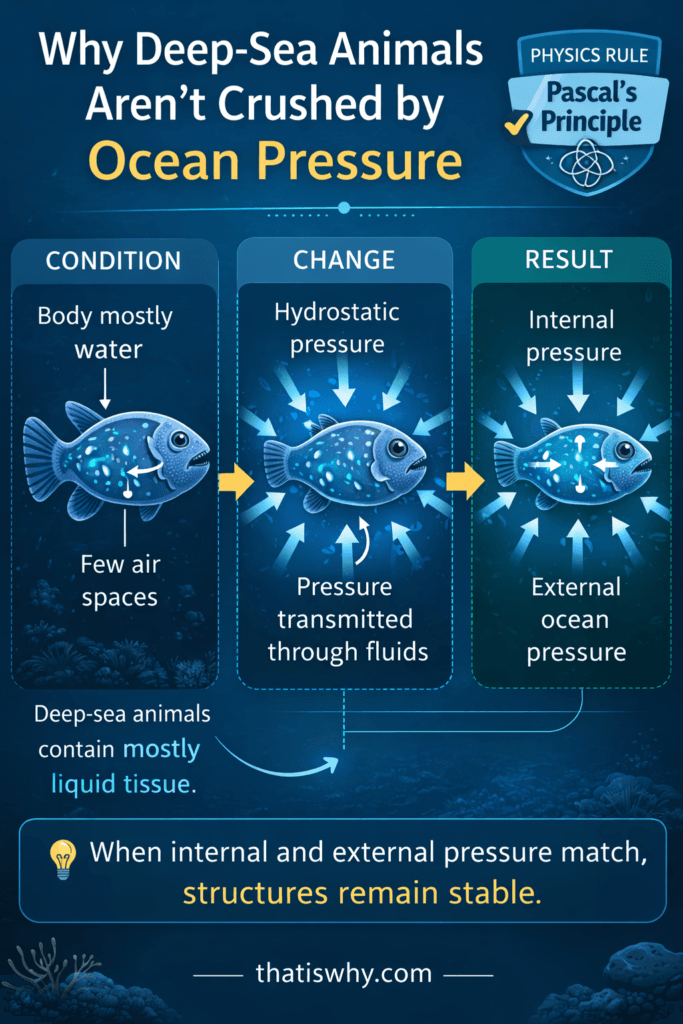
Air compresses dramatically under pressure, which is why submarines and diving equipment must be engineered carefully to resist the ocean. Most deep-sea life avoids this problem entirely by having bodies composed largely of liquids and soft tissues.
Liquids transmit pressure evenly according to Pascal’s Principle. When the surrounding water presses inward, the fluids inside the organism respond in the same way.
The pressure therefore moves through the body instead of collapsing it.
In practical terms, the safest design for surviving the deep ocean is to become physically similar to the water around you.
→ Read more: The Physics of Uncrushable Liquids
The Invisible Boundaries of the Hadal Zone
Once organisms solve the basic challenge of pressure, another reality of the deep ocean begins to emerge. The abyss is not one uniform environment. Instead, it contains a series of invisible boundaries where the physical and chemical rules of seawater begin to shift.
These boundaries do not appear as walls or cliffs in the water. They form gradually as the conditions of the ocean change with depth. Temperature drops, pressure rises, dissolved gases accumulate, and sunlight fades until it disappears entirely.
Each of these changes alters what kinds of life can exist below it. Some boundaries influence the chemistry of shells and skeletons, while others reshape the way animals detect light and move through darkness.
Together these gradual transitions create a hidden geography in the deepest parts of the ocean.
The Carbonate Compensation Depth — The Ocean’s Snow Line
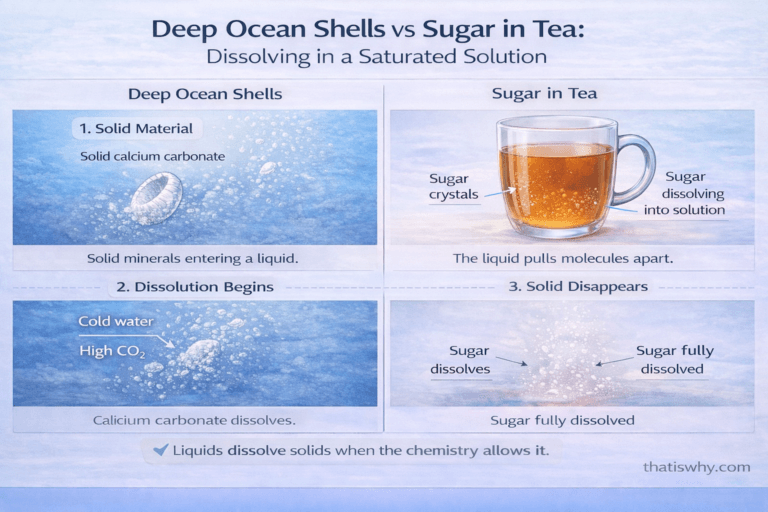
One of the most important chemical boundaries in the deep ocean is the Carbonate Compensation Depth.
Above this depth, shells and skeletons made of calcium carbonate slowly accumulate on the seafloor. When marine organisms die, their remains drift downward through the water column and eventually settle into layers of pale sediment.
Below this boundary the chemistry of seawater changes in a subtle but important way.
Cold temperatures, high pressure, and dissolved carbon dioxide make calcium carbonate less stable. Shells that sink into these deeper waters gradually dissolve before reaching the bottom.
For this reason, the deepest ocean basins are rarely covered with shell fragments. Instead, the seafloor in many of these regions is composed mainly of fine reddish sediment known as deep-sea red clay.
→ Read more: Why Shells Dissolve in the Deep Ocean
The Photon Drought — Living in Near-Total Darkness
Another invisible boundary appears as sunlight disappears with increasing depth.
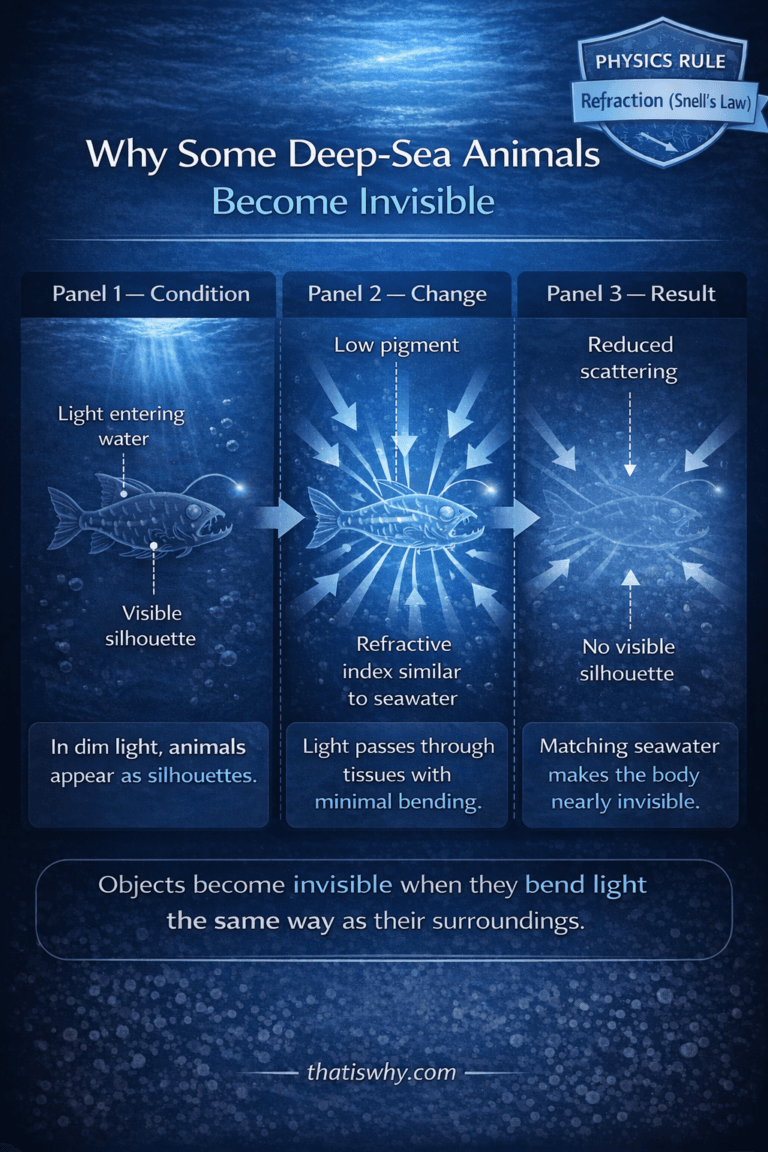
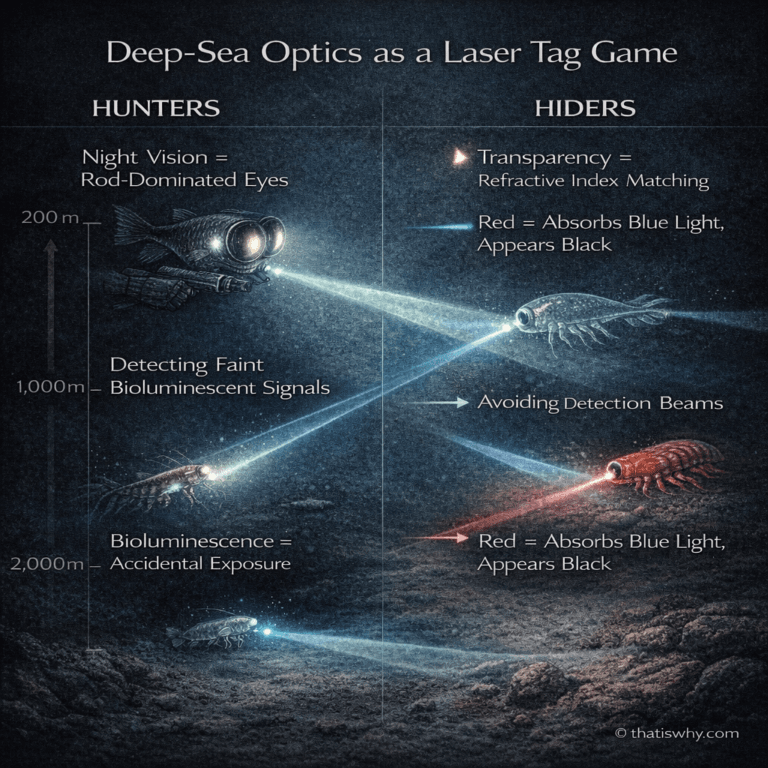
Water absorbs different wavelengths of light at different rates. Red light disappears first, followed by orange and yellow wavelengths, leaving primarily blue light able to travel deeper through the ocean. Eventually even that faint blue light fades away.
Below this point the ocean enters what researchers often describe as a photon drought. Sunlight no longer illuminates the environment, and most visible light in the water comes from living organisms themselves.
Many animals respond to this scarcity of light by evolving unusually large eyes that can detect extremely faint signals. Others produce their own light through Bioluminescence, which allows them to hunt, communicate, or hide their silhouettes from predators.
→ Read more: Why the Deep Ocean Looks Like a Blue Star Field
Human Engineering vs. Biological Evolution
One useful way to understand the deep ocean is to compare how we and living organisms approach the same problem. Both must survive immense pressure.
Our engineers solve the challenge by resisting the surrounding water, while deep-sea life survives by adapting to it.
A submarine is designed to keep the inside of the vessel close to surface pressure so that the crew can breathe normally. Engineers accomplish this by building a rigid hull made from extremely strong materials such as steel or titanium. The hull forms a barrier that holds the ocean outside while protecting the air-filled space inside.
As long as the structure remains intact, the system works. If the hull fails, the surrounding water collapses the vessel almost instantly because the pressure difference disappears in a violent implosion.
Deep-sea organisms follow a very different strategy.
Instead of protecting pockets of air, most animals in the deep ocean avoid air altogether. Their bodies consist largely of liquids and soft tissues, which allows the surrounding pressure to pass through them rather than building up against them. This difference reveals two very different design philosophies.
We attempts to resist the ocean while biological evolution survives by matching it.
| Feature | Human Engineering (Submarine) | Deep-Sea Life |
|---|---|---|
| Basic Strategy | Resist surrounding pressure | Match surrounding pressure |
| Structure | Rigid hull | Flexible body |
| Gas Spaces | Air-filled interior | Minimal or no air pockets |
| Chemistry | Steel and titanium | Stabilizing molecules such as Trimethylamine N-oxide |
| Result of Failure | Structural implosion | Pressure equilibrium with surroundings |
Seen from this perspective, the deep ocean does not reward brute strength. It rewards designs that behave more like the water itself.
Why the Deep Ocean Doesn’t Break Life
When you step back and consider the deep ocean as a whole, the environment begins to feel less mysterious.
At first glance the abyss appears impossibly hostile. Pressure rises to levels that would destroy most human-built structures, sunlight fades until the water becomes dark, and the chemistry of the ocean even begins dissolving shells in the deepest basins.
Life does not disappear there, instead it adjusts to those conditions.
The key insight is that survival in the deep ocean rarely comes from resisting the environment. Most successful organisms avoid fighting the surrounding water and instead adapt their bodies to function within it.
Their bodies contain very little air that pressure could collapse. Their tissues behave much like the surrounding fluid, which allows pressure to move through them rather than crush them. Their proteins remain stable with the help of molecules such as Trimethylamine N-oxide. Their senses adapt to detect faint signals of light in a place where sunlight rarely reaches.
All of these adaptations follow the same principle.
Life in the deep ocean survives by aligning itself with the physical conditions of the environment rather than resisting them.
When viewed from this perspective, the abyss stops looking like a place designed to destroy living things and instead becomes a place where organisms succeed by learning how the ocean itself works.
How We Researched This :
To understand how life survives in the deepest parts of the ocean, we reviewed research across oceanography, marine biology, and deep-sea physics. Explanations of pressure transmission in fluids draw from classical fluid mechanics and principles such as Pascal’s Principle. We also examined research on deep-ocean environments and adaptations published by institutions including the Woods Hole Oceanographic Institution, the Monterey Bay Aquarium Research Institute, and the National Oceanic and Atmospheric Administration.
But we knew that listing physical equations and biological terms would not make the deep ocean easy to visualize. Our real job began when we asked a simpler question: what would this environment feel like if you were inside it? That question led us to the crowded elevator analogy, to show pressure surrounds organisms from every direction and why matching the surrounding environment allows life to persist in the deep sea feel intuitive