Why don’t deep-sea animals get crushed – The Water Balloon Logic
Deep-sea animals are not crushed by ocean pressure because their bodies are mostly water and solids, which resist compression. Since liquids transmit pressure equally in all directions according to Pascal’s Principle, the pressure inside their fluid-filled cells rises at the same rate as the surrounding ocean, keeping the forces balanced.
Imagine holding a water balloon underwater in a swimming pool.
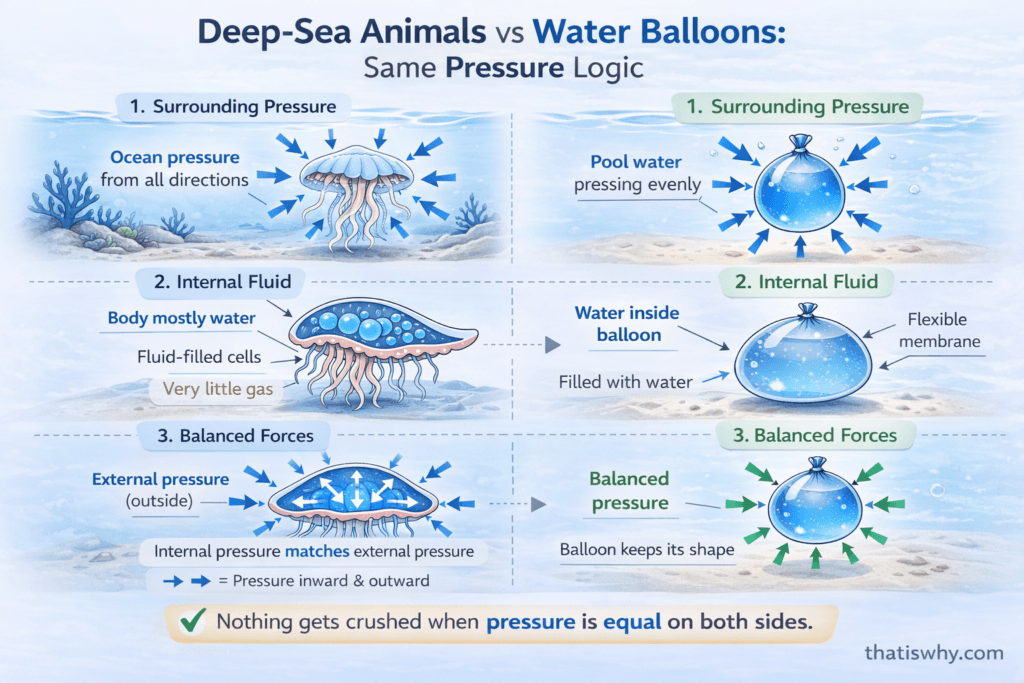
The water outside presses inward from every direction, while the water inside pushes outward with the same force. Because both sides change together, the balloon keeps its shape.
Life in the deep ocean follows that same logic.
Deep-sea animals behave less like empty containers and more like living water balloons drifting inside a much larger ocean. And water, unlike air, is extremely difficult to compress.
Hydrostatic Pressure: The Great Equalizer
To see why pressure stops being dangerous in the deep ocean, it helps to return to the water balloon.
Imagine holding a water balloon completely underwater in a swimming pool. The water outside the balloon presses inward from every direction at once, while the water inside the balloon presses outward with exactly the same strength. Because the forces match perfectly, the balloon keeps its shape.
The deep ocean works in exactly the same way.
Water pressure in the ocean does not behave like a heavy object pushing down from above. Instead, it surrounds everything and presses inward from every direction at the same time. Physicists describe this behavior with Pascal’s Principle, which means pressure inside a fluid spreads evenly in all directions.
As depth increases, the surrounding Hydrostatic pressure becomes enormous, yet it remains perfectly balanced. Deep-sea animals exist inside that balance. That is exactly why whales must collapse their lungs during deep dives, as explained in our earlier article about how whale chests bend safely under pressure.
Their bodies contain fluid-filled cells instead of hollow spaces. When the ocean presses on them, the liquid inside their bodies pushes back with exactly the same force. The pressure moves through their tissues the same way it moves through the surrounding water.
The water balloon comparison keeps working because the animal and the ocean are made of almost the same thing. A creature whose body behaves like water is remarkably difficult for water to crush. Pressure becomes dangerous only when the inside and the outside stop matching.
The 3% Rule: Is Water Really Uncrushable?
The water balloon comparison can make the deep ocean sound perfectly balanced. If everything is made mostly of water and the pressure pushes equally in every direction, it might seem as though nothing really changes down there. That picture is close to the truth, but it is not perfectly complete.
Water strongly resists compression, yet it is not completely immune to it. If you lowered that imaginary water balloon all the way to the bottom of the Mariana Trench, the water inside it would become slightly denser as the surrounding pressure increased. The change is surprisingly small.
Even under the enormous pressure found nearly eleven kilometers below the surface, seawater compresses by only about three to four percent. Physicists describe this resistance using a property called the bulk modulus, which measures how difficult it is to squeeze a substance into a smaller volume.
The water balloon still keeps its shape because the liquid inside and the liquid outside compress by the same tiny amount.
For living cells, however, even a small change like that matters. Proteins and enzymes are delicate molecular machines that evolved to operate within specific physical conditions. When the surrounding liquid becomes slightly denser, those structures can struggle to fold and move the way they normally do.
Deep-sea organisms solve that problem through subtle chemical adjustments inside their cells. Certain molecules help stabilize proteins so that they continue functioning even as pressure increases with depth. These chemical helpers allow life to operate normally in a place where the surrounding water has become just a little tighter than it is near the surface.
The deep ocean therefore does not crush living creatures the way people often imagine. Instead, it quietly changes the physical environment just enough that life has to adapt in clever biochemical ways.
Why Submarines Fail Where Jellyfish Succeed
Some of the most fragile-looking animals in the sea can survive depths that would destroy extremely advanced machines.
Consider a jellyfish, it is composed mostly of water, often more than ninety-five percent. Its body contains almost no rigid structure and almost no air-filled spaces. In practical terms, it behaves like a soft container of seawater drifting inside the ocean itself.
As the jellyfish moves deeper, the surrounding pressure increases steadily. The water inside the animal experiences that increase at the same time as the water outside. Because liquids transmit pressure evenly in all directions, the force spreads through the jellyfish’s body in exactly the same way it spreads through the surrounding ocean.
Now compare that situation with a submarine, it travels through the ocean while carrying a pocket of air inside a rigid metal hull. The pressure inside the vessel remains close to what humans experience at the surface, while the water outside may be hundreds of times more pressurized.
This difference between the inside and the outside creates the real danger.
The hull must constantly resist the ocean pressing inward because the pressure outside is much greater than the pressure inside. If the structure fails, the surrounding water rushes inward immediately as the ocean attempts to equalize the pressure difference.
Deep-sea animals avoid this problem entirely.
Their bodies contain almost no compressible air pockets, which means there is very little difference between the pressure inside their tissues and the pressure outside in the surrounding water.
A jellyfish survives the deep ocean not because it is strong, but because its body behaves like the surrounding water.
Why the Deep Ocean Is Not Actually Crushing Anything
Myth #1: Deep-sea animals must be extremely strong
Truth: They survive because their bodies are mostly liquid.
Most deep-sea organisms are composed largely of water and soft tissue. Because liquids resist compression and transmit pressure evenly, the ocean’s force moves through their bodies rather than crushing them, much like the water balloon floating inside a pool.
Myth #2: Water cannot be compressed
Truth: Water compresses slightly under extreme pressure.
At the bottom of the Mariana Trench, seawater becomes about three to four percent denser. The change is small enough that pressure inside and outside fluid-filled bodies remains balanced.
Myth #3: Ocean pressure pushes downward
Truth: Pressure pushes equally in every direction.
Pressure spreads through liquids according to Pascal’s Principle, which means deep-sea animals experience pressure from all sides at once rather than from above.
The Deep Ocean Cannot Crush a Living Water Balloon
When people picture the deep ocean, they often imagine pressure behaving like a giant invisible weight crushing everything below it.
That mental picture works for empty containers.
It does not describe what happens to something that is already filled with water.
Think again about the water balloon floating underwater in a swimming pool. The surrounding water presses on the balloon from every direction, yet the water inside responds with the same pressure. Because both sides change together, the balloon keeps its shape.
The deep ocean follows the same rule.
As depth increases, the surrounding Hydrostatic pressure becomes enormous, yet that pressure spreads evenly through liquids according to Pascal’s Principle. The fluids inside an animal experience the same conditions as the water outside.
Deep-sea creatures are therefore not surviving by resisting the ocean. They survive because they share the same environment. Their bodies behave less like sealed containers and more like living water balloons drifting inside the ocean itself.
Once you notice this, the idea of crushing pressure begins to feel slightly misleading.
Pressure becomes dangerous mainly when the inside and the outside are different. When the inside matches the outside, the system stabilizes.
The deep ocean does not spare life because it is gentle. It spares life because living systems have learned how to exist within the pressure instead of fighting it.
How We Researched This :
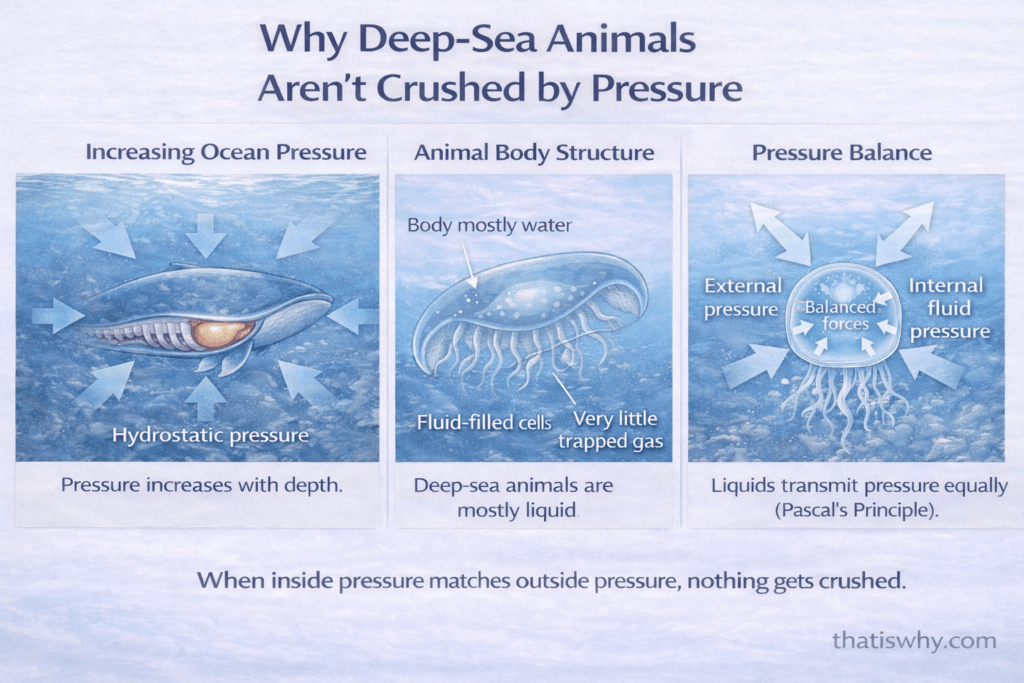
To explain why deep-sea organisms are not crushed by pressure, we reviewed research in fluid physics, oceanography, and marine biology. Core concepts such as Hydrostatic pressure and Pascal’s Principle are described in standard fluid mechanics and oceanography references, while biological adaptations were drawn from studies of organisms living in extreme environments like the Mariana Trench.
But we knew that equations alone would not make the idea intuitive. Our real job began when we asked, “What would this look like in everyday life?” That question led us to the “water balloon underwater analogy“, which helps balanced fluid pressure feel intuitive.