Why do deep-sea animals glow in the Dark – The Science of Bioluminescence
Why do deep-sea animals glow? Deep-sea animals use bioluminescence (biological light) as a survival tool. The four main functions are: Luring prey (like the Anglerfish), Camouflage (using counter-illumination to hide shadows), Defense (blinding predators with “flashbangs”), and Communication (signaling mates in the dark).
That is the biological answer. But seeing it in person feels like entering a different dimension.
If you dive down to the “Midnight Zone” (1,000 meters deep), you expect it to be pitch black. After all, the sun has been gone for a kilometer. But if you turn off the lights of your submarine, you won’t see darkness. You will see a fireworks show.
Everywhere you look, there are flashes of blue, pulses of green, and trails of glowing fluid. It turns out that 90% of deep-sea animals don’t just live in the dark; they glow in it.
This is one of the most common superpowers on Earth, but it’s also the most misunderstood.
In a world without sunlight, these animals aren’t glowing to look pretty light isn’t decoration: it’s a weapon.
The Cold Fire
Before we talk about how they use it, we have to talk about what it is. Because it shouldn’t be possible.
When we make light, like a fire or a lightbulb, we make heat. It’s messy and it’s inefficient. Bioluminescence is different. It is Cold Light.
Think of it like a Glow Stick. When you crack a glow stick, you aren’t burning anything. You are mixing two chemicals that react to release pure light. Zero heat. Deep-sea animals do the exact same thing. They mix a fuel called Luciferin with a spark called Luciferase. The result is a light that is nearly 100% efficient.
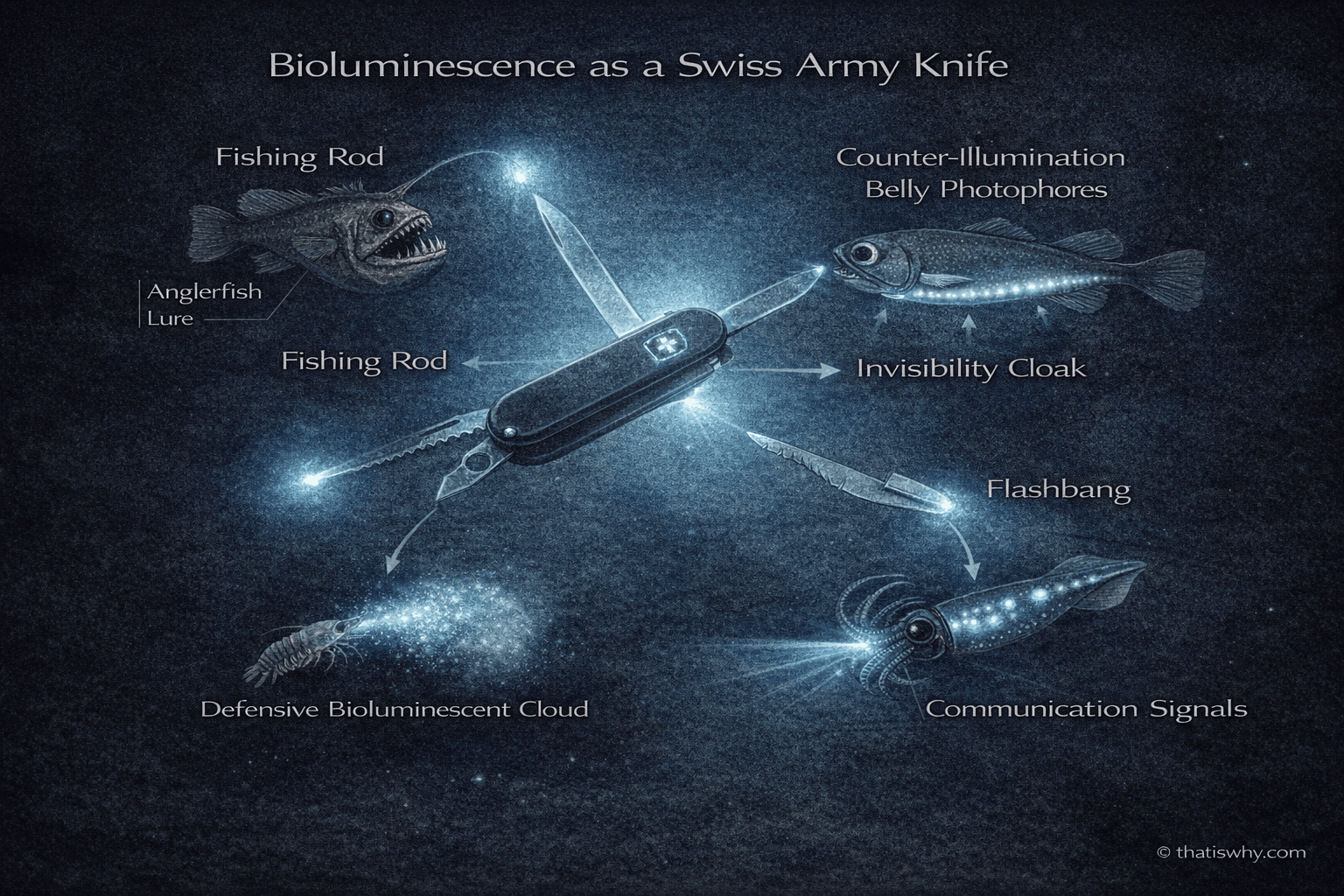
They don’t just use this light to see. They use it as a Swiss Army Knife.
On land, light is just illumination. But in the deep ocean, light is a multi-tool. It can be a trap, a shield, a weapon, or a telephone.
Let’s crack open the toolkit.
Tool 1: The Fishing Rod
The most famous tool in the kit is the Trap. And honestly, it’s the smartest way to hunt.
This is the strategy of the Anglerfish. In the deep, calories are like gold and chasing prey is a waste of energy. So the Anglerfish doesn’t hunt; it goes fishing.
It dangles a glowing lure (the esca) right in front of its jagged teeth. In the absolute darkness, this tiny blue dot looks like a glowing worm. It looks like an easy meal. Small fish swim closer to investigate. The Anglerfish waits—perfectly still—until the prey is within striking distance. And then snap.
The light was a lie. The Anglerfish uses the victim’s own greed against them. It’s not just a flashlight; it’s a baited hook.
Tool 2: The Invisibility Cloak
Here is the trick that defies logic. How can turning on a light make you harder to see?
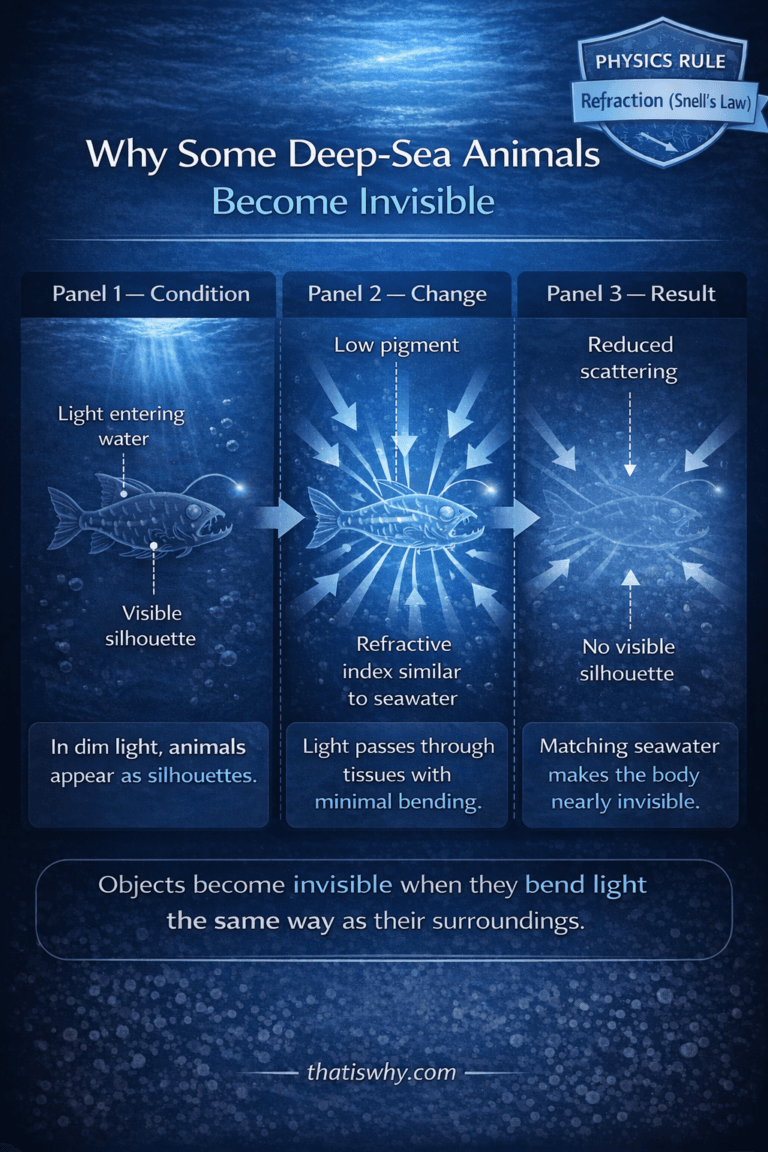
It’s called Counter-Illumination, and it’s an anti-shadow technology. Even deep down, faint sunlight filters from the surface. If a predator swims below you and looks up, your body blocks that light. You create a dark silhouette against the gray water. You might as well be holding a sign that says “Lunch.”
The Hatchetfish has solved this. It has sophisticated light organs along its belly that act like a dynamic screen. If the sun gets brighter, the belly glows brighter. If a cloud passes over, the belly dims. It matches the background light perfectly.
By glowing on the bottom, the fish erases its own shadow. If a predator looks up, it sees nothing but uniform light. The fish has physically deleted its silhouette from the water. It is using a biological projector to camouflage itself against the sun.
Tool 3: The Flashbang Grenade
What if the camouflage fails? What if you get cornered? You stop hiding and you start fighting dirty.
This is the tactic of the Vampire Squid. When a predator lunges, the squid doesn’t bite. It vomits a cloud of glowing, sticky mucus right into the attacker’s face.
It’s a biological Flashbang Grenade. Remember, deep-sea eyes are hyper-sensitive. In total darkness, a sudden burst of bright blue light is blinding. It overloads the predator’s retina, leaving it stunned and seeing stars. While the hunter is flailing around trying to reboot its vision, the squid swims away into the dark.
Tool 4: The Cell Phone
Finally, there is the most urgent need of all: Finding a date.
The deep ocean is vast and empty. Finding a mate down there is harder than finding a needle in a haystack; it’s like finding a specific needle in a pitch-black haystack the size of the Pacific.
So, animals use light as a Secure Line. The Firefly Squid doesn’t just glow; it pulses. It has specific photophores on its tentacles that flash in a precise rhythm. This is a coded message. It says: “I am a Firefly Squid. I am female. I am ready.”
If the pattern is wrong, the male knows it’s a different species (or a predator). If the pattern is right, he knows he’s found a match. Without this light, the ocean would be a lonely, sterile place. It is the only way to send a text message across the void.
Stolen Technology
This biological toolkit isn’t just useful for fish. Humans have stolen it, and it changed medicine forever.
The Glowing Tag (GFP) In the 1960s, scientists isolated a glowing protein in a jellyfish called GFP (Green Fluorescent Protein). It was a cool novelty, until we realized we could attach it to other things. Today, we use GFP as a biological tracking device. We attach the “glowing gene” to cancer cells, viruses, or neurons. When the cell grows, it glows green. It allows doctors to watch a tumor spread or a brain think in real-time.
We essentially took the flashlight from the jellyfish and used it to illuminate the darkest parts of the human body.
Secrets of the Glow
Let’s clear up a few misconceptions about how this actually works.
Myth #1: “The fish make the light.” We assume the fish has a lightbulb inside.
The Truth: Often, they are just the landlord. The Anglerfish, for example, can’t make light itself. Its lure is actually a hollow chamber filled with glowing bacteria. The fish provides the home and the food; the bacteria provide the light. It’s a biological rental agreement.
Myth #2: “It’s a rainbow down there.” We imagine a disco of colors.
The Truth: It’s almost entirely Blue. Why? Physics. Blue light travels the furthest through water. Red light gets absorbed instantly. If you flashed a red light, it would be invisible a few feet away. (Unless you are the Dragonfish, the sniper who uses a secret red beam—but that’s a special case).
A Light in the Dark
When we look at the ocean at night, we see an empty black void but that’s just because our eyes aren’t good enough.
To the creatures that live there, the abyss is a bustling metropolis of light. They are flashing signals, setting traps, hiding in plain sight, and screaming for help, all using the same chemical reaction.
They took a simple biological trick “Cold Fire” and turned it into the most versatile Swiss Army Knife in nature. In this crushing, freezing dark of the deep ocean, that little light is the only thing keeping them alive.
How We Researched This :
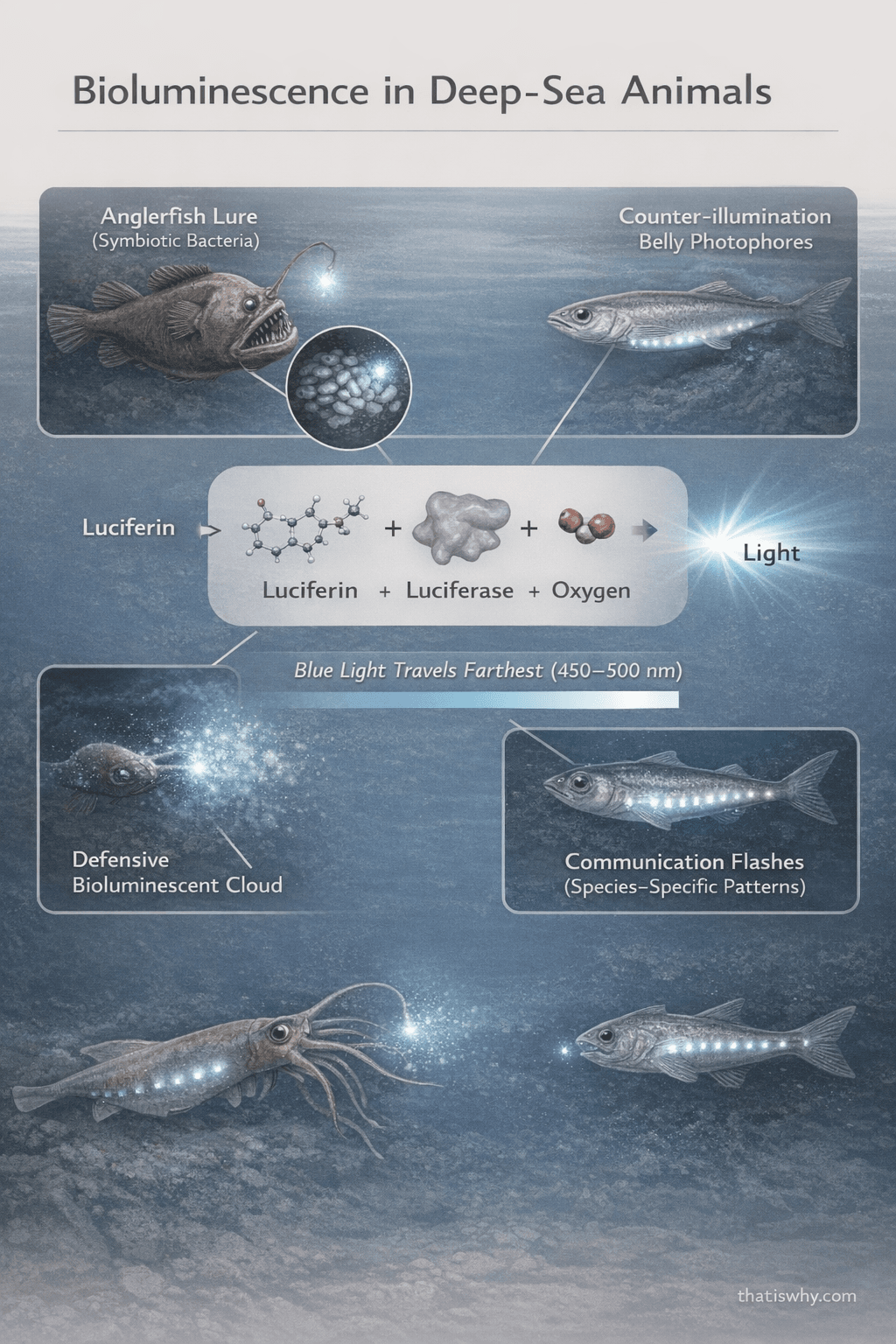
To explain this toolkit, we examined the biochemistry of Chemiluminescence (the Luciferin reaction) and referenced the MBARI database to categorize the functional uses of light.
But we knew that just listing chemical reactions isn’t helpful. Our real job began when we asked, “What does this feel like?” That question led us to the “Swiss Army Knife” analogy—a simple story to make the complex versatility of biological light feel intuitive.