Why is Sea Glass Made
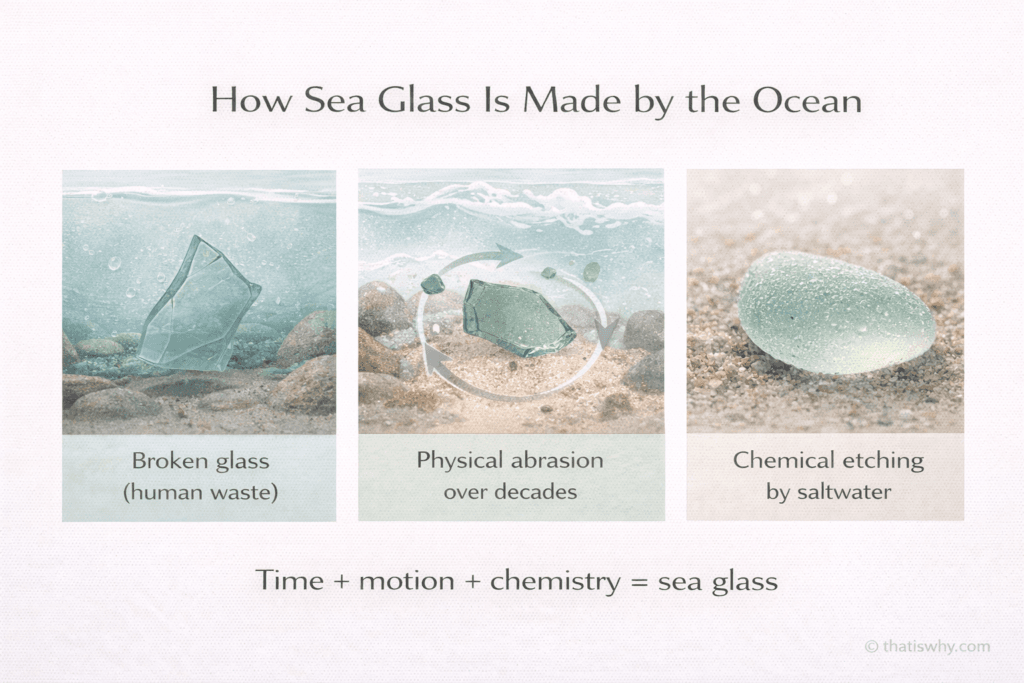
Sea glass is made naturally when broken glass shards are tumbled by ocean waves against sand and rocks for decades, physically smoothing the sharp edges while the saltwater chemically creates a pitted, frosted surface.
Your first instinct is to dismiss it. Just another piece of litter, probably a shard from a green beer bottle, spoiling the coastline. You almost walk right by, maybe with a little sigh.
But something makes you pause. It’s the edges.
They aren’t sharp. They’re soft and rounded, as if the ocean has been holding this piece and tumbling it in its palm for a lifetime. You pick it up. It’s cool and smooth in your hand.
This wasn’t just dropped here yesterday. This is something else entirely.
You realize you’re not holding trash. You’re holding a story.
The Ocean as a Master Jeweler
The simplest way to understand how sea glass is made is to think of the ocean as a master jeweler and a piece of broken glass as a rough, uncut stone.
When a bottle shatters and falls into the sea, it’s a jagged, worthless shard. But the jeweler gets to work. This is a two-step beautification process that takes decades.
First comes the shaping. For 20, 30, even 50 years, the jeweler uses a powerful, relentless tumbler—the waves, sand, and rocks—to grind away every sharp edge. Then, once the shape is perfectly smooth, the jeweler begins the delicate finishing work, using a special chemical bath—the saltwater itself—to give the glass its signature soft, frosty glow.
The Analogy Explained: This works because the creation of sea glass is a genuine two-part process: a violent physical shaping followed by a gentle chemical finishing. The jeweler metaphor perfectly captures this dual action. The limitation, of course, is that a jeweler is acting with intent. The ocean is a blind, indifferent force. The beauty it creates is a wonderful, accidental byproduct of its immense and constant power.
Journey from Trash to Treasure
Now that you have the jeweler’s basic plan, let’s look at the two main steps in the recipe.
Step 1: The Physical Process (The Great Tumble)
This is the brute force part of the journey. A sharp piece of glass is tossed into the surf zone, where it’s smashed, dragged, and ground against rocks, sand, and gravel. The relentless motion of the waves acts like a giant, slow-motion rock tumbler.
Every single day, for decades, every sharp edge is broken off, every jagged point is worn down, and the piece is slowly sculpted into a smooth, organic, pebble-like shape. This is why you’ll never find a piece of true sea glass with sharp corners. The ocean has patiently sanded them all away.
Step 2: The Chemical Process (The Frosty Finish)
This is the slow, silent magic that happens on a microscopic level. Glass has a shiny, smooth surface. But when it sits in saltwater for decades, a process called hydration begins.
The salt in the ocean slowly leaches out some of the chemicals (like lime and soda) from the glass. This process creates millions of microscopic pits all over the surface. When light hits these tiny pits, it doesn’t pass straight through; it scatters in every direction.
It’s the exact same principle as a frosted bathroom window. The glass isn’t cloudy on the inside; its surface has just been etched to scatter light. That is what gives sea glass its soft, ethereal, frosted glow.
Nature’s Upcycling
For me, this is a real recycling lesson. The creation of sea glass is a perfect example of Nature’s Upcycling.
“Upcycling” is the process of taking something considered waste and transforming it into something of greater quality or value. We think of this as a modern, human invention, but nature has been doing it for eons. It is the ultimate master of turning waste into wonder.
The sea glass in your hand is a testament to this incredible power—the ability of the natural world to take our forgotten fragments and, through its patient and powerful forces, elevate them into something beautiful.
This slow, powerful transformation is just one more example of why the ocean operates under its own strange rules.
Seeing Transformation Everywhere
Once you understand this principle of nature transforming our cast-offs, you start to see it in other, even more dramatic, ways.
The most stunning example is a coral reef growing on a sunken ship. A man-made disaster—a massive, cold, dead metal ship—sinks to the ocean floor. At first, it is a scar on the landscape. But slowly, tiny coral polyps begin to colonize it. Over decades, the wreck is transformed. The sharp, rusting metal is covered by a living, breathing, and breathtakingly complex ecosystem.
The ship becomes the foundation for a vibrant reef, teeming with thousands of fish and invertebrates. Nature didn’t just clean up our mess; it used our failure as the scaffolding to create a masterpiece of life.
The Sea Glass Detective’s Field Guide
Now that you understand the incredible, decades-long journey that real sea glass goes on, you can see why some people try to cheat the system by making fakes in a rock tumbler. But you also now have the secret knowledge to tell the difference.
So, let’s put on our “Sea Glass Detective” hats. The next time you’re on a beach, here’s a simple field guide to spotting a true ocean-made treasure versus a man-made imposter.
A Collaboration with History
So, the next time you find a piece of sea glass, you’ll know it’s so much more than just broken glass.
It’s a collaboration between human history and the patient, powerful forces of the natural world. It’s a story that started in a bottle factory decades ago and ended in the palm of your hand. It’s proof that the ocean, given enough time, can turn our sharpest edges soft and our forgotten garbage into treasure.
How We Researched This:
To explain this process, we consulted reports from the North American Sea Glass Association and oceanographic information from NOAA. But we knew that just listing facts isn’t helpful. Our real job began when we asked, “What does this feel like?” That question led us to the ‘Ocean as a Master Jeweler’ analogy—a simple story to make the complex science feel intuitive.