Why The Ocean Has Icy Fingers of Death
The Impossible Icicle
A Brinicle (or “icy finger of death”) is a hollow tube of ice that grows downward from sea ice when super-cooled, salty water leaks out and sinks. Because this brine is colder than the seawater it flows through, it freezes the water around it, creating a descending pipe that kills anything it touches on the seafloor.
Scientifically, it’s a density issue. Visually, it’s a nightmare.
If you remember that viral clip from the BBC’s Frozen Planet, you know why people call this the “finger of death.” You’re watching a pale white icicle grow down from the ceiling of the Antarctic ocean. It looks like magic. It reaches down, touches the sand, and wham—a web of ice shoots out across the floor.
Starfish, urchins, anything too slow to move gets caught. In seconds, they are frozen solid.
But wait a second.
Ice floats. That is Rule #1 of water. If you drop an ice cube in a glass, it goes up, not down. So why is this specific piece of ice sinking to the bottom of the ocean like a stone?
The Reverse Volcano
To get why this happens, you have to stop looking at the Brinicle as an icicle. It isn’t a solid spear of ice plunging through the water.
It’s a plumbing leak.
Actually, the best way to visualize it is to imagine a Volcano, but flipped upside down.
Picture a volcano on Hawaii. You have super-hot lava shooting up from the ground into the cool air. What happens? The outer edges of that lava stream cool down instantly and turn into solid rock. This builds a cone or a tube, shielding the hot liquid still flowing in the center.
A Brinicle is doing the exact same engineering, just in reverse.
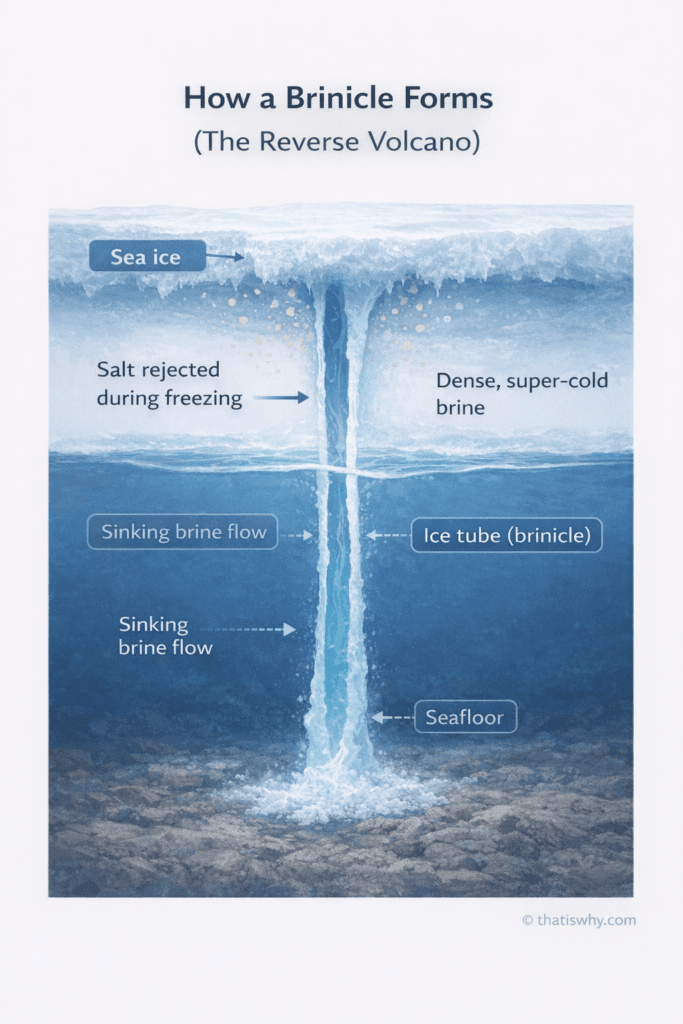
Instead of hot lava shooting up, you have super-cold brine (salty water) sinking down. As this freezing liquid flows through the “warmer” ocean water, it snaps the surrounding water into ice. This creates a hollow, growing tube.
So, the white “finger” you see isn’t actually the killer. It’s just the pipe. The real weapon is the invisible, super-cold fluid rushing through the middle of it.
The Leak in the Roof
So, where does this killer liquid come from? It starts with a weird quirk of chemistry called Brine Rejection.
Basically, ice is a perfectionist. When the ocean freezes, the ice crystals are extremely picky—they only want pure water molecules. They literally kick the salt out.
This leaves behind a leftover sludge of water that is packed with salt. And this sludge has two properties that make it dangerous.
First, it is heavy. All that extra salt makes it much denser than the normal ocean water, so gravity grabs it and pulls it down.
Second, it is super-cooled. Because it’s so salty, its freezing point drops. It can get way colder than normal ice (-2°C) and still stay liquid.
So, this heavy, super-cold brine eventually cracks through the sea ice and starts sinking.
As it flows down through the “warmer” ocean water, it acts like a heat sink. It steals the heat from the water around it, causing that water to snap-freeze instantly. This creates a hollow, icy tube around the stream.
That is the Brinicle. It isn’t an icicle; it’s a frozen pipe built in real-time to protect the flow of super-cold death inside.
The Touch of Death
Once the tube touches the seafloor, the “volcano” erupts.
The tip of the pipe breaks open, and the super-cold brine spills out. Because it’s so heavy, it doesn’t float away. It hugs the sand, spreading out like a creeping, white lava flow.
For the locals—mostly slow-moving starfish and sea urchins—this is an inescapable trap. As the flow washes over them, they get hit with a brutal biological double-whammy.
First, the Freeze. The brine is so cold that it flash-freezes the water around them. In seconds, they are encased in a literal tomb of ice. You can watch it happen in the video—the frost races over their bodies faster than they can crawl away.
Then, the Shock. This is the invisible killer. That brine is hyper-salty. When it hits a starfish, it triggers massive osmotic shock. The salt level is so high that it literally rips the fresh water out of their cells.
It’s a nasty way to go. They are being frozen on the outside and dehydrated on the inside. The starfish in that video didn’t stand a chance; they were drowning in a river that was too cold to touch and too toxic to survive.
From Icicles to Oceans
The Brinicle might look like a rare freak of nature, but the physics driving it is actually the engine that runs our planet.
It all comes down to that sinking brine. Right now, all across the poles, millions of tons of this heavy, salty water are sinking to the bottom of the ocean. This massive downward flow acts like a planetary plunger, driving the Global Ocean Conveyor Belt—the deep currents that circulate heat around the globe. The Brinicle is just a tiny, visible version of the pump that keeps the climate stable.
This same thermodynamic quirk is one of the reasons the deep ocean operates under a completely different set of physical rules, as explored in our guide on Why the Ocean Is an Alien World.
The Driveway Connection You also see this physics every winter in your own driveway. Why do we dump salt on icy roads? You are exploiting the same loophole: salt lowers the freezing point of water. It forces the ice to melt, even when it’s freezing outside. The Brinicle is just nature playing that same card in reverse—using salt to keep water liquid just long enough to deliver a freezing payload to the bottom of the sea.
Wait, It’s Not What You Think
Before you start worrying about “Ice Tornados” chasing you on your next swim, we need to inject a little reality into the horror story.
First, despite what the viral video suggests, this does not happen fast. The BBC footage makes the Brinicle look like a lightning bolt, striking the bottom in seconds. In reality, it’s a time-lapse filmed over several hours. A Brinicle grows inch by inch. If you were a diver (and you were crazy enough to be swimming in Antarctica), you could easily outswim one. The starfish only died because, well… they’re starfish. They aren’t exactly known for their cardio.
And while we are busting myths, let’s fix the big physics error I see in every comment section: “Look at that ice sinking!”
It looks like sinking ice, but it’s not. Remember, ice floats. If you snapped a Brinicle off the ceiling, it would bob straight to the surface. The only reason it grows downward is because it is being built by the heavy, sinking liquid flowing inside it. It’s a stalactite, not a missile.
Gravity is the Killer
When you watch that finger of death touch the seafloor, it’s hard not to feel bad for the starfish. It feels personal. It feels like nature invented a magical ice-weapon just to hunt them down.
But remember our “Reverse Volcano.”
A volcano erupts because the earth needs to release heat. A Brinicle forms because the ocean needs to release cold. In both cases, it’s just the planet trying to balance its internal pressure and temperature. The lava burns the trees, and the brine freezes the starfish, not because nature is cruel, but because the system has to keep moving.
Those starfish weren’t killed by a monster. They were just standing too close to the vent.
And that is the humbling part. The ocean creates things this beautiful and this deadly not for us, or for the starfish, but simply because gravity demanded it. It doesn’t need sea monsters to be terrifying. It just needs physics.
How We Researched This
To explain this phenomenon, we didn’t just watch the viral video. We dug into the hard science of Brine Rejection and Freezing Point Depression—the core principles that allow water to stay liquid below zero. We also referenced the filming notes from the BBC Frozen Planet team to clarify the timescale and debunk the myth that these structures strike instantly.
But we knew that just citing Brine Rejection and Freezing Point Depression isn’t helpful. Our real job began when we asked, “How do we visualize a liquid building a solid tube?” That question led us to the “Reverse Volcano” analogy—a simple way to see the Brinicle not as a magic icicle, but as a geological plumbing leak.