Why the Hatchetfish Looks Invisible : The Living Mirror Strategy
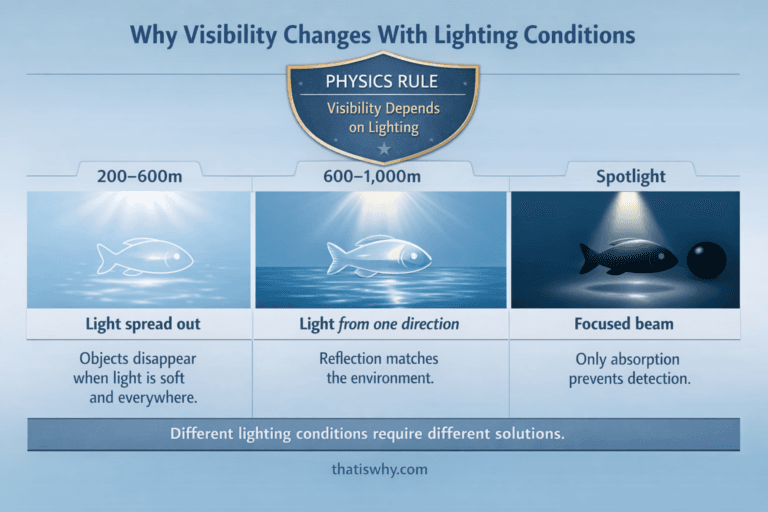
Hatchetfish hide by reflecting their surroundings like a mirror. Their sides are covered in microscopic crystals that bounce the ocean’s dim light back toward predators, making the fish blend into the water. From below, they erase their shadow using light-producing organs.
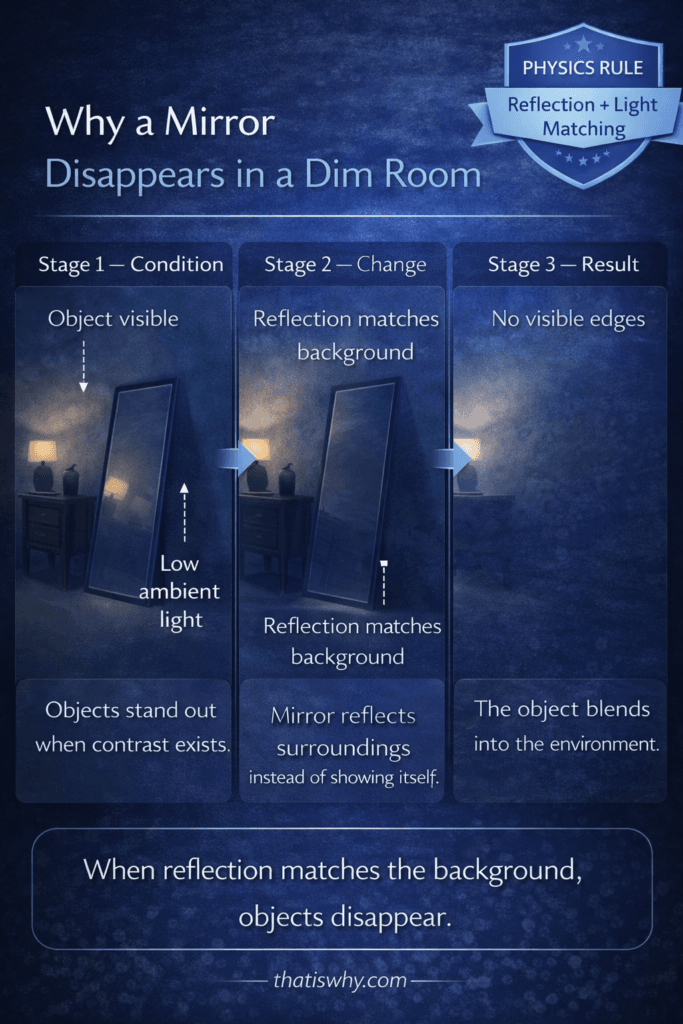
A mirror leaning against a wall in a dim room can be surprisingly hard to notice. Your eyes do not pick up the mirror itself so much as the surface it reflects. When the angle lines up, the mirror stops looking like an object and starts looking like part of the room.
The hatchetfish relies on that same effect in the open ocean.
In the twilight zone, there is no background to blend into. There are no rocks, no plants, and no edges to hide behind. There is only faint light drifting down through open water. Instead of trying to match that environment, the fish reflects it.
From the side, it does not look like something moving through the ocean. It looks like the ocean itself.
Why the Fish Does Not Shine Like a Coin
A flat silver surface usually gives itself away because it catches light and flashes. When a coin tilts under a light source, that sudden glint makes it easy to spot.
The hatchetfish should have the same problem. Its body is silver and reflective, so it could easily stand out in the water, yet it does not. The reason comes back to how a mirror behaves.
A mirror disappears when it reflects the right thing at the right angle. If it catches direct light, it becomes visible, but if it reflects the background correctly, it blends in.
The hatchetfish is built to maintain that alignment.
Its sides are covered in microscopic crystals arranged like tightly packed mirrors, and those mirrors are positioned vertically in a way that matches how light moves through the ocean. Most of the light in the twilight zone comes from above rather than from the sides.
Instead of producing a bright flash, the fish reflects the dim water around it, so anything looking from the side sees a reflection that matches the surrounding ocean.
The mirror does not reveal the fish, because it replaces it.
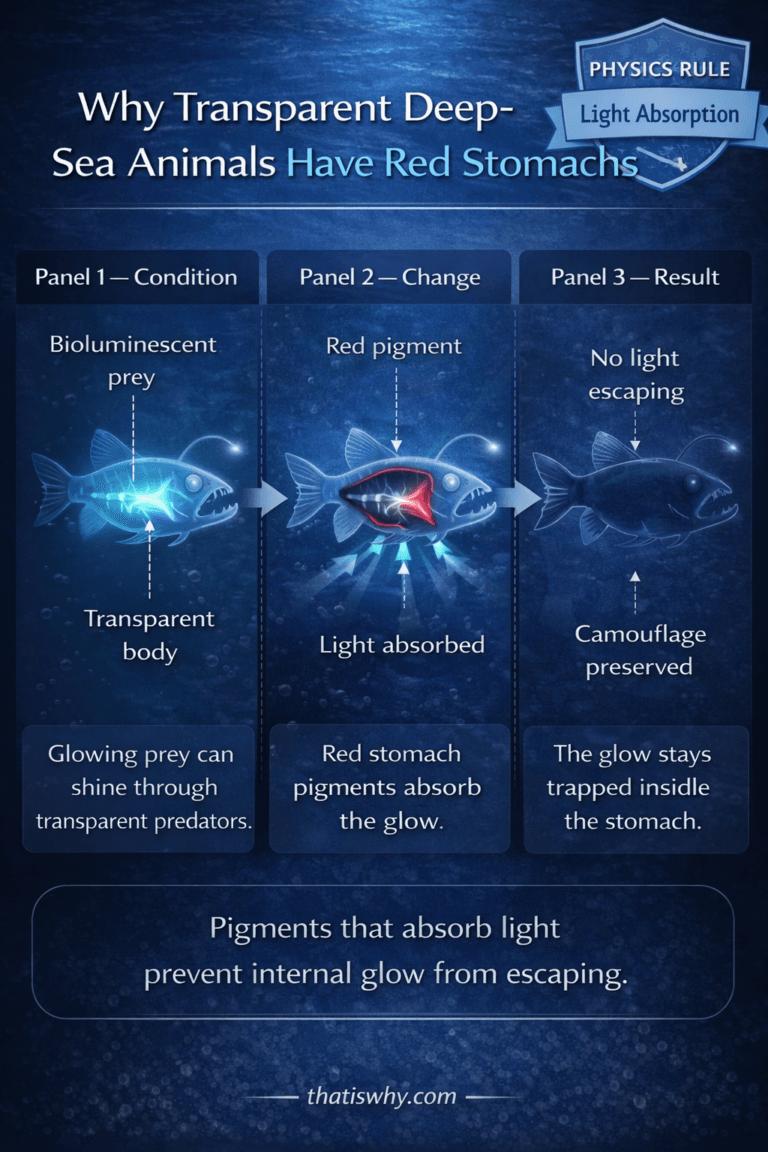
This is a different solution to the same problem explored in Why Transparent Deep-Sea Animals Have Red Stomachs , where animals control the light inside their bodies, while the hatchetfish controls the light bouncing off its surface.
Why a Mirror Alone Is Not Enough
The mirror works from the side, but it leaves another problem behind.
From below, the fish still blocks the faint light coming down from the surface, which creates a dark shape against a brighter background. That contrast makes the fish visible.
The mirror cannot solve that.
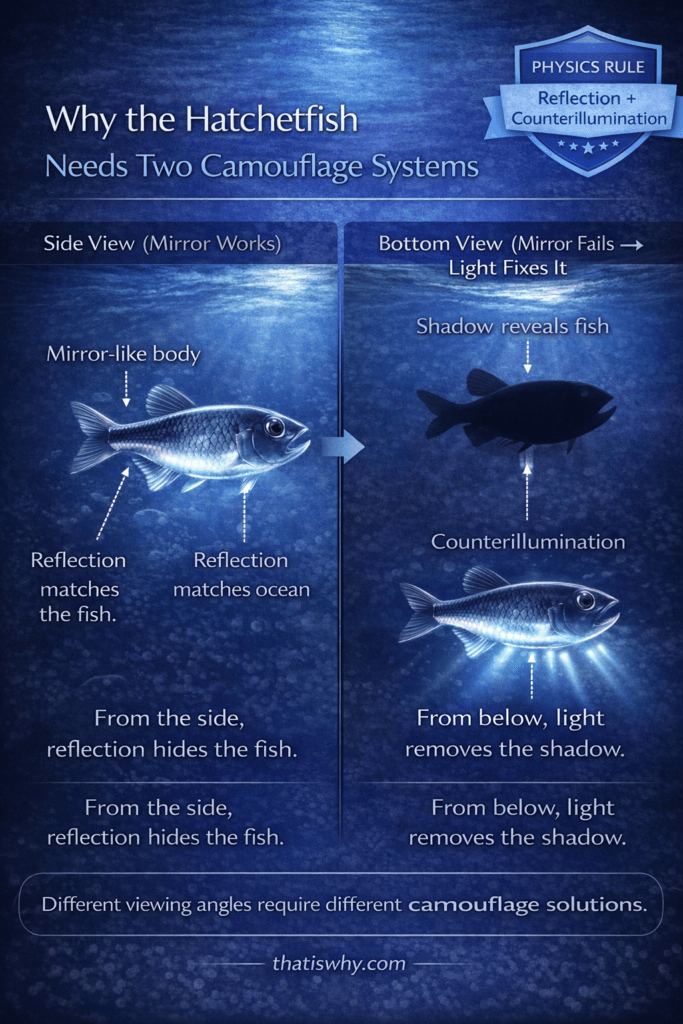
It reflects what surrounds the fish, but it cannot replace the light coming from above. Even if the sides disappear, the silhouette remains.
The hatchetfish solves this by producing its own light. Along its belly are tiny light-producing organs called photophores that emit a soft blue glow matching the light filtering down from the surface.
Instead of leaving a shadow, the fish fills that space with light.
To a predator looking upward, the brightness now blends with the background, and the outline fades. The mirror removes the sides, while the light removes the shadow, so together they erase the last visible trace of the fish.
Why the Fish Is Shaped Like a Blade
The mirror removes the sides, and the light removes the shadow, but shape still matters.
If the body were thick, it would still be visible from certain angles. The hatchetfish solves this by becoming extremely thin.
Seen from the front or from behind, its body almost disappears because there is very little surface facing the viewer. What remains is a narrow edge rather than a full shape.
This works in the same way a thin sheet behaves. When you look at a sheet of paper face-on, it is obvious. When you turn it sideways, it nearly vanishes because there is almost nothing left to see.
The hatchetfish uses that same idea in three dimensions.
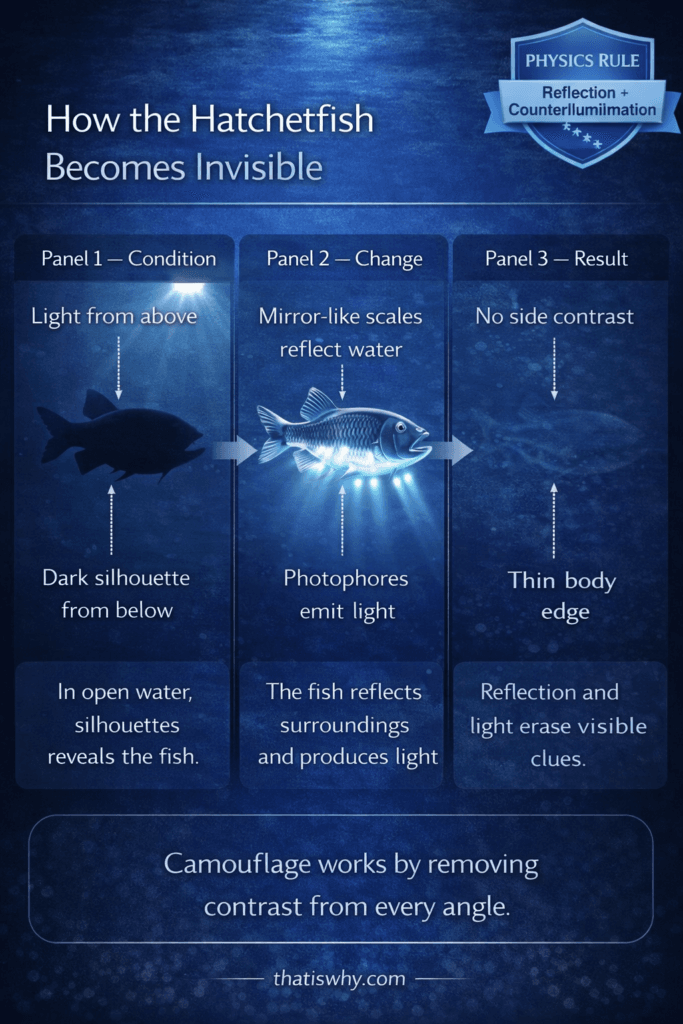
From the side, the mirror reflects the surrounding water. From below, the light removes the shadow. From the front or back, the body presents almost no surface at all. Each angle removes a different clue.
When the Ocean Itself Becomes the Camouflage
The hatchetfish is not the only animal solving this problem.
Across the twilight zone, different species face the same challenge of being exposed in open water with no place to hide, and each one arrives at a different solution.Some animals allow light to pass through their bodies and become nearly transparent. Others absorb light inside their tissues to hide what they have eaten.
The hatchetfish follows a different path, instead of disappearing, it reflects.
All of these strategies follow the same underlying idea. In an environment with no cover, camouflage is not about hiding behind something. It is about turning your body into something that behaves like the environment itself.
This is the same principle explored in Why Life Can Exist in the Crushing Depths of the Ocean, where survival depends on matching the physical rules of the ocean rather than resisting them.
When it reflects the right part of a room, it stops looking like an object and starts looking like part of the space around it. It does the same thing in the ocean.
By reflecting the surrounding water, matching the light from above, and reducing its visible shape, it removes the signals that would normally reveal its presence.
Three Error About Mirror Camouflage in the Deep Ocean
Myth #1 — A Reflective Fish Should Be Easy to Spot
Truth — Reflection Can Make the Body Disappear
A shiny surface usually makes something more visible.
When light hits metal or glass at the wrong angle, it creates a flash that immediately draws attention. It seems natural to assume that a silver fish would stand out in the same way.The hatchetfish avoids that problem by controlling what it reflects.
Its body does not catch random light. Instead, it reflects the dim water around it. When the angle is aligned, the reflection matches the surrounding ocean closely enough that the fish blends into the space instead of standing out from it.
Myth #2 — A Mirror Should Work From Every Angle
Truth — Reflection Only Solves One Direction
It is easy to assume that a reflective surface would hide the fish completely from all directions.The mirror works from the side, but it does not remove the silhouette seen from below.
That is why the hatchetfish produces its own light. The glow from its belly fills in the shadow that would otherwise reveal its shape.
Myth #3 — Camouflage Comes From One Single Trick
Truth — Invisibility Comes From Multiple Adjustments Working Together
It might seem that the mirror alone is enough to make the fish invisible. The hatchetfish combines several strategies at once.
Its reflective sides blend into the surrounding water, its light removes the shadow from below, and its thin body reduces what can be seen from the front or back.
Each adjustment removes a different clue, and together they make the fish extremely difficult to detect in the open ocean.
Why Invisibility in the Ocean Comes Down to What You Show
A mirror disappears when it reflects the right thing.When the reflection matches the background, the mirror no longer looks like an object. It looks like part of the space around it. The hatchetfish depends on that effect.
Its sides reflect the surrounding water, its belly produces light that blends with the faint glow from above, and its thin body avoids presenting a visible shape. Each adjustment removes a signal that would otherwise reveal it.
Nothing about this is random. Every surface, every angle, and every source of light is controlled in a way that reduces contrast with the environment.
Some creatures survive pressure by matching the movement of the water around them. Others adjust their internal chemistry so life continues under extreme conditions. Some allow light to pass through their bodies, while others control how light reflects or is produced.
In a place with nowhere to hide, survival depends on reducing the differences between the organism and its surroundings.
What draws attention is often not what exists, but what does not match. The closer something fits into its environment without creating contrast, the less likely it is to be noticed. The hatchetfish survives by minimizing those differences.
How We Researched This :
To understand how the hatchetfish hides using reflection, we looked at research in marine optics and deep-sea biology, focusing on how light behaves underwater and how certain animals control it. Studies on hatchetfish show that their scales contain layers of guanine crystals arranged in a very specific way, allowing them to reflect light like tiny mirrors.
Work from groups such as the Woods Hole Oceanographic Institution and the Monterey Bay Aquarium Research Institute helped connect those pieces, showing how reflection and light production combine into a single camouflage system.
But describing the physics alone does not make the idea intuitive. The clearer question was what this would look like in everyday life. That is what led to “the mirror analogy”, which make the concept of the object disappearing not because it is gone, but because it reflects the right part of its surroundings feel intuitive.