Why Snakes Don’t “See” Heat but Map It
They don’t see heat, they map it by turning microscopic temperature differences into space, pit vipers hunt with precision in total darkness.
A pit viper can strike a mouse in total darkness with unsettling accuracy. There’s no moonlight, no silhouette, and no visual outline you or I would recognize as useful. And yet the strike lands exactly where it should.
We saw a similar trade-off in the star-nosed mole, which abandoned vision entirely underground and built a detailed picture of the world using touch instead of light.
The key is understanding what isn’t happening.
The snake isn’t seeing a glowing animal in the dark, and it isn’t running a biological version of night-vision goggles. There’s no picture in the usual sense. What it’s doing instead is reading space through temperature, turning warmth into information.
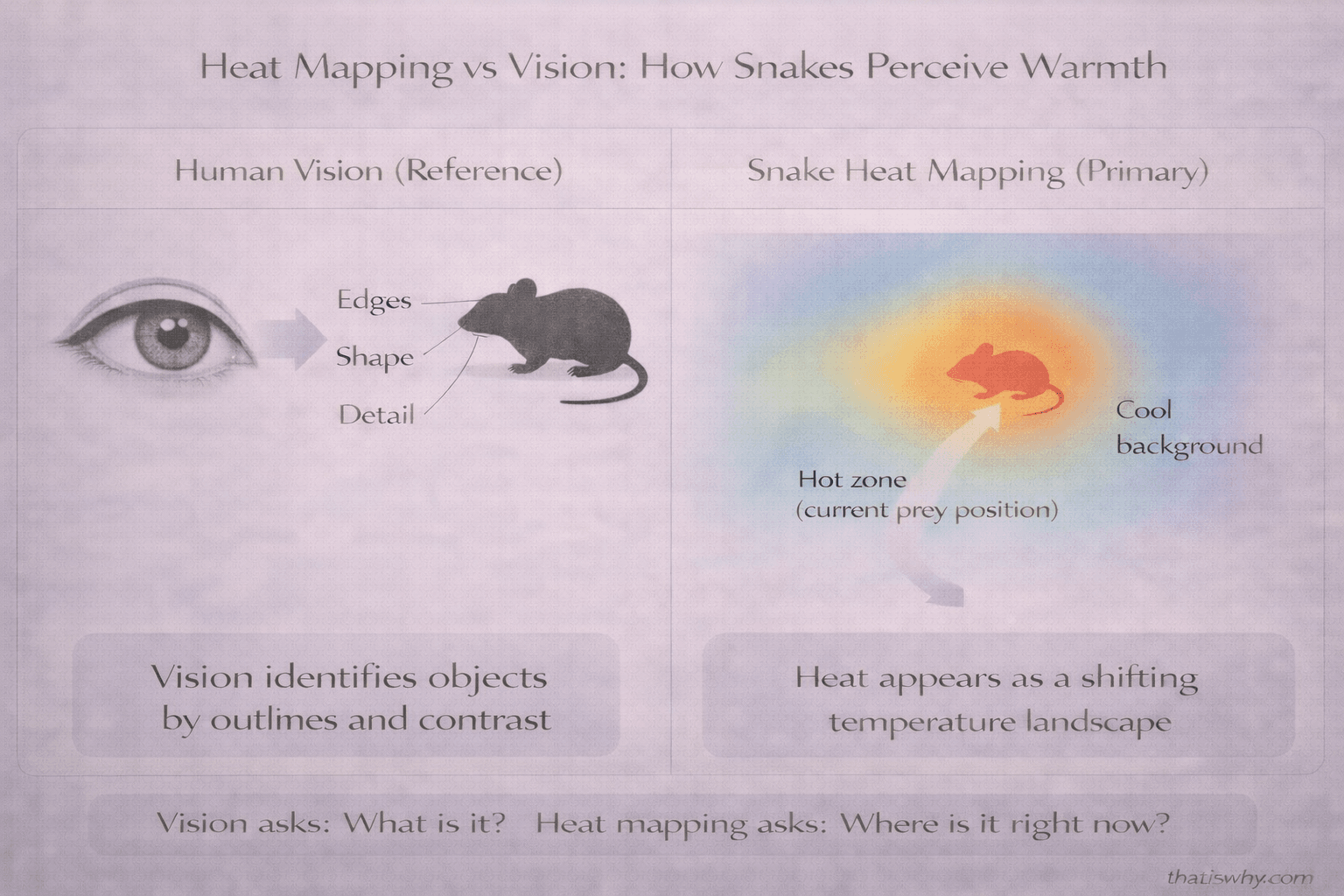
The best way to think about it is as a living heat map.
Warm bodies don’t appear as shapes or edges. They show up as shifting zones of higher temperature against a cooler background, more like a weather pattern than a photograph. The warmest point matters most, because that’s where the living thing is right now.
Once you see it that way, the accuracy stops feeling mysterious. The snake doesn’t need detail or color. It needs contrast, direction, and timing, delivered quickly enough to act.
The Pit: Where the Heat Map Begins
If the snake’s perception really works like a living heat map, then the pit organs are where that map first comes to life.
On each side of a pit viper’s head, right between the eye and the nostril, there’s a small hollow called a pit organ. It’s easy to miss if you don’t know what you’re looking for. But inside that shallow pocket is a membrane doing an enormous amount of work.
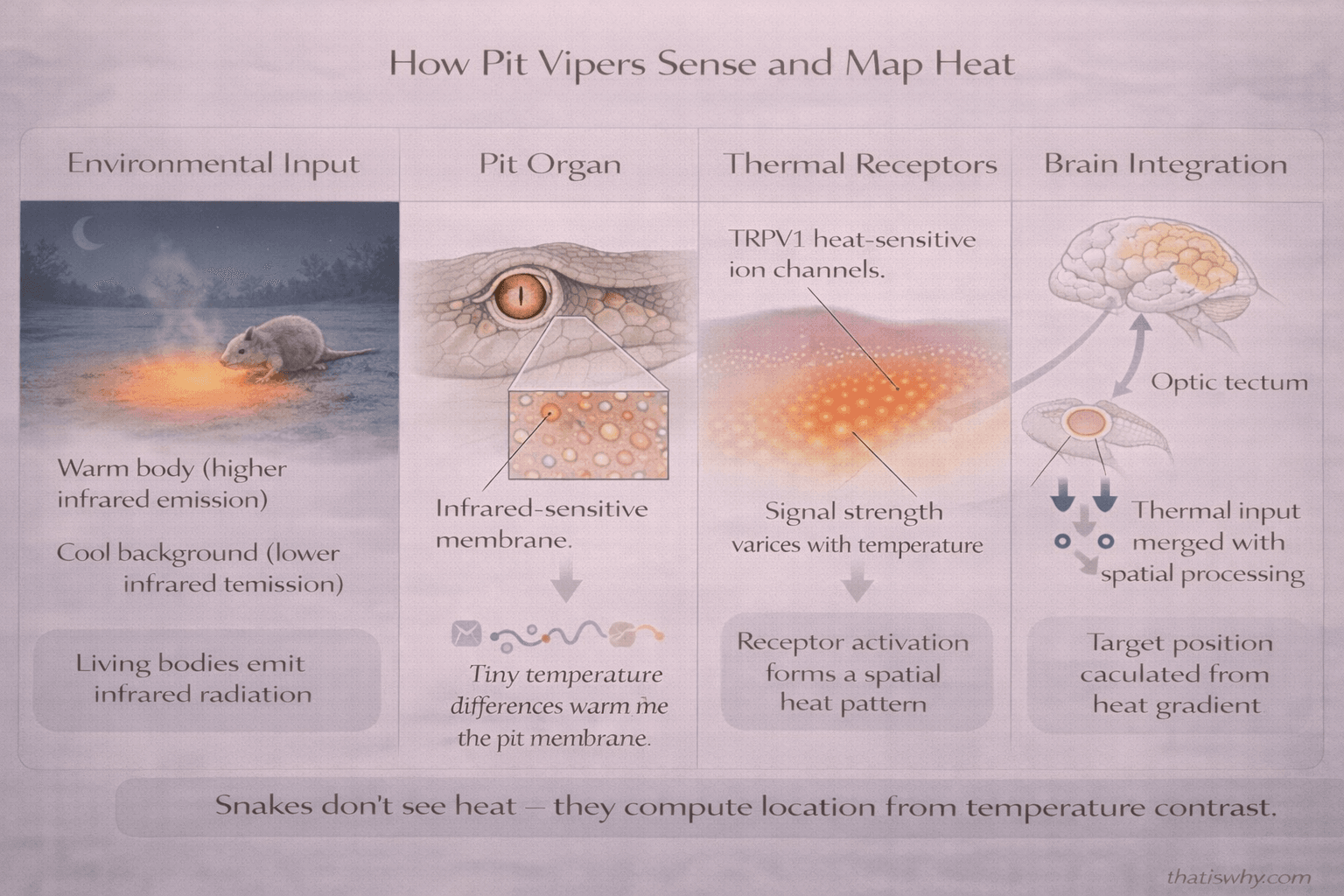
When something warm enters the space in front of the snake, infrared radiation gently warms that membrane. The change is incredibly small, but the nerve endings lining its surface are tuned to notice it immediately.
A heat map doesn’t try to draw clean outlines. It isn’t concerned with edges or fine detail. What it cares about is contrast. Where is it warmer than the background? How steep is that difference? Is the warm zone drifting left or right?
That’s exactly what the pit organ is built to detect.
Experiments have shown that pit vipers can sense temperature differences as tiny as one-thousandth of a degree Celsius. In practical terms, that means a warm animal doesn’t need to be obvious or close. As long as it’s warmer than the surrounding air or ground, it registers clearly on the snake’s internal map.
At this stage, there’s still no picture in the way we usually think about pictures. What the snake has is a thermal landscape spread across the space in front of its face, constantly updating as temperatures shift.
The Receptor: How Warmth Becomes a Signal
The next step is understanding how that warm landscape turns into something the nervous system can actually use.
This is where a protein called TRPV1 comes in.
If that name rings a bell, it’s because it’s the same heat-sensitive channel that fires in your mouth when you eat chili peppers. In humans, TRPV1 helps signal heat and pain. In pit vipers, evolution took that same basic component and tuned it for precision sensing instead.
Each TRPV1 channel acts like a microscopic thermometer. When infrared radiation warms the pit membrane, even slightly, these channels open and trigger nerve signals. Across the surface of the membrane, thousands of these signals activate at once.
Individually, they don’t say much. Together, they form a pattern.
That pattern is the heat map.
Warmer areas produce stronger signals. Cooler areas fade into the background. As a warm animal moves, the pattern shifts smoothly rather than jumping from point to point. The snake isn’t tracking an object so much as following the brightest gradient across space.
What’s especially important is what happens next. These thermal signals don’t remain isolated in a separate part of the brain. They feed directly into regions that also process vision, merging temperature information with spatial awareness.
The snake doesn’t experience two worlds layered awkwardly together. It experiences one continuous space, enriched with temperature cues.
At this point, the heat map stops being abstract data and becomes actionable space.
Hunting in the Dark: Reading the Map, Not the Shape
Once you picture the snake working from a living heat map, the hunt starts to feel less mysterious and more practical.
In laboratory tests, pit vipers can still strike prey accurately even when their eyes are covered. That sounds dramatic until you remember what the snake is actually aiming at. It isn’t lining up a face or a body. It’s tracking the warmest region in a moving thermal field.
A small mammal doesn’t register as a single dot of heat. Different parts of its body radiate warmth at slightly different intensities, creating a gradient the snake can follow. The head and chest usually stand out most, and as the animal moves, that warm center shifts in predictable ways. The strike follows that shifting hotspot rather than a visual outline.
This also explains why pit vipers don’t appear rushed when they hunt. As long as the prey remains warm, its position never truly disappears. Even brief pauses or sudden changes in direction don’t erase the signal. The heat map simply updates.
Researchers have also observed that snakes can respond to faint thermal traces left behind by moving prey. Warm ground cools slowly, and that fading heat can still register long enough to suggest where something was moments ago and where it might be heading.
So when the strike finally happens, it isn’t a guess. It’s the last step in reading a map that has been quietly updating since the prey entered range.
Not True Vision: What the Heat Map Can’t Do
At this point, it’s tempting to imagine the snake walking around with a crisp thermal picture layered over the world. That image is appealing, but it isn’t accurate.
The pit organs don’t resolve fine detail. They don’t outline fur, limbs, or facial features. What they provide are broad zones of warmth and the gradients between them. This system is optimized for detection and targeting, not identification.
That limitation is intentional.
The heat map doesn’t replace the eyes. It complements them. When light is available, vision still handles structure, distance, and obstacles. The thermal sense quietly answers a narrower question: where is something alive right now? The brain fuses those inputs so the snake experiences one continuous space rather than two competing senses.
This also explains why pit vipers aren’t striking every warm object they encounter. Heat alone isn’t enough. Context still matters. Distance matters. Timing matters. The map guides action, but it doesn’t override judgment.
The system does one job extremely well, and it resists the temptation to do more.
When Temperature Becomes Information
Once you get comfortable with the idea of a living heat map, the snake stops feeling like an exception and starts feeling like part of a pattern.
Whenever vision becomes unreliable, evolution looks for another way to extract structure from the environment. Electric fish do this with electric fields in muddy water. Bats do it with sound when light disappears. Even humans rely on similar shortcuts when navigating familiar spaces without looking.
The snake’s solution sits comfortably in that family of ideas.
Heat is unavoidable. Living bodies leak it constantly, and in cool nighttime environments the contrast becomes especially strong. By turning tiny temperature differences into spatial patterns, pit vipers gain access to a layer of the world most animals barely register.
What’s interesting is how seamlessly this information is integrated. The snake doesn’t feel like it’s switching senses or consulting a backup system. Warmth becomes location. Movement becomes shifting contrast.
Once you start thinking about perception this way, it becomes clear that evolution isn’t trying to build perfect senses. It’s trying to build systems that extract just enough structure from chaos to act at the right moment.
What People Get Wrong About Snake “Heat Vision”
Myth #1: Snakes see glowing animals in the dark, like night-vision goggles.
Truth: Pit vipers don’t see outlines or silhouettes. They sense broad zones of warmth, closer to a heat map than a photograph.
Myth #2: Heat sensing replaces vision entirely.
Truth: The heat map layers onto vision rather than replacing it, adding temperature information to an already existing spatial framework.
Myth #3: This ability is almost supernatural and unique.
Truth: The building blocks exist in many animals. What’s unusual is how finely tuned and tightly integrated they are in pit vipers.
Mapping the Dark
The advantage isn’t seeing more. It’s focusing on exactly the information that matters most in the dark. What pit vipers really force us to rethink is not vision, but certainty.
When light fades, most animals lose confidence in what they perceive. Shapes blur, motion becomes ambiguous, and hesitation creeps in. The snake avoids that problem by changing the question it asks. Instead of trying to see clearly, it asks where warmth is gathering right now and builds a spatial answer from that alone.
The resulting heat map doesn’t try to describe the world in detail. It ignores texture, color, and identity, focusing only on contrast and direction. That restraint is its strength. By concentrating on one reliable signal, the snake removes ambiguity before it ever has to decide what to do.
Humans do something similar more often than we admit. Think about moving through a familiar room in the dark. You’re not visualizing every object. You’re navigating by expectation, by subtle cues, by where things should be rather than what they look like. The snake’s heat map is that intuition turned into biology.
Seen this way, the ability stops feeling exotic. In a world where light can’t be trusted, mapping warmth isn’t a trick. It’s simply what perception becomes when it’s designed for the night.
How We Researched This :
To explain how pit vipers sense heat without actually seeing it, we focused on well-documented pit organ research rather than broad summaries. That includes Kenneth C. Catania’s behavioral experiments on infrared-guided striking in pit vipers, which quantified accuracy with vision blocked, and physiological studies published in Nature and The Journal of Experimental Biology that identified TRPV1 ion channels as the heat-sensitive mechanism inside the pit membrane. Together, these papers map the full chain—from infrared radiation, to neural activation, to strike behavior.
But we knew that listing receptors and temperature thresholds wouldn’t help the reader feel how the system works. Our real job began when we asked, “How that’s feel?” That question led us to the “living heat map” analogy, a simple way to translate infrared sensing, neural fusion, and strike behavior into something intuitive without oversimplifying the science.