Why the Star-Nosed Mole Sees Faster Than Sight
The fastest mammal eater on Earth doesn’t have sharp eyes, claws, or lightning reflexes.
It has a nose. The star-nosed mole can identify and swallow prey in eight milliseconds. That’s about one-eighth of the time it takes you to blink. By the time your visual system finishes deciding what it’s looking at, this animal has already touched, identified, and eaten its meal.
That raises an obvious question.
If you live underground, in muddy tunnels where light is useless and sound is distorted, how do you even know what you’re touching, let alone decide whether to eat it that fast?
The answer is that the star-nosed mole doesn’t use touch the way we do.
It uses touch the way we use vision.
The World’s Fastest Eater
In controlled laboratory experiments, researchers measured the star-nosed mole performing up to 120 feeding actions per minute. Each action : contact, identification, decision, and consumption, takes roughly eight milliseconds from start to finish.
That speed sits far below conscious thought. Your brain usually needs 150 to 200 milliseconds just to visually recognize an object before you can even begin deciding what to do with it. The mole completes the entire sequence long before that loop would normally close.
What’s striking is how calm the behavior looks.
The mole doesn’t pause to feel around or test possibilities. The nose makes brief contact, and the outcome is already determined. If the object fits the right profile, it’s eaten immediately. If it doesn’t, the system moves on without slowing down.
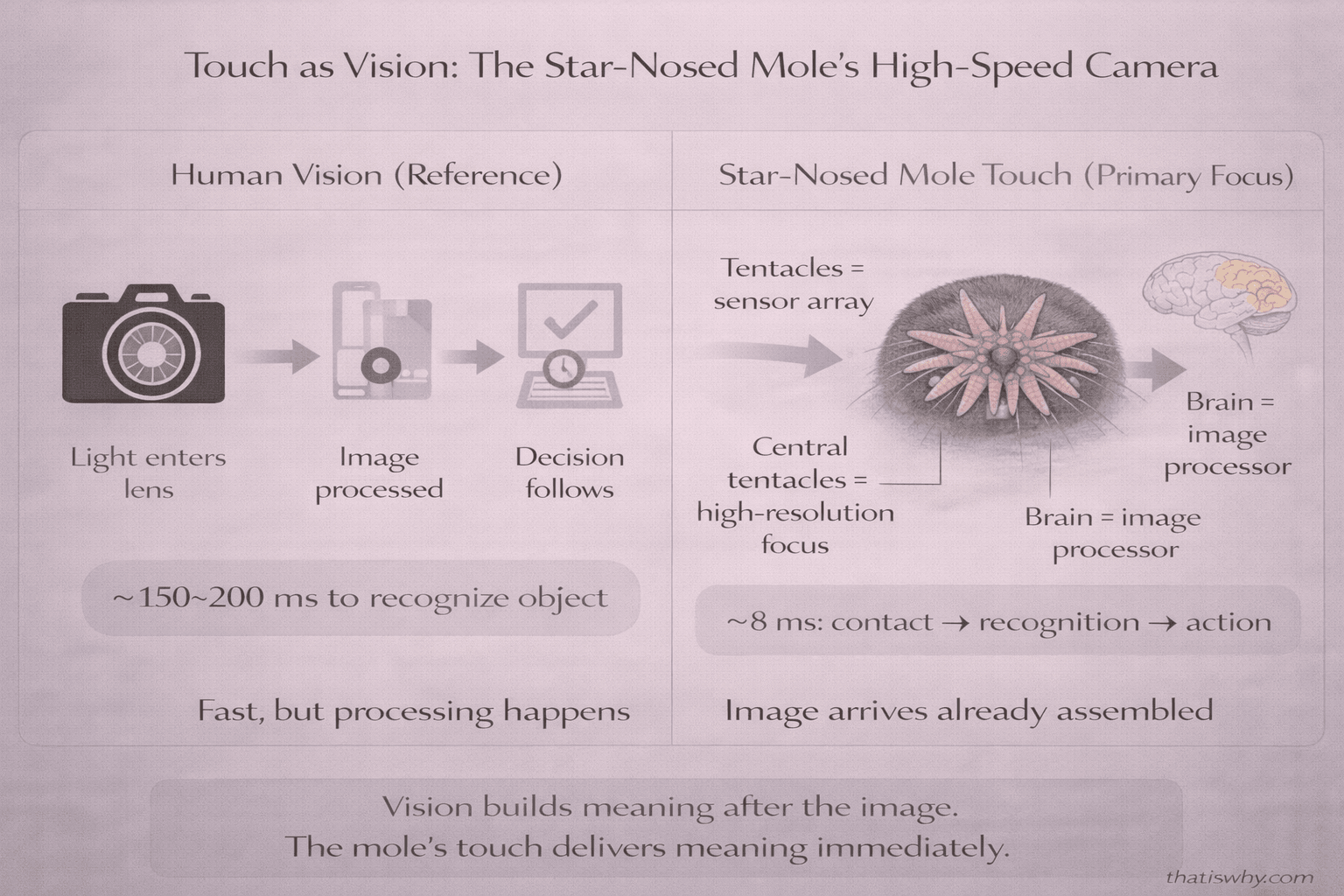
That only makes sense if each touch isn’t vague information, but a complete capture.
Instead of building understanding gradually, the mole’s nose grabs finished tactile snapshots. Shape, texture, and size arrive together, already assembled. By the time the nose lifts, the picture is complete.
That’s why the speed feels effortless. The mole isn’t reacting quickly. It’s acting on information that arrives already finished, the way a fast camera delivers a sharp image without hesitation.
The Star: 22 Tentacles, 25,000 “Pixels”
If the nose works like a camera, this is the sensor.
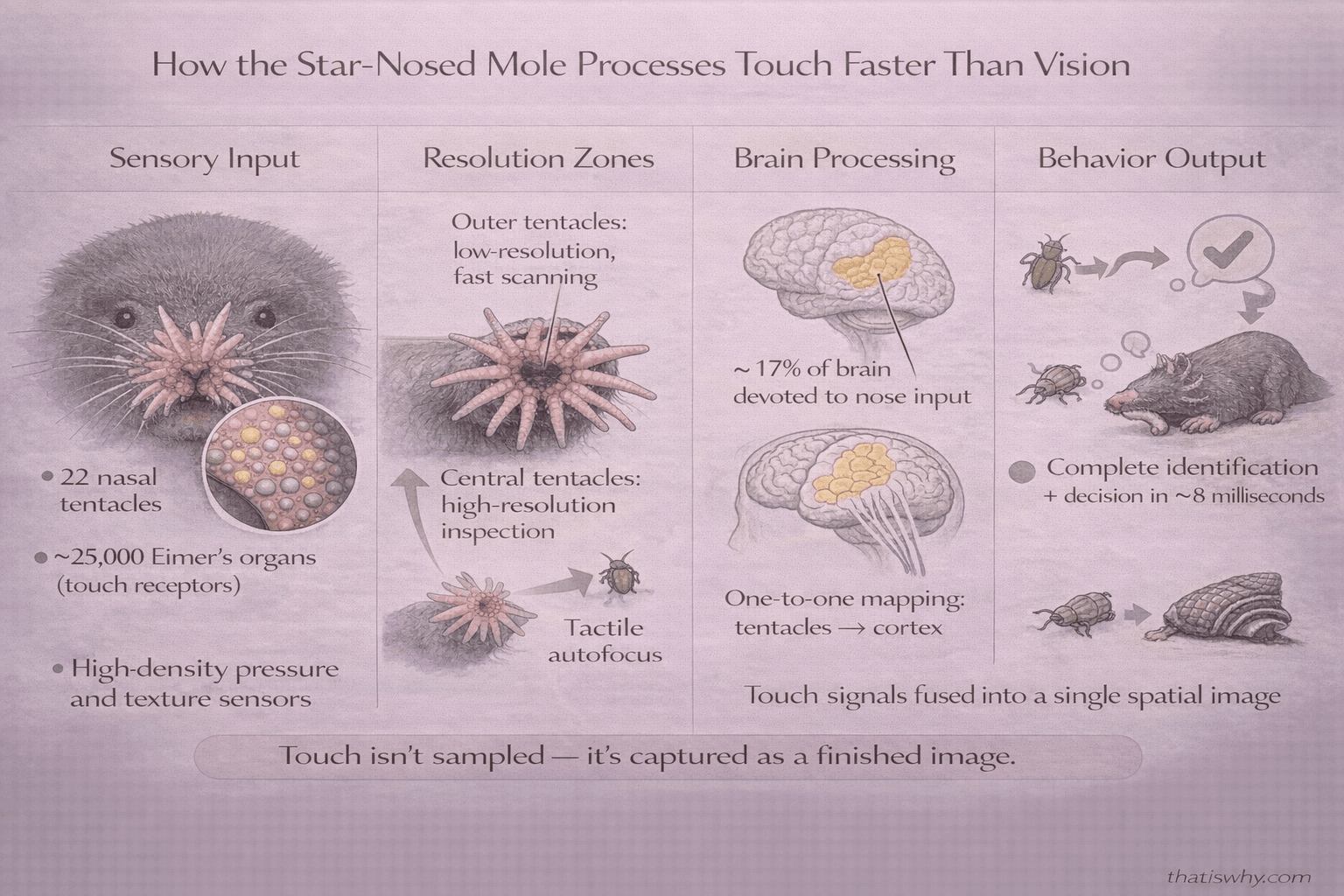
At the center of the mole’s face is a star-shaped ring of 22 fleshy tentacles, constantly in motion. Each tentacle is covered in microscopic structures called Eimer’s organs, specialized touch receptors tuned to tiny changes in pressure and surface detail.
Altogether, the nose contains around 25,000 sensors, packed into an area smaller than your thumb.
What matters isn’t just how many there are. It’s how they’re arranged.
Most of the tentacles provide wide coverage, scanning the environment quickly at moderate resolution. But a small central pair behaves differently. These tentacles have denser sensor packing and are used to inspect anything interesting in finer detail.
It’s the tactile equivalent of autofocus.
When the outer tentacles detect something promising, the nose pivots automatically so the high-resolution tentacles can capture a sharper image. This happens without pause, fast enough that the mole never breaks rhythm.
A camera doesn’t need repeated passes to understand a scene. One clean capture, at the right resolution, is enough. The star-nosed mole’s nose works the same way.
Neural Bandwidth: Where the Image Comes Together
Taking a picture is easy. Making sense of it is the real work.
About one-sixth of the star-nosed mole’s brain is dedicated to processing information from the nose. For an animal this small, that’s a massive investment, comparable to how much cortex humans devote to vision.
When thousands of touch signals arrive, they aren’t processed one by one. They’re fused into a single, stable tactile image. The mole isn’t aware of individual tentacles making contact. What it experiences is a coherent surface, already organized and ready to use.
Researchers have found that the mole’s brain mirrors the layout of the nose itself. Each tentacle has its own mapped region in the somatosensory cortex, preserving spatial relationships all the way through processing. Nothing gets scrambled. Nothing needs reconstruction later.
By the time the signal reaches the parts of the brain that control movement, the image is already finished. The decision to eat or ignore isn’t slow because the question has already been answered upstream.
That’s why the behavior looks so decisive. The work happened earlier.
Underground Life: Why Touch Had to Become Vision
All of this only makes sense once you picture the mole’s world.
Its tunnels are dark, flooded, and tight. Light is unreliable. Sound echoes unpredictably. Even smell spreads too slowly to guide split-second decisions.
Touch, by contrast, is immediate. When something is in front of you, you’re already in contact with it.
The problem is that ordinary touch is usually too slow to guide fast action. So instead of abandoning touch, evolution rebuilt it.
Think about what happens when a camera struggles in low light. You don’t keep the same settings and hope for the best. You redesign the system around the conditions. The star-nosed mole did the biological equivalent of that.
Its nose became the primary interface with the world. Every tunnel wall, every insect, every edible target passes through that tactile camera first. Once the picture arrives, the rest of the animal can move calmly, because uncertainty has already been removed.
When Touch Becomes the Picture
Once you start thinking this way, the star-nosed mole stops feeling unique.
Bats do something similar when vision fails entirely. They assemble spatial images out of sound, fast enough to fly and hunt in complete darkness. Electric fish rely on electric fields when murky water makes sight unreliable. Even you do a mild version of this when you reach into a bag without looking and instantly recognize objects by shape.
The mole simply lives in a world where that fallback strategy became the main event.
Whenever vision becomes noisy or slow, evolution looks for another way to build a picture that arrives cleanly and on time. The star-nosed mole shows what that solution looks like when it’s taken seriously from the ground up.
Why the Star-Nosed Mole Isn’t “Blind” at All
Myth #1: “It’s just a blind mole with a weird nose.”
Truth: The star-nosed mole isn’t stumbling through the dark and compensating for a missing sense. Its vision is limited, yes, but that’s not the story. The nose isn’t a patch. It’s the primary imaging system. It isn’t an animal that lost its eyes and learned to cope. It’s an animal that built a better camera for the conditions it lives in. Underground, touch delivers clearer pictures than light ever could, and the mole is designed around that reality.
Myth #2: “It’s fast because it has more sensors.”
Truth: More sensors don’t automatically make a better picture. What matters is how those sensors are organized and how quickly their signals are assembled into something usable. A camera with more pixels isn’t helpful if the image processor can’t keep up. The star-nosed mole’s advantage comes from pairing dense touch sensors with a brain wired to fuse them instantly into a single tactile image. Speed comes from integration, not excess.
Myth #3: “Touch is always slower than vision.”
Truth: Touch is slower for humans because it’s not our primary imaging system. For the star-nosed mole, touch has been rebuilt to do exactly what vision does for us: capture, assemble, and deliver a picture of the world before conscious thought gets involved. Once touch is doing that job, the usual hierarchy flips. Vision becomes optional. Touch becomes decisive.
Myth #4: “This is just a niche trick for one strange animal.”
Truth: The trick isn’t the nose, it’s the strategy. Whenever an environment makes vision unreliable, evolution looks for another way to build fast, trustworthy images. The star-nosed mole is just one of the clearest examples of that move, because its solution is so visible on its face.
Seeing Without Eyes
The star-nosed mole forces a quiet rethink of what “seeing” actually means it isn’t impressive because it’s extreme. It’s impressive because it’s coherent.
Every part of the system, from the tentacles to the brain to the behavior, exists to answer the same question as quickly as possible: What am I touching, and does it matter?
We tend to treat vision as a privileged sense, something special and irreplaceable. But when you strip it down, vision is just one way of building a reliable picture of the world quickly enough to act. Light happens to be the medium we use. That’s not a rule. It’s a convenience.
In the mole’s tunnels, light is a liability. Touch, if it can be made fast and precise enough, does the job better. So evolution doesn’t cling to eyesight out of loyalty or tradition. It builds a different camera, tuned to the conditions, and wires the entire animal around it.
The system works because uncertainty is resolved early. By the time a decision is visible to us, it’s already been made upstream, quietly and confidently.
We like to believe our own senses show us the world as it truly is. In reality, they show us one workable version of it. The star-nosed mole reminds us that perception isn’t about truth or elegance. It’s about usefulness under pressure.
And once you see that, it becomes harder to assume that the way we experience the world is the default, rather than just another successful solution.
How We Researched This :
To understand how the star-nosed mole can identify and eat prey in milliseconds, we drew on behavioral timing experiments and neuroanatomical research on Condylura cristata, including studies published in Nature and The Journal of Comparative Neurology.
But numbers alone don’t explain experience. Our real work began when we asked a simpler question: what would touch need to become to replace vision entirely? That question led us to the “high-speed camera” analogy, a way to visualize the mole’s nose not as a strange appendage, but as a sensory system built to capture complete images without light, delay, or hesitation.