Why Emperor Penguins Turn Antarctic Ice into a Living Thermal Battery
Antarctica can drop to minus sixty degrees Celsius. At that temperature, a human without serious protection would lose heat fast enough to die in minutes. An emperor penguin stands on that same ice for four months without eating.
The trick is not just fat or thick feathers, it’s thermodynamics. Thousands of penguins press together and behave less like individual birds and more like a single, shared thermal battery, storing, balancing, and recycling heat so efficiently that the middle of the group can reach full body temperature.
They do not beat the cold by being tougher. They beat it by being smarter with energy.
The Huddle: When the Battery Pack Turns On
At first glance, a penguin huddle looks like simple crowding. Thousands of birds stand pressed tightly together, barely moving, their backs turned to the wind and their heads tucked low against the cold. It does not appear organized, yet what is happening inside that mass is remarkably structured.
Each emperor penguin produces heat continuously through metabolism, which is essentially the slow conversion of stored fat into energy. In Antarctica, that heat disappears quickly because the temperature difference between a warm body and minus sixty degrees creates a constant pull outward. Wind accelerates the loss, and the ice beneath their feet conducts heat away even faster.
Instead of resisting that drain individually, the penguins change the geometry of the problem.
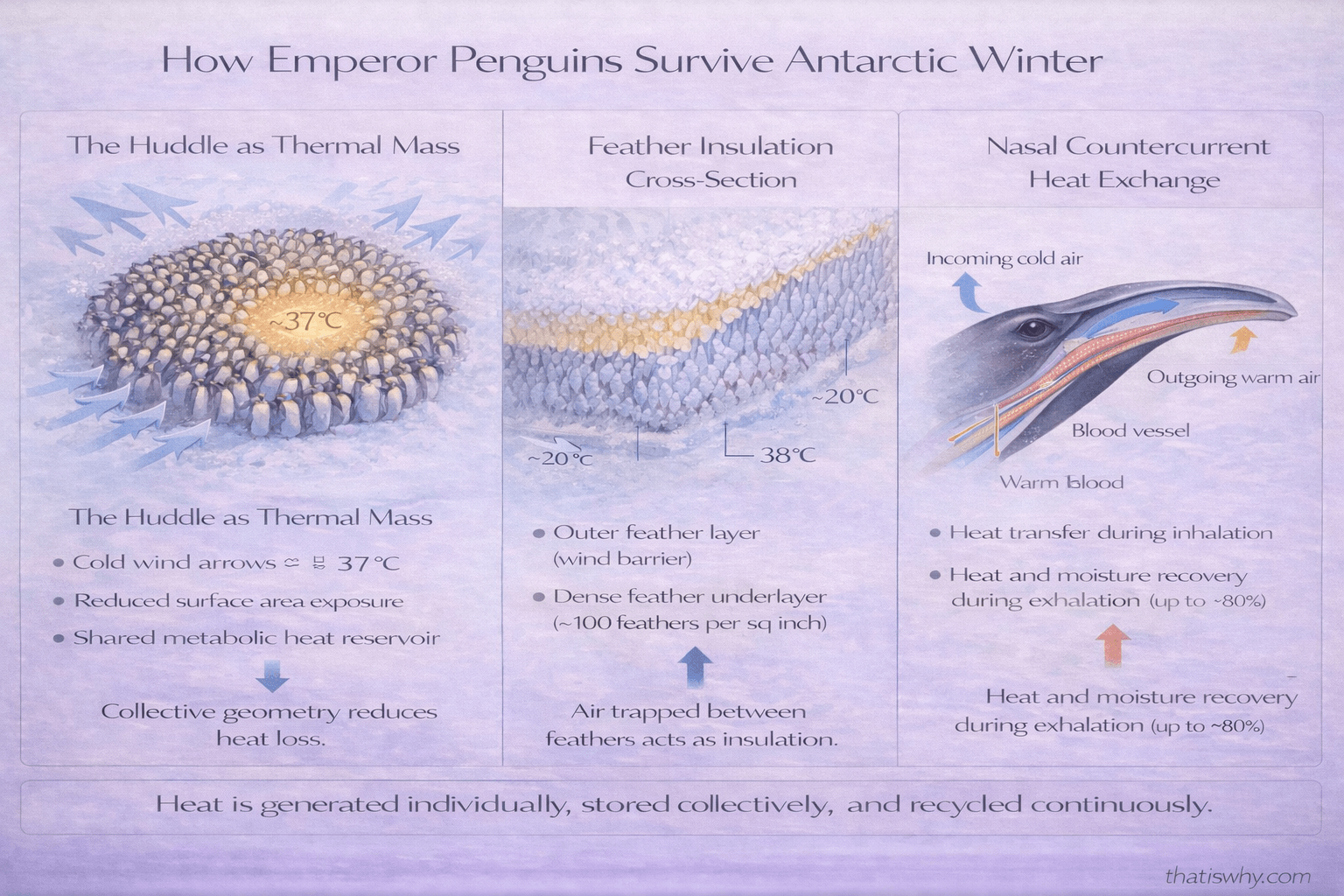
When they press tightly together, their combined surface area drops dramatically, which means less total exposure to the air. Surface area determines how much heat can escape, so by reducing it, they immediately slow the rate of energy loss. That alone would help, but something more interesting begins once thousands of warm bodies share contact.
Inside the huddle, metabolic warmth from every bird builds into a shared reservoir. Measurements taken within dense colonies show that the core temperature of the group can climb to around thirty-seven degrees Celsius, which is normal body temperature for a penguin. Birds in the center are not just less cold; they can actually become too warm if they remain there for long periods.
The huddle behaves like a slow-moving solid. When one penguin shifts forward by just a few centimeters, that tiny adjustment triggers a wave that passes through the entire colony. Over time, individuals rotate from the outer edge, where wind and cold are strongest, toward the warmer interior. Birds that have spent time in the protected center eventually move outward and take their turn facing the cold.
No bird is in charge of this process. There is no visible signal or command structure. The redistribution emerges from small, local movements that scale across thousands of bodies.
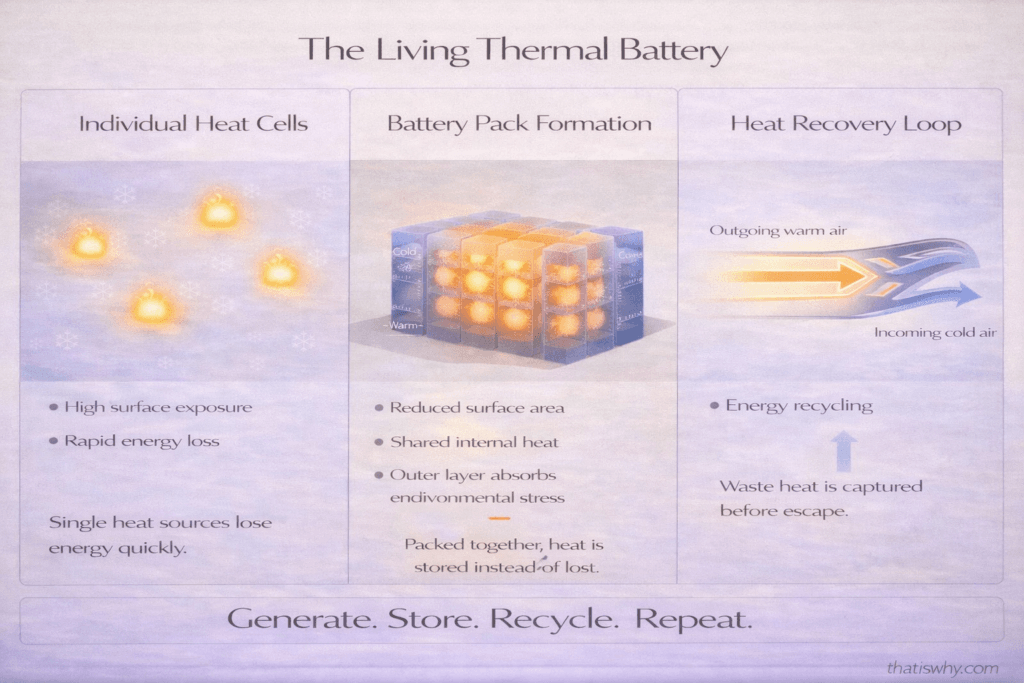
If you picture the colony as a living thermal battery, this is the balancing phase. The outer layer absorbs the environmental stress. The interior stores warmth. The entire mass continuously redistributes exposure so that no single penguin bears the full thermal cost for long.
It looks like a crowd standing still. It functions like a system managing energy.
The Feathers: The Battery’s Insulation Casing
The huddle stores and balances heat, but it only works because each penguin is already carrying serious insulation. Think of the colony as the battery pack and the feathers as the casing that keeps the charge from leaking out.
Emperor penguins have the highest feather density of any bird, with roughly one hundred feathers per square inch. That density matters because feathers do not just sit flat like a coat. They overlap in tight layers and trap air between them. Air is a poor conductor of heat, which makes it an excellent insulator.
A penguin’s skin sits close to thirty-eight degrees Celsius. Just outside that skin is a thin layer of trapped air warmed by body heat. Beyond that, the outer feather surface can be far colder, sometimes close to the surrounding air temperature. The drop from warm skin to frozen exterior happens across only a few centimeters, and most of the heat never escapes that boundary.
The feathers prevent the internal warmth generated by metabolism and amplified by the huddle from bleeding away into the environment. Without that insulation, the colony would lose energy too quickly to matter. With it, the stored heat remains available long enough to be shared and redistributed.
Insulation and huddling amplify each other. The feathers slow heat loss at the individual level, while the huddle reduces exposure at the group level. Together, they turn thousands of small heat sources into something that behaves like a stable energy reservoir instead of a collection of vulnerable birds.
The battery works because the casing works.
The Nose: The Battery’s Heat Recovery Circuit
Even with dense feathers and a tightly packed huddle, there is still one major place where heat can escape: breathing.
Every time a warm-blooded animal exhales into freezing air, it risks losing both heat and moisture. In Antarctica, that loss would be brutal. Exhale warm, moist air into minus forty or minus sixty degrees, and the temperature difference alone would drain energy quickly.
Emperor penguins do not allow that to happen.
Inside their nasal passages is a countercurrent heat exchange system. Blood vessels carrying warm blood toward the tip of the beak run alongside vessels returning cooler blood back into the body. Incoming cold air passes over those surfaces before reaching the lungs.
When the penguin inhales, the frigid air is gradually warmed by outgoing blood that has already given up some of its heat. When the penguin exhales, the process reverses. The outgoing warm air passes over cooler surfaces inside the nasal passages, and much of its heat and moisture condenses and is recaptured before the air leaves the body.
Studies suggest that penguins can recover up to eighty percent of the heat and water that would otherwise be lost through breathing.
If the huddle stores energy and the feathers prevent leaks, the nose makes sure the system does not waste what it has already generated. It functions like a heat recovery unit in an efficient building, capturing outgoing warmth and redirecting it back into circulation.
The result is a layered defense against the cold. The colony shares heat. The feathers hold it in. The nose recycles what would otherwise escape.
When Engineers Build the Same Battery on Purpose
Once you understand how emperor penguins manage heat, the system stops feeling like strange animal behavior and starts looking like something engineers try very hard to design.
Modern buildings in extreme climates use heat-recovery ventilation systems that work almost exactly like a penguin’s nose. Warm outgoing air transfers energy to incoming cold air before it escapes, dramatically reducing heat loss. High-efficiency jackets use layered insulation that traps air the same way penguin feathers do. Data centers and battery storage facilities rely on collective thermal behavior to stabilize temperature across large systems.
Long before engineers began experimenting with these materials and systems, emperor penguins were already running the same principle at biological scale. Thousands of small heat sources pressed together behave like one large, stable thermal mass.
The power does not come from one extraordinary feature. It comes from structure, layering, and coordination.
It’s Not Just Fat: Clearing Up Penguin Winter Myths
Myth #1: Emperor penguins survive because they are simply covered in fat.
Truth: Fat helps, but fat alone would not solve Antarctica.
Blubber provides insulation and stored energy, but without the huddle reducing surface area, the feathers trapping air, and the nasal system recycling warmth, those reserves would drain far faster. Survival is collective thermodynamics, not just body composition.
Myth #2: The strongest penguins stay in the center while the weaker ones freeze on the outside.
Truth: The huddle rotates constantly.
Observations show that penguins shift positions continuously. Small movements ripple through the colony, gradually cycling birds from the freezing perimeter toward the warmer interior. No individual permanently occupies the most protected position.
Myth #3: They just stand still and endure it.
Truth: The system is dynamic.
The colony looks motionless from a distance, but inside it is constantly adjusting. Tiny synchronized steps keep the structure compact while allowing slow circulation that maintains contact and balances heat.
The Winter That Taught Them to Share Heat
If you picture one emperor penguin alone on the ice, the odds look terrible. The temperature difference between its body and the Antarctic air is extreme, and nothing in that landscape is forgiving.
But the penguins are not tougher than Antarctica they are just better at managing energy.
When they gather, the rules change. The wind no longer strips heat from isolated bodies. It meets a compact structure. The warmth from one bird becomes part of a shared reservoir. The feathers slow the leak. The huddle stores the charge. The slow rotation keeps the load balanced. The nose even recycles what would otherwise be lost with every breath.
The colony behaves like a living thermal battery, not because any one penguin is extraordinary, but because the system is.
We often imagine survival in extreme environments as brute resilience. The emperor penguins show something different. They survive by reducing waste, sharing load, and adjusting constantly. They do not defeat the cold by overpowering it. They reorganize themselves so the cold has less access to their energy.
Antarctica does not get warmer, they just stop giving it so much to take.
How We Researched This :
To explain how emperor penguins survive Antarctic winters, we relied on field research conducted on Aptenodytes forsteri, including thermal imaging and behavioral studies published in Proceedings of the National Academy of Sciences (PNAS) on huddle dynamics and wave-like collective movement, as well as classic work by André Ancel and colleagues on social thermoregulation and metabolic savings during breeding season. We also referenced studies in The Journal of Experimental Biology detailing feather insulation density and nasal countercurrent heat exchange efficiency in penguins.
But listing metabolic rates and temperature gradients does not make the system intuitive. Our real job began when we asked what this looks like as a system. That question led us to “the living thermal battery” analogy, a simple way to make heat storage, insulation, and recovery feel intuitive.