Why The Drongo Is Nature’s Con Artist
The Boy Who Cried Wolf
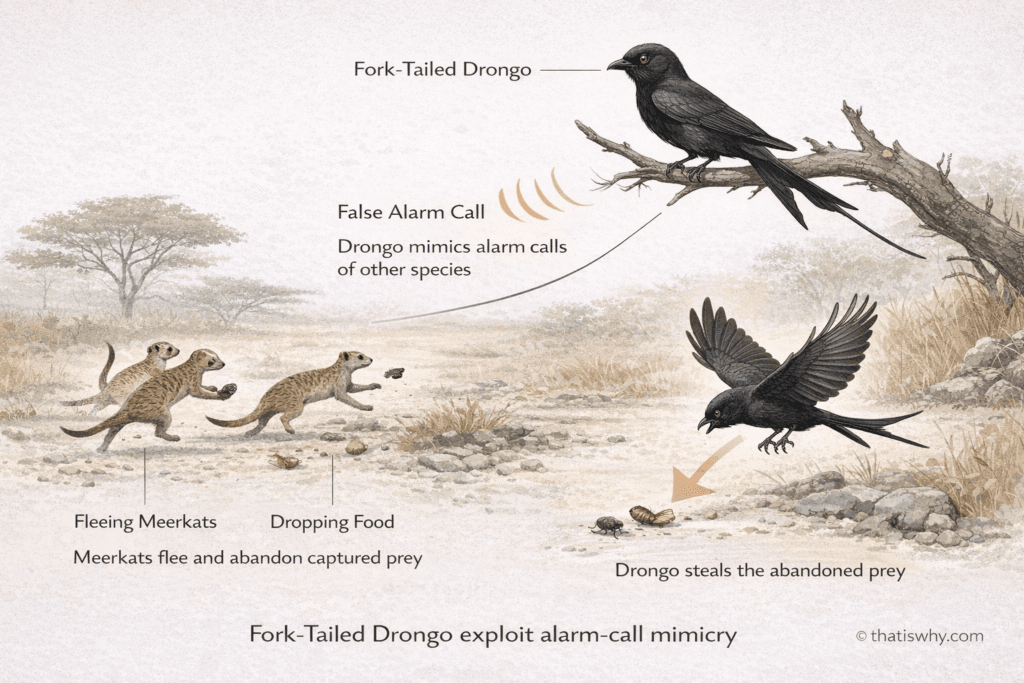
Why does the Drongo bird mimic alarm calls? The Fork-Tailed Drongo practices Kleptoparasitism (theft by parasitism). It mimics the alarm calls of other species—like Meerkats or Babblers—to trigger a panic response. When the victims flee, they drop their food, and the Drongo swoops in to steal it.
Scientifically, it’s parasitism. But honestly, it’s just a really good con.
Picture the scene. A family of Meerkats is digging for scorpions in the Kalahari. Sitting on a branch above them is a Fork-Tailed Drongo.
At first, this looks like a great team. The bird acts as a lookout. It scans the sky for eagles and screams when danger is near. The Meerkats trust it with their lives.
But that trust is exactly what the bird is banking on. A Meerkat finally digs up a massive, juicy scorpion. There are no eagles in the sky. The coast is totally clear.
Suddenly, the Drongo screams: “EAGLE! RUN!”
The Meerkat doesn’t check; it panics. It drops the food and sprints for the hole. The Drongo swoops down, steals the scorpion, and eats it.
There was no eagle. The bird lied. It is the only animal in the world that has turned “Fake News” into a survival strategy.
The Corrupt Security Guard
To understand why the Meerkats put up with this, you have to realize they are in a hostage situation.
The Drongo is basically a Corrupt Security Guard.
Imagine you hire a guy to watch your bank. He’s incredible. He spots robbers from a mile away. He saves your life every single day. You trust him.
But on payday, he gets greedy. He pulls the fire alarm himself. While you run outside screaming, he walks into the vault and grabs a stack of cash.
Do you fire him? No. Because tomorrow, the real robbers are coming back, and you need him on the wall.
The Meerkats are stuck. The Drongo is an honest sentry 90% of the time. He builds up a massive line of credit with the community, just so he can cash it in for a stolen scorpion whenever he feels like it.
The Inside Job
Scientists call this Kleptoparasitism. But let’s call it what it is: An inside job.
The Drongo doesn’t just scream at random. He has the patience of a sniper. He watches the Meerkats digging for hours. He ignores the small change—the beetles and tiny grubs. He waits for the exact moment a Meerkat pulls up the big money—a fat gecko or a scorpion.
Only then does he trigger the alarm.
He is weaponizing their reflexes. Meerkats live in a world where hesitation means death. If they hear the alarm, they don’t stop to ask questions; they run. The Drongo uses their own survival instinct against them, forcing them to drop the loot so he can swoop in and collect.
Identity Theft
If the story stopped there, the Drongo would just be a crooked cop. But what happens next proves he is a criminal mastermind.
Eventually, the Meerkats get suspicious. If the security guard pulls the alarm too many times, the staff stops believing him. They start ignoring the siren.
Most animals would give up here. But the Drongo has a backup plan.
He steals a new ID badge.
The Drongo is a master impressionist. It can mimic the alarm calls of over 50 different species, including the Meerkats themselves.
So, when the Meerkats stop responding to the “Drongo Alarm,” the bird reads the room. He switches tactics. He mimics the specific, high-pitched warning bark of a Meerkat sentry. Suddenly, the Meerkats aren’t hearing the corrupt guard; they are hearing their own manager screaming “DANGER!”
They panic all over again. By constantly forging new identities, the Drongo keeps the con running long after a lesser thief would have been fired.
The Intelligence of the Lie
This behavior brings up a massive question in biology: Does the bird know it is lying?
Usually, we assume animals are just robots running a program. They repeat a sound because evolution wired them to do it.
But the Drongo challenges that assumption. The fact that it switches voices only when the first lie fails suggests something deeper. It isn’t just repeating a script. It is monitoring the audience. It understands that “Voice A stopped working, so I need to try Voice B.”
This suggests the bird has a Theory of Mind, it understands that the Meerkat has a perspective, and that perspective can be manipulated. It isn’t just reacting to the world; it is actively shaping how other animals see it.
Hero or Villain?
It’s easy to look at the Drongo and see a villain. But the truth is more complicated.
Myth #1: “The Drongo is just a bully.” He steals food, so he must be bad, right?
The Truth: He is actually a hero… 90% of the time. Without the Drongo’s honest warnings, many more Meerkats would be eaten by eagles. The stolen scorpions are just the “tax” the Meerkats pay for the service. It’s a protection racket, sure, but it keeps them alive.
Myth #2: “Meerkats are stupid.” Why don’t they just check the sky before running?
The Truth: Because checking takes time. If you take 1 second to look up, and there is an eagle, you are dead. Evolution has wired Meerkats to prioritize speed over verification. The Drongo isn’t tricking a stupid animal; it is exploiting the safety protocols of a smart one.
The Value of a Lie
We all grew up with the fable of The Boy Who Cried Wolf. The moral was simple: “If you lie, no one will trust you.”
The Drongo read that story and learned a completely different lesson. It learned that honesty is just currency. If you tell the truth 90% of the time, you build up enough credit to get away with the lie when it really counts. And if they stop believing you? You don’t apologize. You just change your voice and lie again.
Humans invented the fable to teach kids about integrity. The Drongo used it to invent a business model. And honestly? In the harsh economy of the Kalahari, business is booming.
How We Researched This
To understand this con artist, we looked at the field studies of Dr. Tom Flower from the University of Cape Town. He spent over 800 hours in the Kalahari Desert observing these interactions. His 2014 study in Science Magazine was the breakthrough that documented the Voice-Switching behavior, proving that Drongos actively change their strategy based on the victim’s response.
But we knew that just citing behavioral studies isn’t helpful. Our real job began when we asked, “What does this feel like?” That question led us to the “Corrupt Security Guard” analogy—a simple story to make the complex dynamic of trust and betrayal feel intuitive.