Why the Orchid Mantis Out-Blooms Nature
The Flower That Bites
Does the Orchid Mantis mimic a specific flower? No. Research shows the Orchid Mantis (Hymenopus coronatus) mimics a “generic” flower pattern rather than a specific species. By combining the pink-and-white coloration of nectar-rich blooms with petal-shaped legs, it acts as a “super-normal stimulus,” attracting pollinators even more effectively than real orchids.
That is the science. But visually, it is pure magic.
Look at a photo of this insect. It doesn’t look real. It looks like something a Disney animator designed. Its legs are flattened into heart-shaped petals. Its body is creamy white with perfect gradients of pink. It is arguably the most beautiful insect on the planet.
If you were hiking in Southeast Asia, you’d probably stop to take a picture. But if you were a bee, you wouldn’t just look. You’d dive straight for it, expecting the best meal of your life.
And that would be the last mistake you ever made.
We usually think of camouflage as a way to hide—like a stick bug blending into a twig. But the Orchid Mantis isn’t hiding. It is doing something way more aggressive. It isn’t trying to blend in; it is trying to be the center of attention.
The Forbidden Candy Bar
To understand why a bee would be stupid enough to land on a predator, you have to understand a glitch in the brain called Super-Normal Stimulus.
Basically, the Orchid Mantis is a Giant Candy Bar.
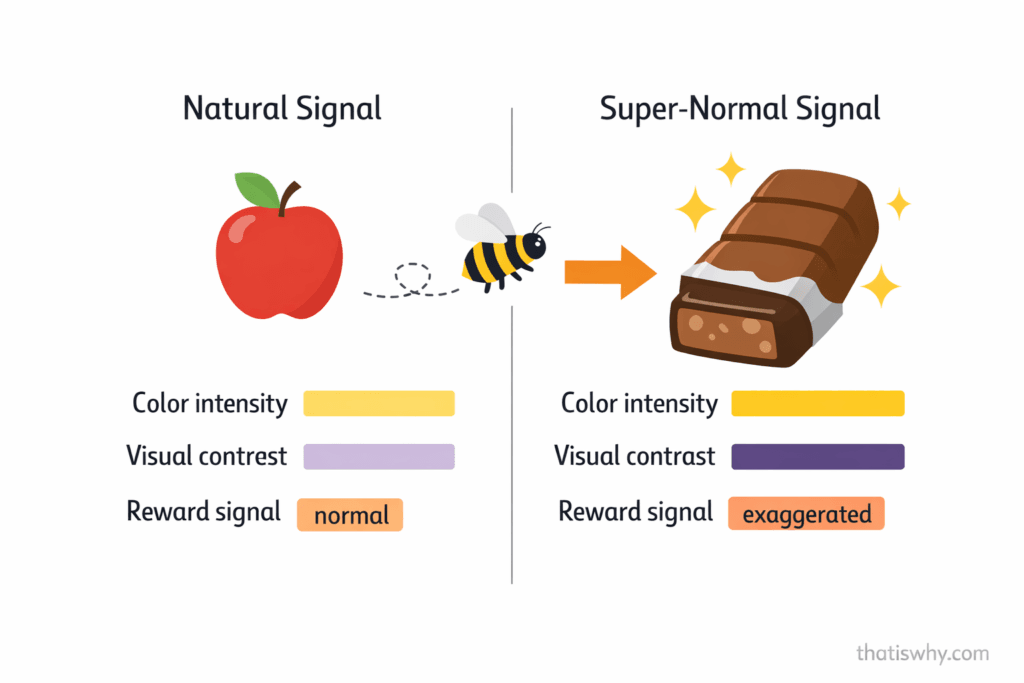
Imagine you are starving. On one table, there is a bowl of apples. They are healthy, natural, and fine. On the other table, there is a giant, glowing, triple-chocolate cake.
You know you should eat the apple. But your brain is hardwired to seek sugar. The cake is an artificial exaggeration of everything you want. It hits your dopamine triggers harder than nature ever intended. You ignore the apple and grab the cake.
That is exactly what the bee is doing. The mantis isn’t just copying a flower; it is exaggerating it. It is brighter, pinker, and bigger than the real orchids next door. It exploits the bee’s brain by offering a signal that is “more flower than a flower.” The bee flies right past the real nectar to land on the killer, simply because the killer looks tastier.
The Pure Chocolate Essence
For decades, scientists argued about which specific flower the mantis was copying. They were looking for a match that didn’t exist.
In 2013, researcher James O’Hanlon realized they were asking the wrong question. The mantis isn’t mimicking like the Spider-Tailed viper, a specific brand of flower. It is mimicking the universal signal for nectar.
Think of it this way: If you are craving chocolate, you don’t really care if it’s Swiss or Belgian. You just want the cocoa. The mantis has evolved to be “Pure Chocolate.” Its legs are shaped like generic petals, and its body reflects UV light exactly like a nectar-rich bloom. It is a “General Average” of everything a bee loves.
By not mimicking one specific orchid, the mantis ensures that every bee in the forest thinks it looks delicious. It is the universal candy bar.
The Green Leaf Trick
Here is the part that proves this mantis is a genius.
If you were pretending to be a flower, where would you sit? Probably in a flowerbed, right? You’d want to blend in. Wrong.
Researchers found that Orchid Mantises almost never sit on flowers. They sit alone, right in the middle of green leaves.
This is a brilliant marketing move. If the mantis sat on a pink orchid, it would just be one more petal in the crowd. It might blend in too well. But by sitting on a green leaf, it creates massive Contrast. It pops against the background like a billboard in a desert. It clears the stage, ensuring that it is the only “flower” the bee sees for miles.
The Razor-Blade Wrapper
The beauty of the Orchid Mantis is hypnotic, but the mechanics are brutal.
When the bee comes in for a landing, it thinks it has found the ultimate sugar rush. It expects soft petals, sweet nectar, and a reward for its hard work. Instead, the candy bar bites back.
The strike happens faster than the human eye can track. The mantis snatches the bee out of the air before its feet even touch the “petals.” Those delicate, heart-shaped legs are actually lined with jagged spines that clamp shut like a bear trap.
It is the ultimate betrayal. The bee dies thinking it found the perfect meal, never realizing that it was the meal all along.
We Are The Bees
Before you judge the bee for falling for a fake flower, look in the mirror. We fall for “Super-Normal Stimuli” every single day.
Fast Food : Processed food is engineered to be “hyper-palatable”—sweeter, saltier, and fattier than anything found in nature. We skip the apple for the burger because our brains are hacked by the exaggerated signal. We are literally choosing the neon candy bar over the real food, just like the bee.
Social Media : We see it in beauty filters. We are attracted to faces that are smoothed and symmetrized beyond reality. We prefer the digital “Super-Normal” image over the real human face. We are falling for the same trick as the fly—chasing a perfection that doesn’t actually exist.
The Killer Fairy
Because it looks like a flower, people assume this insect is gentle. Let’s correct that.
Myth #1: “It eats flowers.” The name is confusing.
The Truth: It doesn’t eat orchids; it eats the things that love orchids. It is a carnivore. It protects the plant by eating pests, but it also eats the pollinators. It’s a mixed blessing for the garden.
Myth #2: “It is peaceful.” It looks like a fairy from a children’s book.
The Truth: It is a cannibal. If you put two Orchid Mantises in a cage, you will soon have one very fat Orchid Mantis. The females are also notorious for eating the males during mating. The “Femme Fatale” vibes are strong with this one.
Dressed to Kill
When you look at the Orchid Mantis, you are seeing one of nature’s most confusing paradoxes.
It is a creature built for violence, yet it is dressed in the universal symbol of peace. It is a stone-cold killer wearing a ballgown.
But that contradiction is the point. The beauty isn’t there for us to admire. It’s there to exploit the deepest, most primal hunger of a bee. It reminds us that in nature, “beauty” is rarely just decoration. Usually, it’s the most dangerous weapon in the arsenal.
How We Researched This :
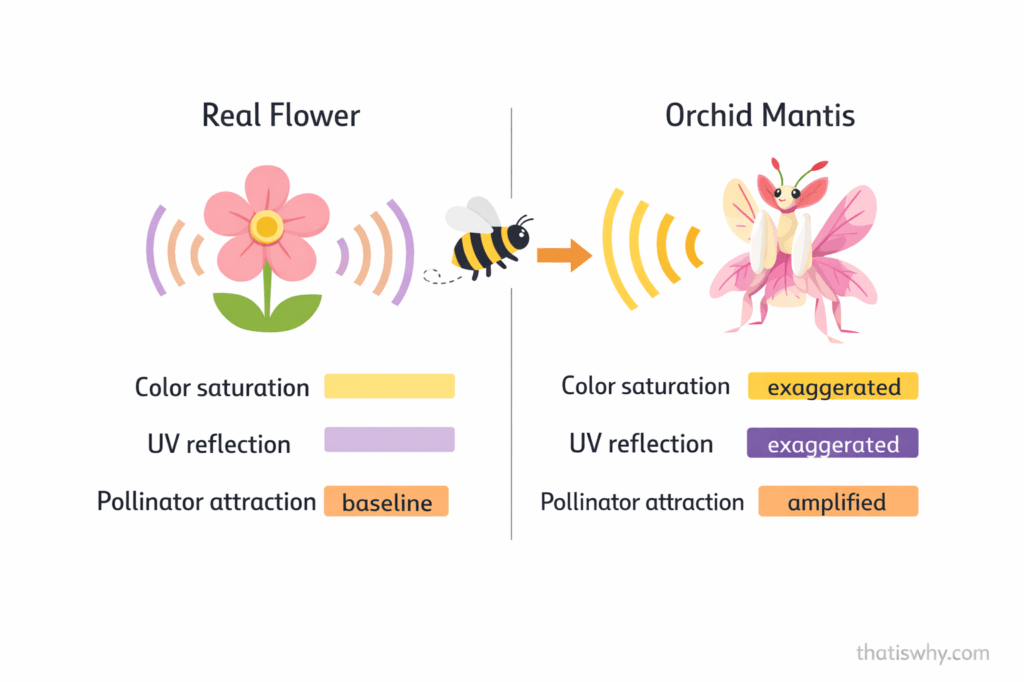
To get the real story, we looked at the groundbreaking behavioral studies of James O’Hanlon from Macquarie University. His 2013 study was the first to systematically prove that the mantis is a Super-Normal Stimulus, attracting pollinators at a higher rate than real flowers.
But we knew that just citing behavioral studies isn’t helpful. Our real job began when we asked, “What does this feel like?” That question led us to the “Candy Bar” analogy—a simple story to make the complex concept of hyper-attractive biological signals feel intuitive.