Why Some Trees Have Needles
It comes down to engineering for survival. While broad leaves are efficient solar panels, needles are specialized adaptations designed to minimize water loss. Their thin, cylindrical shape drastically reduces surface area to prevent dehydration in dry winter air, while a thick waxy coating seals moisture inside.
Most of the tree, the Maples, Oaks, and Birche are smart. They know they can’t win against this environment, so they quit. They drop their leaves, shut down the factory, and go into a deep sleep.
Then, you have the Pine tree.
Why would any living thing try to survive a winter desert by keeping its leaves on?
The answer is that the Pine tree isn’t playing by the same rules. It hasn’t just adapted to the cold; it has engineered a way to cheat the physics of winter. We need to stop looking at pine needles as just “pointy leaves” and start seeing them for what they really are: high-performance, weather-proof machinery.
The Wet Towel Theory
To understand why the needle design is so brilliant, we first have to look at the fatal flaw of a standard leaf.
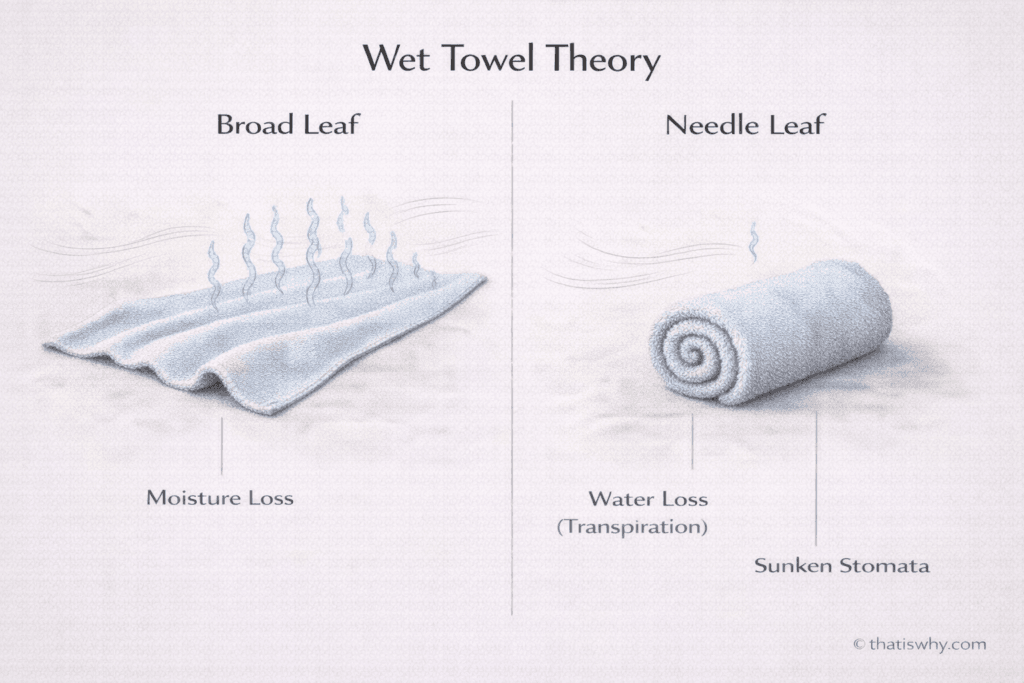
I want you to picture a soaking wet beach towel.
If you take that towel and spread it out flat on the hot sand, what happens? It dries out in twenty minutes. By spreading it out, you’ve maximized the surface area exposed to the sun and wind. This is exactly how a broad leaf works. A Maple leaf is basically a big, flat sheet designed to catch as much solar energy as possible.
But in winter, that massive surface area is a liability. The dry air acts like a vacuum, sucking the moisture out of the leaf faster than the tree could ever replace it.
Now, imagine taking that same wet towel and rolling it up tight into a hard cylinder.
Suddenly, the game changes. Most of the towel is now hidden on the inside, protected. Only the very outer layer touches the air. You could leave that rolled-up towel in the sun for hours, and if you unrolled it, the inside would still be damp.
This is essentially what a pine needle is.
It is a leaf that has been “rolled up” to minimize its exposure to the elements.
It’s a perfect example of the Surface-to-Volume Ratio in action. The material—the leaf tissue—is exactly the same, but the geometry changes how it interacts with the world. By tightening up its shape, the tree protects its water reserves.
Now, obviously, a towel isn’t a perfect comparison. A towel is dead cotton, while a needle is living tissue that still needs to do work. But the principle remains the same: to save water, you have to hide your surface.
The Broadleaf Problem: Solar Panel vs. Liability
To really appreciate the genius of the pine tree, you have to look at what its neighbors are doing. During the summer, broadleaf trees are the “Fast and Cheap” engineers of the forest, designed to capture massive amounts of energy and pump water through their systems like a firehose.
But when winter hits, those assets turn into huge liabilities.
Remember our flat, wet beach towel? In the summer, spreading it out is great for drying off. But in winter, the environment changes drastically. Winter isn’t just cold; winter is a desert. When the ground freezes, the water in the soil locks up as ice. The tree can’t drink. Meanwhile, the air becomes incredibly dry and windy, acting like a vacuum trying to suck every drop of moisture out of the plant.
If a Maple tree kept its “flat towels” hanging out in January, that dry air would pull the water out of that massive surface area in hours. The tree would literally freeze-dry. That’s why they cut their losses, drop their leaves, and go dormant. It’s not just a nap; it’s a desperate financial decision to avoid bankruptcy.
The Needle Solution: Engineering for Survival
Conifers took a different evolutionary path. They decided they wanted to keep the factory running year-round. To do that, they had to engineer a “leaf” that acted less like a delicate solar panel and more like a weather-proofed, low-drag pipe.
We already talked about rolling up the towel to hide the surface area, but the tree takes that concept a step further.
Imagine taking our rolled-up towel and dipping the whole thing in candle wax.
That is exactly what a pine needle does. If you’ve ever touched one, you know it feels hard, slick, and almost plastic-like. That’s because it is coated in a heavy-duty layer of wax called the cuticle. It creates a literal seal. Even if the dry wind howls around the needle, that waxy layer keeps the moisture locked deep inside the roll.
They even get clever with their breathing. Leaves have tiny mouths called stomata to let air in. On a broad leaf, these are right on the surface. On a pine needle, the tree buries these valves deep in microscopic pits—like hiding the fabric deep inside the folds of the towel—so the wind blows right over the top without stealing the moisture.
The Snow Load Factor
There is another massive structural risk in winter that we often forget: Weight.
Have you ever tried to hold a shovel full of heavy, wet snow with your arm fully extended? It’s exhausting. Now imagine being a tree branch holding thousands of those “shovels.”
If a Maple tree kept its flat leaves, they would act just like that flat towel laid out on a clothesline during a blizzard. It would catch every single snowflake. The weight would accumulate until the branches would break off, causing catastrophic injury to the tree.
The needle is an aerodynamic masterpiece.
Because it is “rolled up” tight, it offers almost no resistance. It’s like hanging a rope on the clothesline instead of a sheet. When snow falls on a pine branch, it sifts right through the gaps between the needles. If the snow does land, that waxy coating helps it slide off immediately. This “low-drag” design allows Conifers to keep their foliage all winter without crumbling under the load.
The Trade-Off: The Tortoise and the Hare
If this design is so superior—if it’s weather-proof, snow-proof, and drought-proof—why doesn’t every tree have needles?”
It’s a fair question. Why would anyone choose to be a fragile Maple when you could be an armored Pine?
The answer lies in the classic fable of The Tortoise and the Hare.
You see, biology is a zero-sum game. You never get something for nothing. By rolling that leaf up into a tight needle, the Conifer gains incredible protection, but it pays a steep price in efficiency.
Remember, a leaf is basically a solar panel. By reducing its surface area to hide from the wind, the Pine tree also hides from the sun. It simply can’t capture as much energy as a big, broad Oak leaf.
The Broadleaf trees are the “Hares.” These are the high-stakes gamblers of the forest. They build massive, fragile surface areas to catch maximum sun. They grow explosively fast in the summer, racing to the top of the canopy. But the moment the weather turns, they have to fold. They shut down completely for five or six months.
The Conifers are the “Tortoises.” These guys play the long game. Because their needles are inefficient, they grow slowly. But because they are evergreen, they are ready to work the instant conditions allow.
On a random sunny Tuesday in February, while the Maple is still essentially a stick in the mud, the Pine tree is awake. It’s photosynthesizing. It’s sipping sunlight. It wins the race not by being fast, but by being stubborn, steady, and tough.
The Universal Rule of Geometry
This isn’t just about trees. You’ve just stumbled onto one of the fundamental rules of the universe. It’s called The Surface-to-Volume Ratio.
We and nature manipulate this ratio constantly to control how things interact with the world. It’s a sliding scale between Exchange and Protection.
Do you want to exchange energy fast? You maximize surface area. That’s why the radiator in your car has hundreds of thin metal fins—to dump heat as fast as possible. That’s why your intestines are folded back and forth—to absorb food quickly. This is the “Broadleaf Strategy.”
Do you want to conserve energy and stay safe? You minimize surface area. You roll up. This is why oil pipelines are cylinders. This is why polar bears curl into a tight ball when they sleep in a blizzard. They are essentially turning themselves into a pine needle to survive the cold.
Seeing the Pattern
This “Geometry of Survival,” isn’t limited to the forest; it’s seemingly everywhere.
You can see it right in your living room. Watch your cat. When it’s hot, what does it do? It stretches out long across the floor—the classic “Long Cat”—maximizing its surface area to dump heat. But when it’s cold, the behavior flips. It curls into a tight, compact “loaf,” tucking in its paws and tail. Your cat is instinctively minimizing its surface area to keep heat in, using the exact same physics as the pine needle.
Nature applies this rule in the desert, too. Have you ever wondered why cacti have spines? A spine is actually just a leaf that has been “rolled up” even tighter than a pine needle. The cactus faces a different enemy—scorching heat instead of freezing cold—but the strategy is identical. It sacrifices photosynthesis to stop water loss.
Even we humans copy this design. Look at the cabins in a snowy ski town. They almost always have steep, A-frame roofs designed to shed snow instantly, just like the tip of a spruce tree. If we built flat roofs—like a broad leaf—they would collapse under the weight of the first blizzard.
Busting the Evergreen Myths
Before we head back inside, let’s take a moment to set the record straight on a couple of rumors that tend to follow these trees around.
There is a common misconception that needles aren’t “real” leaves. I know they look like plastic bristles, but biologically, a needle performs the exact same function as a maple leaf—photosynthesis. It’s just wearing a heavy-duty, weather-proof outfit to do the job.
Also despite the name “Evergreen,” these trees absolutely do lose their leaves. If you look at the ground under a pine tree, you’ll see a carpet of brown, dead needles. The difference is that they don’t drop them all at once like a Maple or Oak.
A pine needle might live for two, three, or even ten years, but eventually, it gets old and falls off. The tree just replaces them gradually, so it never looks naked. Think of it as a continuous rotation rather than a seasonal shutdown.
The Silent Survival Machine
Next time you’re out in the cold and you see that dark green conifer standing against the white snow, don’t just see a tree. See a survival machine.
See the “rolled-up towels” resisting the dry wind. See the aerodynamic engineering shedding the heavy snow.
While the rest of the forest has retreated, the Conifer is standing its ground, using simple geometry to defy the winter. And because of that incredible structural strength, these trees can achieve massive scale—some becoming the absolute giants of the forest. (But that’s a story for [Why Do Trees Grow Tall?]).
How We Researched This :

To get to the bottom of the pine tree’s survival strategy, we started by digging into standard botany textbooks like Raven Biology of Plants to understand the specific anatomy of gymnosperms—specifically the “xerophytic” (dry-environment) adaptations like the waxy cuticle and sunken stomata. We also looked at engineering studies on “drag coefficients” to understand how cylindrical shapes interact with wind and snow loads compared to flat surfaces.
But simply listing biological terms like “transpiration rates” and “stomata,” we knew that just isn’t helpful. Our real job began when we asked, “What does this feel like?” That question led us to the “Wet Towel” analogy—a simple story to make the complex physics of surface-to-volume ratio feel intuitive.