Why Do Leaves Have Different Shapes
It isn’t random; it is a precise calculation involving thermodynamics and aerodynamics. A solid, round leaf would act like a sail in the wind and trap a layer of stagnant hot air (the Boundary Layer) against its surface, cooking the plant cells. Trees evolved lobes, teeth, and holes to create turbulence, disrupting this hot air and allowing wind to pass through, while sun leaves and shade leaves differ in shape to maximize light capture at different heights.
If you gave a engineer a blank sheet of paper and asked him to design the perfect solar panel, he would draw a circle.
It does makes sense, circle is geometry’s masterpiece. It packs the maximum amount of surface area into the smallest possible perimeter. It is pure efficiency. So, if a tree’s only goal was to catch sunlight, every single leaf in the forest should be a perfect, solid green dinner plate.
We just assumed this was nature being artistic. It’s wrong : leaf shape isn’t about art; it’s about survival physics.
You have to remember that a leaf isn’t just a pattern; it is a factory. And that factory has to operate in a hostile environment, battling two invisible enemies that are constantly trying to destroy it: Heat and Wind.
If a tree actually used that “perfect” circular design, it would be a disaster. The leaf would cook itself to death in the sun or get torn to shreds in the first storm. To understand why, we have to stop looking at the leaf and start looking at the invisible air surrounding it.
The Hot Potato Strategy
To understand why a simple round leaf is a bad idea, we need to talk about cooling.
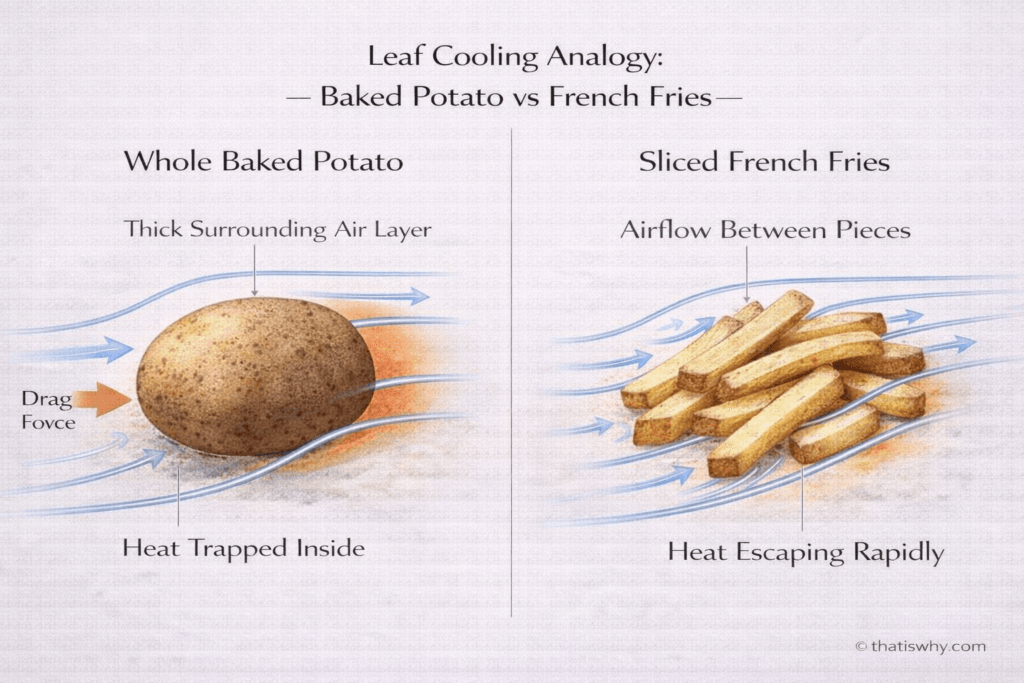
Imagine you just cooked a massive, whole baked potato. You take it out of the oven and set it on the counter. It stays hot for an incredibly long time, right? The center remains molten lava for twenty minutes because the heat is trapped inside.
Now, imagine you took that same potato and sliced it up into thin French fries. Which one cools down faster?
The fries. Obviously. But ask yourself why.
It isn’t just because the fries are smaller pieces. It’s because the air can flow around and between the individual fries, stripping the heat away efficiently. The big potato creates a block. Air gets stuck around it, acting like a warm blanket that insulates the heat.
This is exactly what happens with leaves.
In physics, there is a concept called the Boundary Layer. It turns out, air is actually “sticky.” When wind hits a large, flat surface—like a big round leaf—it doesn’t just flow smoothly over it. Friction makes the air slow down and cling to the surface.
This creates a thick blanket of stagnant, dead air that sits right on top of the leaf.
This blanket is a killer. It traps heat. On a sunny day, a large, solid leaf acts exactly like that hot baked potato. It can’t shed heat because that layer of still air insulates it. The internal temperature spikes, and the solar factory essentially cooks itself.
The solution? You have to turn the potato into fries. You have to cut the leaf up.
The Thermodynamics: Don’t Cook the Factory
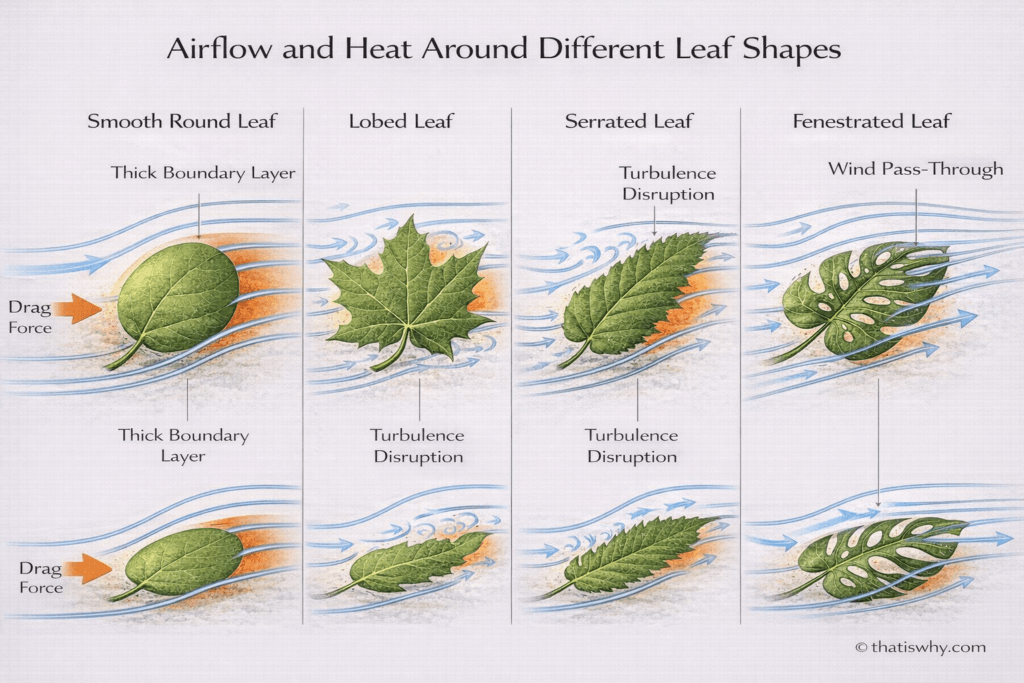
This simple physics problem explains why so many leaves—especially those in hot climates or at the very tops of trees—have those deep lobes (like an Oak) or jagged teeth (like a Cherry tree).
Essentially, the tree is taking its “baked potato” and turning it into “fries.”
We tend to look at these shapes and think they are just decoration, but they are actually turbulence generators.
When the wind hits the jagged edge of a serrated leaf, it trips. It creates tiny swirls and eddies of air. These swirls act like miniature tornadoes that break up that stagnant Boundary Layer. It’s exactly like blowing on a hot spoonful of soup to cool it down—you are using turbulence to strip the heat away.
By simply disrupting the airflow—by cutting the potato into smaller strips—a jagged leaf can shed heat 40% to 50% faster than a smooth, round leaf.
So, when you see those deep cuts in an Oak leaf, don’t just see a pretty shape. See a radiator. The tree has engineered a way to cool its engine using nothing but geometry.
The Aerodynamics: Surviving the Storm
But heat isn’t the only enemy. The other killer is drag force.
A large, solid leaf acts exactly like a sail on a ship. It catches the wind, great if you’re a sailboat, but if you’re a tree anchored to the ground, it’s a liability. In a 40 mph storm, all that force is transferred straight down the stem to the branch. If the drag is too high, the branch snaps, and the tree loses a limb.
This is where the engineering come in.
Those same cutouts that help cool the leaf also drastically reduce the “Drag Coefficient.” They act as vents, letting the wind slip through the gaps rather than pushing against the flat surface.
The most extreme example of this is the Monstera plant—the “Swiss Cheese Plant” you see in every trendy coffee shop. It has actual holes punched right through its leaves. That isn’t a bug; it’s a feature called “fenestration.” Monsteras evolved in tropical hurricane zones. Those holes are literal escape hatches for the wind. They allow the plant to build huge solar panels that won’t turn into kites and fly away during a tropical storm.
The Sunlight Economy: The Self-Shading Problem
Here is where the tree gets really smart. It doesn’t just pick one shape and stick with it.
If you look closely at a single large tree—like an Oak or a Maple—you might notice something strange. The leaves at the top look different from the leaves at the bottom.
Biologists call this “Phenotypic Plasticity.” let’s call it “Budgeting.”
The tree is actually changing its architectural blueprints floor-by-floor to match the local conditions.
The leaves at the very top—the “Penthouse” leaves—are the high-rollers. They get blasted by full sun and high wind. Because they are at risk of overheating, the tree builds them small, thick, and with deep lobes (think “extra-crispy fries”). These deep cuts serve a double purpose: they shed heat, and crucially, they let light pass through the gaps to the leaves below.
Down at the bottom branches, it’s a different world. It’s dark, cool, and calm. These leaves don’t need to worry about overheating. They are starving for light. So, the tree builds them large, thin, and flat—almost like solid plates. They are designed to catch every stray photon of light that filters down through the canopy.
Seeing the Physics Everywhere
Once you understand that leaf shape is just a solution to a physics problem, you start seeing these solutions everywhere.
Look at a leaf from a tropical rainforest. It almost always has a long, pointy, downturned tip. Why? Because warm, standing water is a breeding ground for fungus and bacteria. That tip is a funnel designed to shed water instantly after a rainstorm. It’s a self-drying mechanism.
Or look at the desert. In the absolute hottest environments, even a lobed leaf acts too much like a “hot potato.” So, the Cactus took it to the extreme. It reduced the leaf to a non-existent sliver—a spine. It gave up on being a solar panel entirely just to solve the heat problem. We cover this extreme engineering in Why Some Trees Have Needles.
Myths vs. Physics
Let’s take a second to clear up a few rumors that tend to follow these trees around.
Myth: The “teeth” on a leaf are just there to look scary to bugs.
Truth: They are actually metabolic “jump starters.”
It turns out, those jagged edges aren’t weapons; they are engines. Scientists have found that photosynthesis starts earlier in the teeth than in the rest of the leaf. The tips of the serrations are capable of ramping up sap flow and “waking up” first on cold spring mornings. A serrated leaf is effectively a car with a high-performance starter motor—it gets the factory running faster after a cold night.
Myth: Leaf shape is just random decoration.
Truth: Every shape is a calculated compromise.
Nature doesn’t do art for art’s sake. A tree never designs a shape just to look unique. If a leaf is lobed, it’s fighting heat. If it has holes, it’s fighting wind. If it’s broad and flat, it’s fighting for light in the shade. The shape isn’t a fashion statement; it is the physical result of an evolutionary equation balancing Heat vs. Light vs. Drag.
Aerospace Engineering in the Park
So, when you are walking through a park tomorrow, pick up a fallen leaf.
Don’t just look at it as a piece of biology. Look at it as a piece of aerospace engineering.
Run your finger over the teeth that break the wind. Look at the lobes that act as radiator fins. Notice the size and ask yourself if it came from the sunny penthouse or the shady basement.
The tree has spent millions of years calculating the perfect balance between catching the sun and surviving the wind. The result isn’t just beautiful; it’s aerodynamic perfection.
How We Researched This :
To get the physics right, we looked at studies on boundary layer conductance and leaf energy balance equations commonly found in biophysics journals like Plant, Cell & Environment. We specifically looked at the “Vogel efficiency” (named after Steven Vogel) regarding drag reduction in lobed leaves.
We knew that just listing dry equations about “Reynolds numbers” and “viscosity” isn’t helpful. Our real job began when we asked, “What does this feel like?” That question led us to the “Hot Potato” analogy—a simple story to make the complex thermodynamics of heat dissipation feel intuitive.