Why The Solar Salamander Is Impossible
Can animals photosynthesize? No vertebrate animal can perform photosynthesis on its own. However, the Spotted Salamander (Ambystoma maculatum) is the only known vertebrate to have a symbiotic relationship with algae (Oophila amblystomatis) inside its cells. The algae provides oxygen and glucose to the developing embryo, effectively functioning as a biological solar panel.
That is the biological exception. But to understand why it matters, you have to understand the rules.
In biology, there are two main teams. Team Plant: You sit in the sun, eat light, and make your own food. Team Animal: You move around, eat plants, and breathe oxygen.
The rules are strict. Animals do not photosynthesize. We have immune systems specifically designed to destroy any foreign plant matter that tries to invade our bodies.
But there is one animal that broke the treaty. Meet the Spotted Salamander.
If you look at their eggs in a pond, they are glowing, neon green. For 100 years, scientists thought this was just algae growing on the outside. But in 2011, a researcher looked closer and found something impossible. The algae wasn’t on the egg, it was inside the embryo. The salamander had invited the plant into its own cells, creating the world’s first solar-powered vertebrate.
The Live-In Chef
To understand why this matters, you have to look at the economy of the egg.
Most animal embryos are like people ordering takeout. They rely entirely on the yolk for food and the water for oxygen. If the oxygen stops coming, the embryo suffocates.
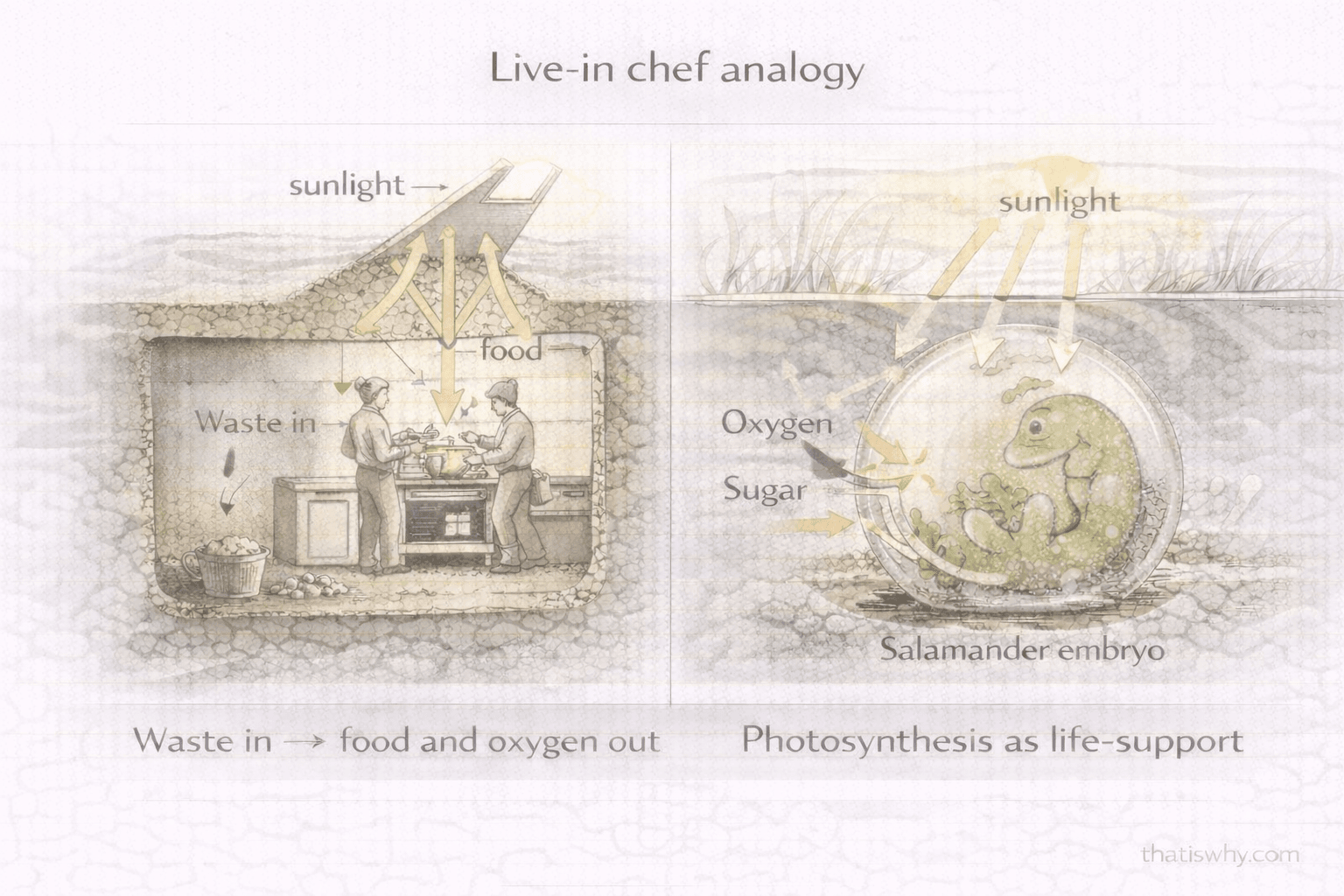
The Spotted Salamander solved this by hiring a Live-In Chef.
Imagine you are trapped in a sealed bunker with no fresh air and a pile of garbage. You are going to die. But then, you invite a chef to move in with you. You make a deal: You give him your trash (Carbon Dioxide and Nitrogen waste), and he takes that trash, cooks it using sunlight, and serves you fresh Oxygen and Sugar.
This is exactly what happens inside the egg. The algae moves into the salamander’s tissues, eats the embryo’s waste, and exhales pure oxygen directly into the salamander’s mitochondria. It is a perfect, self-sustaining loop. The chef gets ingredients; the bunker gets fresh air.
The Impossible Discovery
For decades, we missed this because we assumed it was impossible.
Vertebrates (animals with backbones, like us) have aggressive Adaptive Immune Systems. Our bodies are xenophobic, we are programmed to kill anything that isn’t “Self.” If a plant cell tried to set up shop inside you, your white blood cells would massacre it instantly.
When researcher Ryan Kerney looked at a salamander embryo under a microscope in 2011, he thought he was hallucinating. He saw green cells. But they weren’t on the outside. They were nestled deep inside the salamander’s tissues, sometimes even inside the cells themselves.
The salamander had somehow convinced its immune system to stand down. It had opened the door to a foreign invader and welcomed it home. This was the first time anyone had ever seen a vertebrate farm plants inside its own body. It basically rewrote the biology textbook overnight.
Solar Batteries: How It Works
This partnership isn’t just a novelty; it is a life-support system.
Spotted Salamanders lay their eggs in murky, stagnant vernal pools. These ponds are often choked with rotting leaves and have dangerously low oxygen levels. A normal egg would suffocate in the “bunker.”
But the “Green Eggs” thrive. Because the Chef is working overtime. Studies show that embryos with the algae hatch faster, are larger, and have a much higher survival rate. The algae acts like a Solar Battery, charging the embryo with oxygen during the day when the sun hits the pond. It allows the salamander to grow big and strong in water that would kill a frog.
The Origin Story
This discovery isn’t just about a salamander. It forces us to look at the history of life on Earth.
The Origin of You : Billions of years ago, a single-celled organism swallowed a bacteria and didn’t eat it. That bacteria became the Mitochondria, the power plant that runs every cell in your body today. The Spotted Salamander is re-playing that ancient history. It is showing us how two separate lives can merge into one complex organism.
The Thief vs. The Farmer : There are other green animals, like the Emerald Elysia sea slug. But the slug is a thief. It eats algae and steals the chloroplasts (Kleptoplasty). The salamander is different; it is a farmer. It keeps the whole algae alive. It proves that vertebrate cells are much more flexible than we thought.
Medical Dreams : We struggle to transplant a kidney from another human without the body rejecting it. Yet this salamander accepts an entirely different kingdom of life into its cells. If we could figure out how it turns off the “Reject” signal, it could revolutionize organ transplants.
Green Myths
Let’s clear up a few misconceptions about this partnership.
Myth #1: “Adult salamanders eat sunlight.” We imagine them sunbathing instead of hunting.
The Truth: The solar power is mostly for the babies. Once the salamander hatches, it loses most of the algae. The adult is a normal carnivore that eats worms. It cancels the Chef’s contract the moment it moves out of the bunker.
Myth #2: “It’s a genetic hybrid.” People think it’s a mutant.
The Truth: It’s a landlord-tenant agreement. The algae and the salamander keep their own DNA. They aren’t merging into a new species; they are just roommates with benefits.
Myth #3: “All green eggs are good.” If it glows, it’s healthy?
The Truth: Not always. It’s a delicate balance. If the water gets too warm, the algae can bloom out of control and actually smother the egg. The Chef can take over the kitchen if you aren’t careful.
The Open Door
We like to put nature in boxes. Plants stay in the garden; animals stay in the house.
The Spotted Salamander proves that those boxes are made of cardboard. In the murky water of a vernal pool, the line between “Flora” and “Fauna” dissolves.
The salamander isn’t just an amphibian; it is a walking greenhouse. It reminds us that survival isn’t always about fighting the world or building a fortress. Sometimes, the smartest move is to unlock the door, invite the weird neighbor in, and let him cook dinner.
How We Researched This :
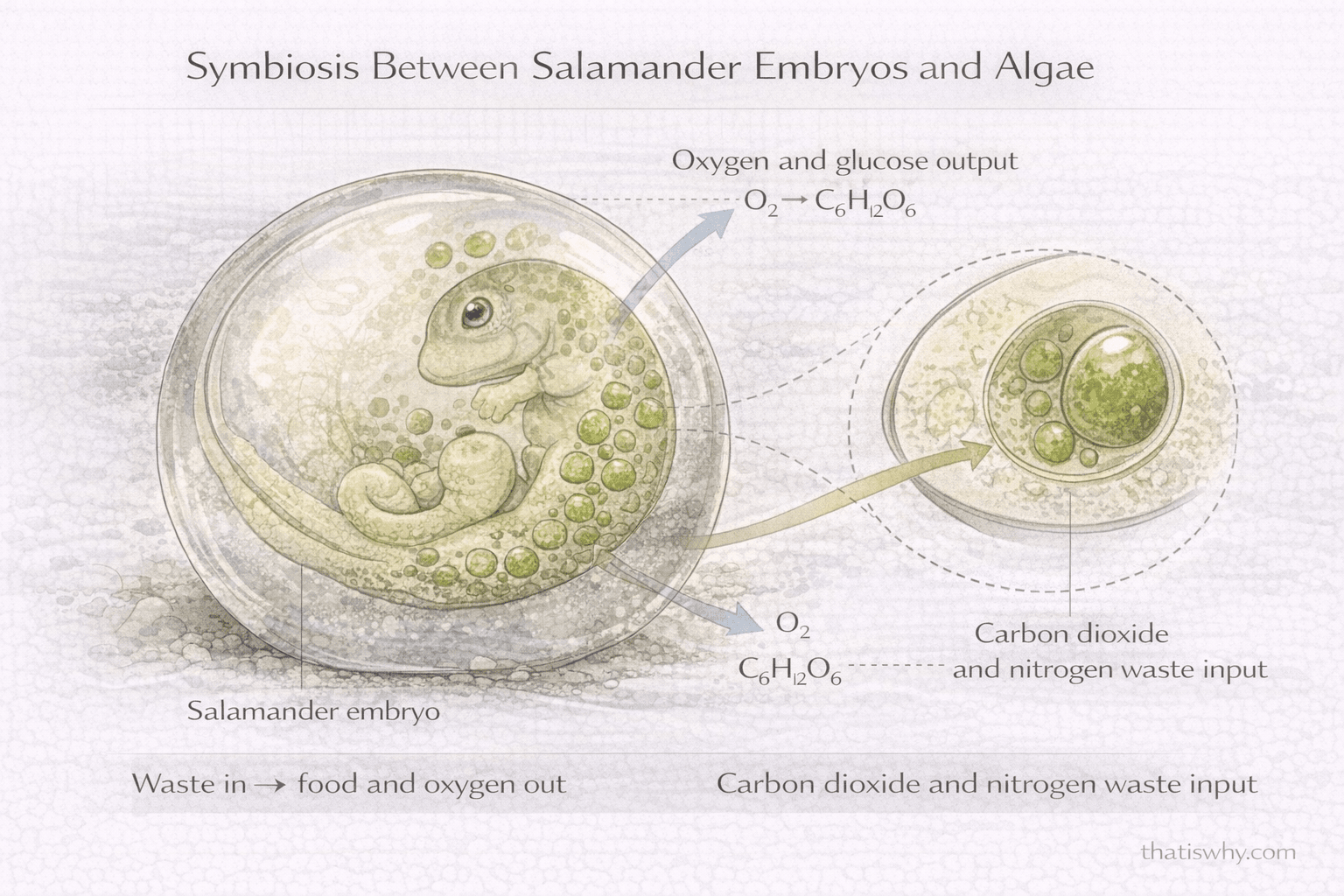
To explain this biological rule-breaker, we examined the 2011 breakthrough study by Ryan Kerney at Dalhousie University. His use of time-lapse imaging and fluorescence microscopy provided the visual proof that the algae was intracellular (inside the cell), not just environmental.
But we knew that just citing microscopy isn’t helpful. Our real job began when we asked, “What does this feel like?” That question led us to the “Live-In Chef” analogy—a simple story to make the complex exchange of waste-for-food that allows life to thrive in a suffocating environment feel intuitive.