Why a Dead Whale Creates a Whale Fall in the Deep Sea – The Abyssal Graveyard
When a whale dies and sinks to the seafloor, it doesn’t simply rot. In a process called a whale fall, its body opens a temporary market in the deepest ocean, one that feeds entire communities for decades before quietly shutting down.
If you were dropped five kilometers below the ocean’s surface, you would land in a place with almost no food, no light, and no way to grow it.
No sunlight no plants and barely any energy at all.
The deep sea is often described as a biological desert, where most life survives on a thin, dusty drizzle of organic debris called marine snow. A few crumbs at a time. That’s it.
Then something extraordinary happens.
A 40-ton whale dies at the surface… and sinks.
In a single afternoon, the abyss receives the equivalent of about 2,000 years’ worth of food, delivered all at once.
That fall doesn’t just add food to the seafloor.
It opens a market—in a place where nothing is usually for sale.
When a Body Becomes a Market
A whale fall isn’t decay. It’s commerce.
Most of the deep sea runs on scarcity. Energy arrives slowly, unpredictably, and in pieces too small to support anything complex. A whale changes that overnight.
When the body hits bottom, it’s like a massive shipment arriving in the middle of nowhere. Everything valuable is suddenly concentrated in one place. For the first time in centuries, there is enough energy to attract crowds, specialists, and systems that don’t normally survive here.
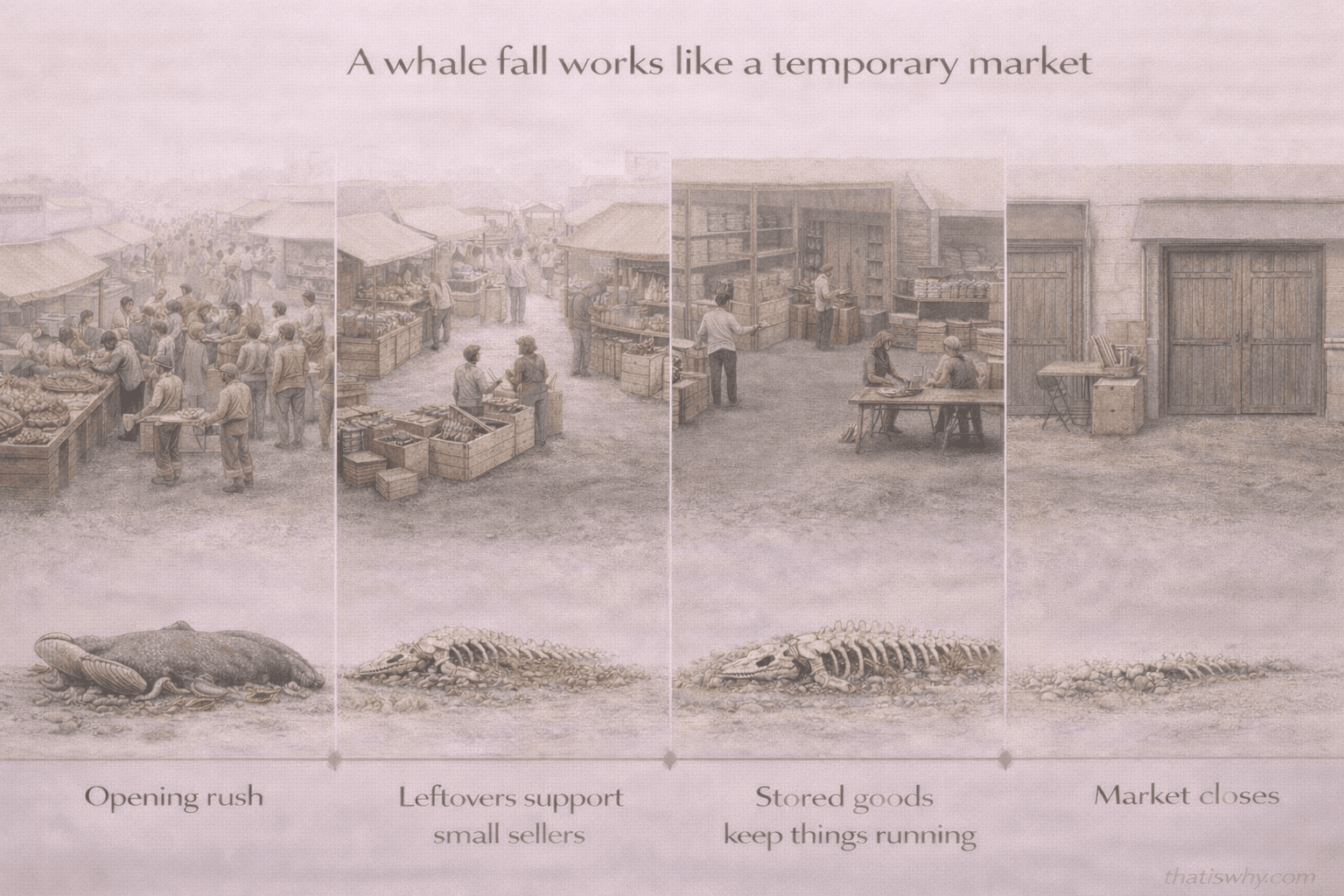
But like any market, it doesn’t unfold all at once.
It opens in phases, it draws different participants over time, and eventually, when the goods are gone, it closes.
Phase 1: The Opening Rush (Months 0–24)
The Mobile Scavengers
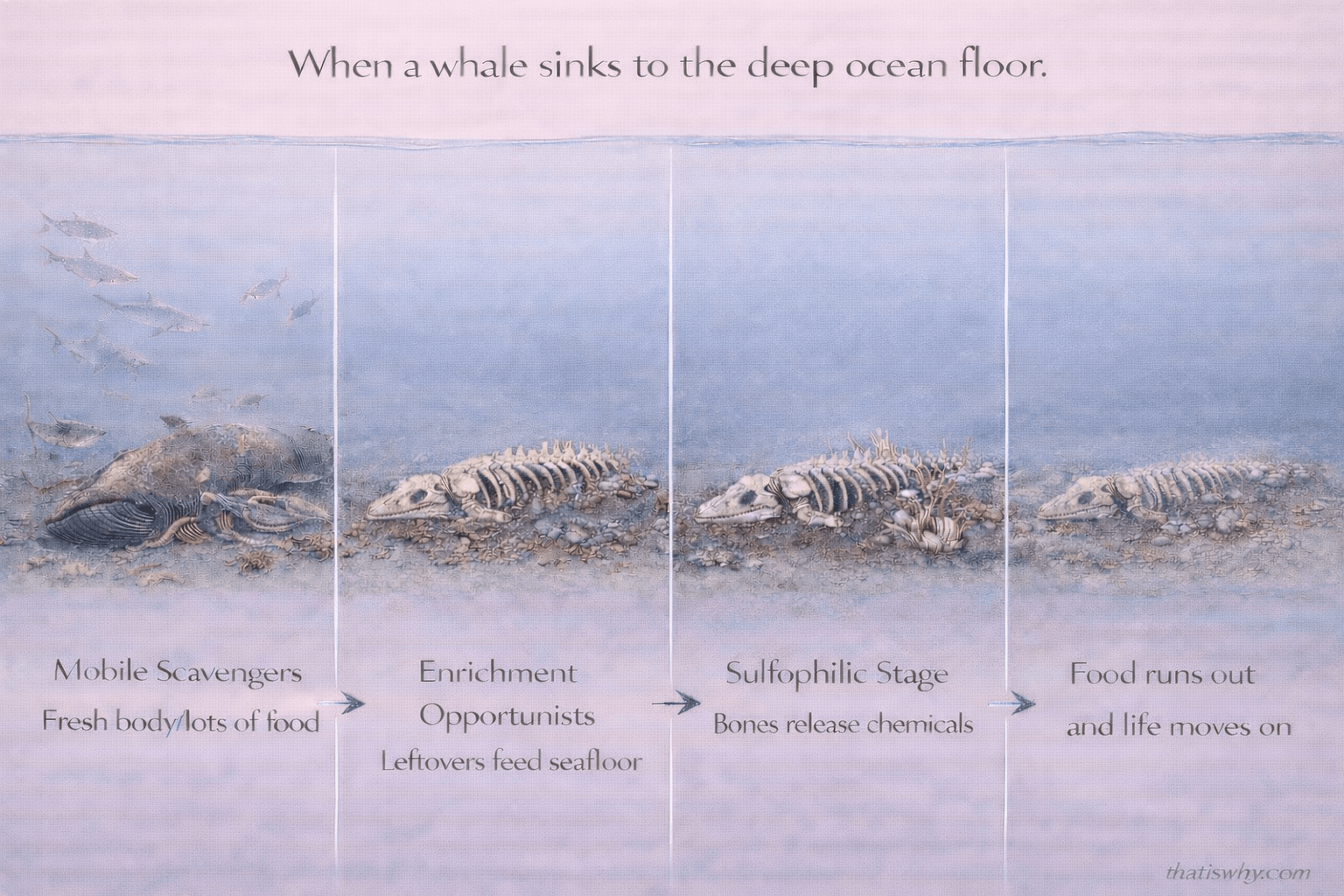
The moment the whale hits bottom, the quiet breaks. The first arrivals aren’t careful buyers. They’re opportunists.
Hagfish force their way into the body, knotting themselves through muscle and blubber as they feed from the inside out. Sleeper sharks circle slowly, taking what they can. Crabs swarm the seafloor beneath the carcass.
This is the market’s opening rush.
Everything exposed is taken immediately. Blubber and muscle disappear as fast as they can be reached. Entire sections of the body collapse inward as they’re hollowed out. In rich whale falls, up to 60 kilograms of flesh can vanish each day, a rate documented by deep-sea researchers observing these events from submersibles operated by institutions like the Monterey Bay Aquarium Research Institute.
There’s no planning here or efficiency just speed. And then, almost as suddenly as it began, the rush ends. The goods are gone and the crowds thin out.
The market doesn’t close, it just changes.
Phase 2: The Side Stalls (Years 2–4)
Enrichment Opportunists Take Over
When the frenzy ends, the whale is no longer being eaten directly. But the energy hasn’t left, it has spilled.
Liquefied fats and organic debris seep into the surrounding seafloor, spreading outward from the skeleton. What was once barren sediment becomes enriched ground, dense with calories but slow to release them.
This is when the smaller stalls open.
Snails, bristle worms, and small crustaceans blanket the area, forming thick mats around the bones. They aren’t tearing into the main body anymore. They’re working the leftovers, processing runoff, recycling what sank, pulling energy from the ground itself.
The market expands beyond its original center. Activity spreads. The footprint grows.
For a few years, this patch of seafloor supports far more life than anything around it—not because something new arrived, but because the original delivery is still being broken down and redistributed.
And beneath it all, the skeleton remains, it’s locked, loaded, and untouched.
Phase 3: The Back-End Economy (Years 4–50+)
The Sulfophilic Stage
By now, the whale no longer looks like food. From above, it’s just bone, ribs collapsed into sediment, vertebrae half-buried. Nothing moves on the surface anymore, but the most valuable goods were never on display.
Deep inside the bones, thick reserves of fat remain sealed away. They don’t rot. They don’t leak freely. They sit there, inaccessible to anything that can’t break bone from the inside.
This is where the market becomes specialized.
Inside the skeleton, bacteria begin breaking down fats without oxygen, releasing hydrogen sulfide, a toxic gas that smells like rotten eggs. In the deep sea, that waste becomes currency.
Chemosynthetic bacteria use the sulfide to build food from chemicals instead of sunlight. Worms and clams gather where that production happens. They don’t roam. They don’t chase meals. They stay put, plugged directly into the supply.
Years pass, then decades, market slows, but it doesn’t collapse. As long as the chemical output continues, the stalls stay open. In the richest whale falls, this back-end economy can operate for half a century, supporting generation after generation of life.
Nothing here is flashy, that’s why it lasts.
Osedax: Breaking Into the Vaults
For decades, the deepest reserves stay locked, then Osedax arrives.
From the outside, it looks harmless, thin red plumes rising gently from the bone, unmoving, but Osedax isn’t browsing the market, it’s targeting the vaults.
The worm anchors itself to the skeleton and sends root-like tissues directly into the bone. Acid softens the mineral barrier. Channels open. Inside those channels, symbiotic bacteria digest fats sealed deep within the skeleton and pass the nutrients back to the worm.
This isn’t scavenging, it’s forced access.
Where the market once relied on slow release, Osedax pulls energy directly from storage. Bones weaken unevenly. Cavities open. Structural collapse begins.
The market doesn’t shut down overnight. It slumps, stalls fail, production slows. Osedax doesn’t end the whale fall quickly : it sets its direction.
A Chain of Markets Across the Abyss
Out in the deep ocean, distance isn’t measured in kilometers.
It’s measured in starvation.
Most of the seafloor is too empty to cross in a single lifetime. But whale falls change that.
Scattered across the abyss, they form a loose circuit. One market is closing while another, far away, is just opening. Species adapted to this way of life move slowly between them, generation by generation, following opportunity rather than location.
Each whale fall is temporary. Together, they form a system.
Without these markets, entire groups of deep-sea organisms would be isolated, cut off by sheer emptiness. With them, movement becomes possible. Networks form. Life spreads.
What This Isn’t
Myth #1: Whale falls are dramatic feeding events.
Truth: The feeding is just the opening rush. The early frenzy is loud and easy to notice, which is why it dominates documentaries and headlines. But like the opening hours of a market, it’s chaotic and short-lived. What shapes the deep sea isn’t that initial crowd—it’s everything that continues operating after the rush has passed.
Myth #2: The deep ocean survives on a steady rain of food from above.
Truth: A trickle can sustain life, but it can’t organize it. Marine snow keeps organisms alive at the edge of starvation, but it never creates structure. Markets don’t form around crumbs. They require bulk delivery and time—resources concentrated enough to attract specialists and stable enough to support long-term activity.
Myth #3: Whale falls are rare accidents.
Truth: They’re expected events in a long-running system. From the surface, a sinking whale looks like chance. From the abyss, it’s part of a pattern. Life here has adapted not to predict these events—but to depend on them when they appear.
Myth #4: Once the bones are exposed, the story is nearly over.
Truth: That’s when the longest phase begins. What remains isn’t waste. It’s storage. The deepest trade happens out of sight, long after the obvious goods are gone.
Myth #5: The end of a whale fall is a failure.
Truth: Closure is built into the system. Markets aren’t meant to last forever. Their value lies in how long they stay open, not in permanence. The deep sea stays connected because markets open and close on staggered timelines.
When the Market Closes
Eventually, the goods run out.
The bones thin. The sealed fats are exhausted. Chemical output slows, then stops. The back-end stalls shut down. The specialists leave or die. The market simply empties.
By the time it closes, it’s almost invisible. But long before that, it has already done its work, feeding crowds, sustaining specialists, and connecting empty places across the seafloor.
What’s striking is how familiar this feels.
We talk about supply chains, storage, slow release, and sustainability as modern challenges. But five kilometers below the surface, those problems were solved long ago. A whale fall does what we’re still learning to do: concentrate resources, distribute them over time, and shut down without waste.
The deep sea doesn’t rely on permanence, it relies on timing. Markets open, Markets close and life moves through them.
How We Researched This
To understand how a whale fall unfolds, we focused on direct observation and established field research, including long-term deep-sea monitoring by the Monterey Bay Aquarium Research Institute (MBARI), classic whale-fall ecology studies by Craig Smith and Amy Baco. For the later stages, we drew on work following the 2004 Science paper that first described bone-eating worms (Osedax) and their use of symbiotic bacteria to dissolve bone and access stored fats.
But listing studies isn’t enough. Our real job began when we asked, “What does this feel like ?” That question led us to the “market analogy“, a clear way to understand how energy arrives in bulk, is redistributed by specialists, and then slowly disappears without waste.