Why The Slime Mold Is Smarter Than An Engineer
Can slime mold solve problems? Yes. Despite having no brain, the slime mold Physarum polycephalum can solve complex spatial problems. It uses “External Memory” (chemical trails) to navigate mazes and “Distributed Intelligence” to optimize its network. In a famous experiment, it recreated the layout of the Tokyo subway system in just 26 hours by connecting food sources with maximum efficiency.
That is the scientific summary. But seeing it happen is humiliating for a human engineer.
Building the Tokyo subway system took us nearly 100 years. It required billions of dollars, thousands of workers, and decades of complex urban planning to figure out the most efficient way to connect millions of people.
In 2010, a team of researchers decided to see if a yellow blob of goo could do it better.
They placed oat flakes on a petri dish to mimic the locations of Tokyo and its surrounding cities. Then, they dropped a Slime Mold in the center.
What happened next stunned the scientific world. Within just 26 hours, the slime mold had grown a network of tubes connecting the oats. It didn’t just connect them randomly. It created a layout that was nearly identical to the actual Tokyo subway map.
It balanced efficiency (speed) with resilience (backup lines) almost perfectly. This organism has no brain. It has no eyes. It has no nervous system. Yet, in a single day, it solved a logistics problem that took humans a century.
The Living Internet
To understand how a brainless blob can solve math problems, you have to stop thinking of it as an animal. It doesn’t have a brain to process information.
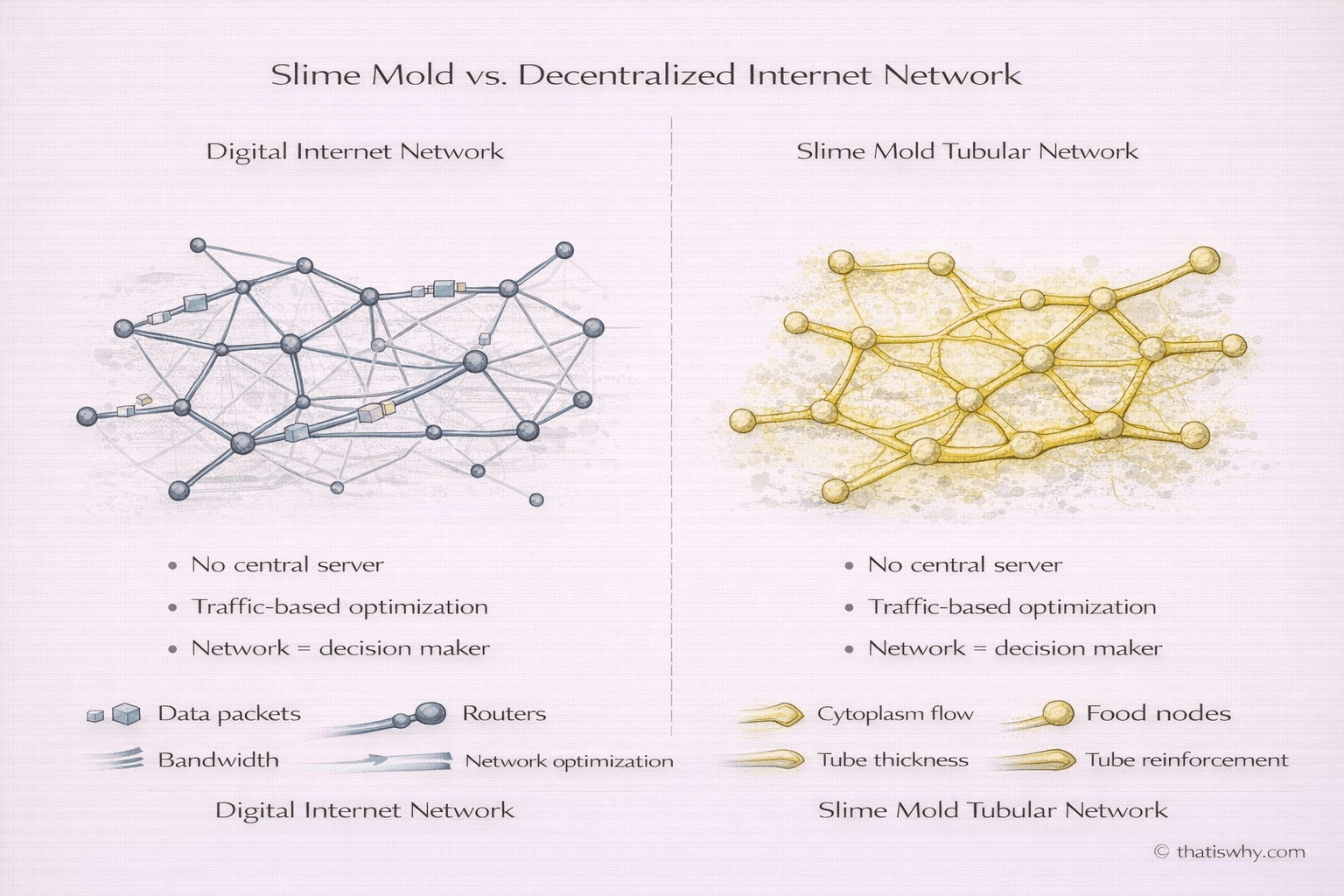
Think of it as a Living Internet.
The Slime Mold isn’t a creature; it is a decentralized network. It works like a biological fiber-optic cable. Instead of sending digital packets, it sends pulses of cytoplasm (cell fluid). When one part of the network finds food, it pulses faster. This wave travels through the tubes to the rest of the body, broadcasting a signal: “High Bandwidth Needed Here!”
The network responds instantly. It widens the cables that lead to the food and shrinks the cables that lead to nowhere. It is constantly rewiring its own architecture in real-time to find the strongest signal. It doesn’t need a central server (a brain) to tell it what to do. The network is the decision maker.
The “Blob” Problem
So, what exactly is this thing?
If you see it in the woods, it looks like yellow mold growing on a log. Most people think it’s a fungus. It’s not. Fungi stay put. This thing hunts.
It is a Slime Mold, which is basically a giant, crawling germ. But here is the detail that seems impossible: The entire yellow web,even if it’s as big as a pizza, is one single cell.
Biologists call this a Coenocyte (a cell with multiple nuclei). This is why the “Living Internet” works so well. Normally, cells have walls. Sending a message from one cell to another takes time, like sending an email. But the Slime Mold has no walls. It is one giant, open room. This means the data (cytoplasm and chemical signals) can flow through the cables at high speed without any resistance. It’s not just a network; it’s a hardwired connection with zero lag.
How It Solves the Maze
The Tokyo experiment wasn’t a fluke. This network is designed to solve problems. But how does it navigate a maze without a brain?
It uses Cached Data (External Memory).
Imagine you are browsing the web. Your browser saves your “History” so you know which links you have already clicked (purple links). The Slime Mold does the same thing physically. As it crawls, it leaves behind a trail of translucent slime. This slime is its browsing history. It acts as a “404 Error: Dead End” sign.
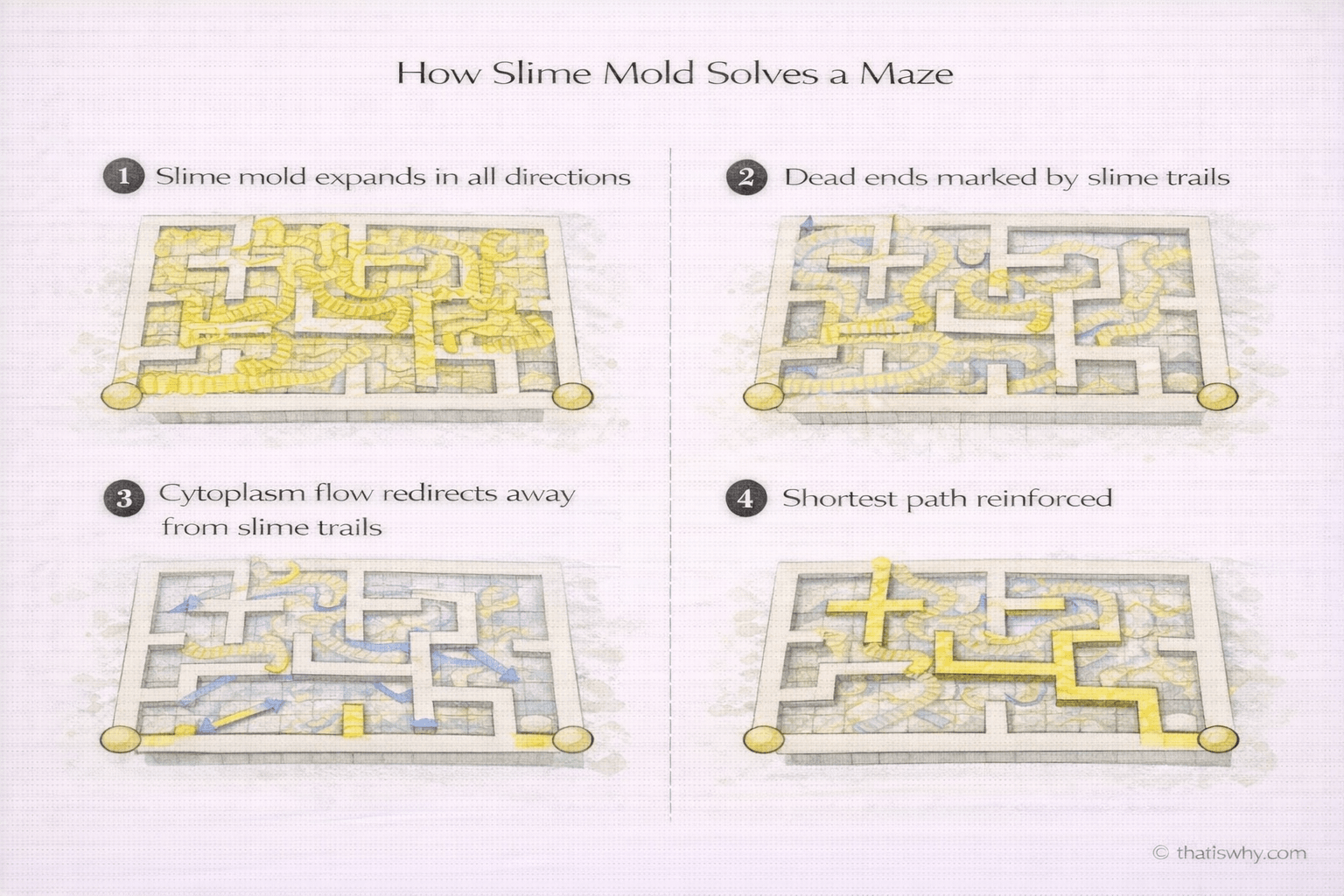
When the network is expanding, if it bumps into its own slime trail, it reads the data: “We have already processed this area. No food found.” It redirects the bandwidth (cytoplasm) elsewhere.
It doesn’t keep the map in a hard drive. It writes the code directly onto the environment. This allows a brainless blob to solve complex spatial problems by offloading the memory requirement to the physical world.
The Biological Computer
This isn’t just about mold. It turns out that “Slime Logic” is the future of computing.
Mapping the Universe The way the slime mold connects food sources is mathematically identical to how gravity connects galaxies. Astronomers have actually run “Slime Simulations” to map the Cosmic Web, the invisible filaments of dark matter that hold the universe together. The mold found connections that supercomputers missed.
Disaster Relief Researchers are using these same algorithms to design evacuation routes. If a slime mold can find the fastest way out of a maze, it can help us find the fastest way out of a burning stadium.
Road Planning Engineers in the UK and Mexico have used slime molds to test their own highway systems. They place oats on major cities and watch the mold grow. If the mold ignores a highway the humans built, it usually means the human highway is inefficient and needs to be redesigned.
Debunking the Blob
Because it looks like sci-fi goo, people get the wrong idea. Let’s set the record straight.
Myth #1: “It’s a fungus.” Everyone calls it a mold.
The Truth: It eats fungi for breakfast. Literally. Calling it a fungus is like calling a lion a gazelle just because they live in the same field. It is a Myxomycete (Protist) a giant, single-celled hunter that moves.
Myth #2: “It has thoughts.” We see it solving puzzles and assume it’s conscious.
The Truth: It doesn’t “think”; it computes. It follows the laws of physics, flowing toward the strongest chemical signal and retracting from the weak ones. It is an optimization engine, not a philosopher.
Myth #3: “It’s toxic.” People see bright yellow slime and panic.
The Truth: It’s harmless. It doesn’t release toxic spores like black mold. You could technically keep it as a pet (and many scientists do). It just wants oats, not your lungs.
The Original Network
When we look at the Slime Mold, we see a gross, yellow blob. We assume it is primitive because it lacks a brain.
But in reality, it is a biological supercomputer. It has spent millions of years perfecting the algorithms of efficiency, routing, and connection.
The Slime Mold isn’t just goo. It is the original internet, crawling across the forest floor. It teaches us a humbling lesson: Intelligence doesn’t require neurons, and it doesn’t require a skull. Sometimes, the smartest thing in the room isn’t the individual; it’s the network itself.
How We Researched This
To explain this brainless brilliance, we looked at the 2010 Ig Nobel Prize-winning study by Toshiyuki Nakagaki and his team. They were the ones who proved that Physarum polycephalum could replicate the Tokyo rail network.
But we knew that just citing network theory isn’t helpful. Our real job began when we asked, “What does this feel like?” That question led us to the “Living Internet” analogy—a simple story to make the complex concept of decentralized biological computing feel intuitive.