Why Eucalyptus Trees Want to Burn
Firefighters in Australia and California have a nickname for eucalyptus forests, and it is not a flattering one. They call them gasoline on a stick.
The strange part is not that eucalyptus trees burn intensely during wildfires. The strange part is that they are often the first to return after the fire has erased almost everything else.
Most trees treat fire as a worst-case scenario. Their bark chars, their tissues collapse, and whatever survives usually does so by chance rather than design. Eucalyptus followed a different path. Instead of trying to avoid fire, it reorganized its entire biology around it.
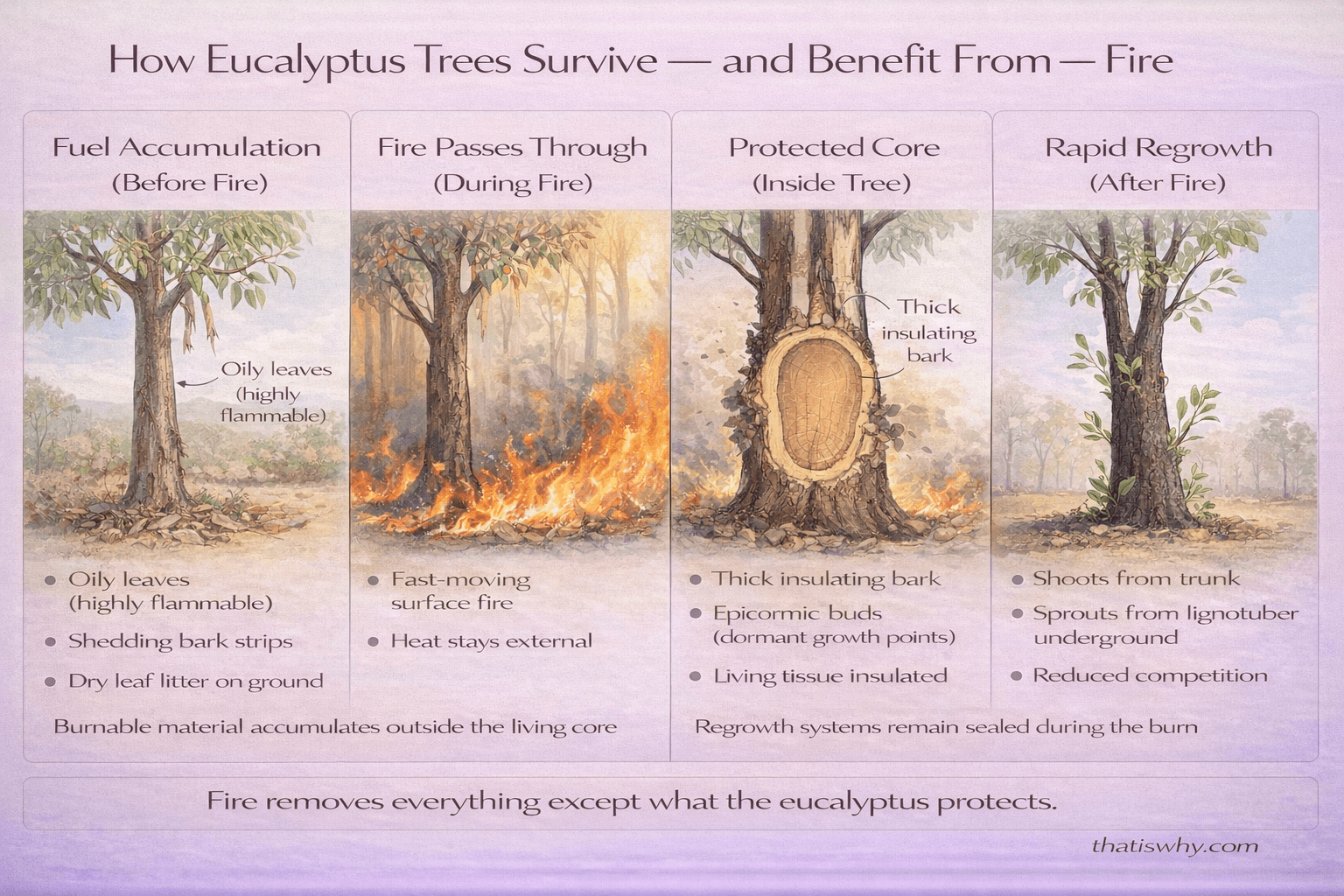
Spend time in a eucalyptus forest on a hot, dry day and that strategy becomes hard to miss. The leaves release volatile oils that hang in the air, producing a sharp, medicinal scent that is also highly flammable. The ground beneath the trees is layered with dry bark strips and oily leaves that resist decay. Year after year, fuel quietly accumulates.
At first glance, this looks like a terrible idea, why would a tree evolve to make itself more flammable in landscapes already shaped by wildfire? The answer only makes sense once you stop thinking of eucalyptus as something trying not to burn and start thinking of it as something designed to let the outside fail completely while the contents remain sealed.
In that setup, the flames are not the main threat. What matters is what the fire cannot reach. The easiest way to understand eucalyptus is to think of it as a fireproof safe placed inside a burning building, designed so the outside can fail completely while the contents remain sealed.
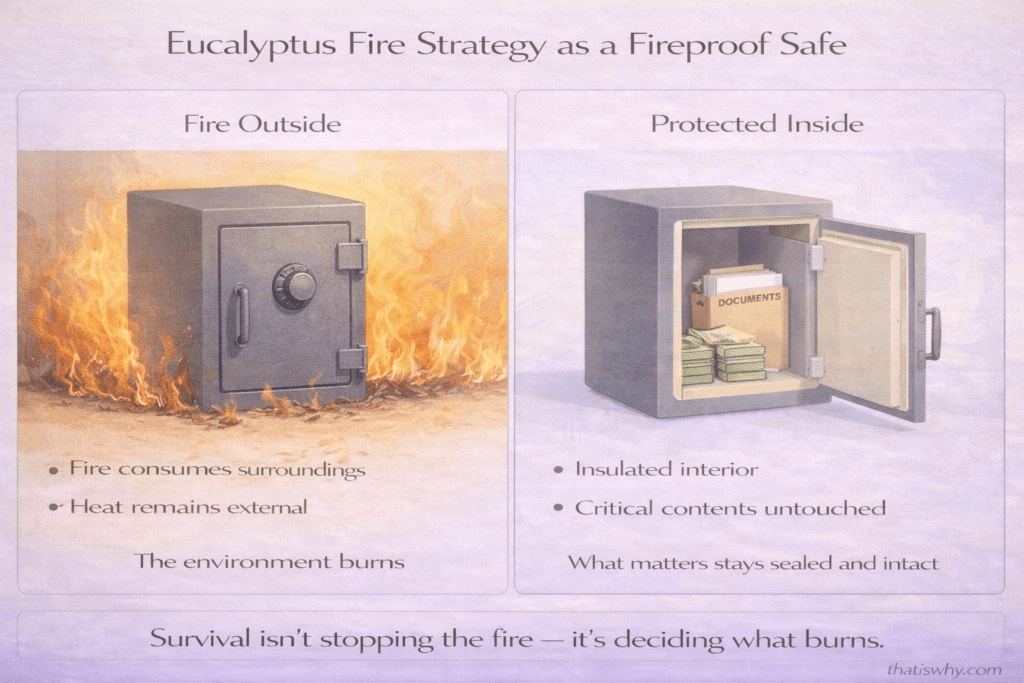
The eucalyptus does not survive by escaping fire or suppressing it. It survives by insulating its living core while allowing fire to do what fire does naturally, which is remove everything that is not protected. When flames move through a eucalyptus forest, they race through oils, bark, and leaf litter, killing trees that are not built to tolerate that heat. Meanwhile, the eucalyptus keeps its regenerative tissue locked behind thick bark and underground reserves.
After the fire passes, the landscape looks finished, then growth resumes. Green shoots emerge directly from blackened trunks and from structures beneath the soil, as if the tree had simply been waiting for the smoke to clear.
This is not self-destruction but a competitive strategy that turns one of nature’s most violent forces into an advantage.
The Gasoline Tree
Almost everything you see on the outside of a eucalyptus is intentionally expendable, like the casing around something built to survive heat.
The leaves are saturated with volatile oils, the same compounds distilled into eucalyptus oil. On hot days, those oils evaporate easily, forming a flammable haze around the canopy. Fire does not need to touch the leaves directly. Heat alone can ignite the vapor, which helps explain how eucalyptus forests can flare so suddenly once conditions align.
That volatility does not stay overhead. Eucalyptus sheds bark in long, curling strips and drops leaves continuously. Instead of breaking down quickly, this material accumulates. The same oils that make it flammable also suppress the microbes that would normally decompose it. Over time, the forest floor fills with dry, oily debris that behaves less like soil and more like kindling stacked around a structure.
Seen without context, this looks reckless. The tree appears to be surrounding itself with fuel. What matters, though, is not the surface. What matters is what remains protected when the fire arrives.
When flames move through this environment, they burn fast and hot, feeding on oils, bark, and leaf litter. That intensity is devastating for neighboring trees with thin bark or shallow roots. Species that might otherwise compete for light and water are removed efficiently.
Inside, nothing essential is exposed. The fuel is sacrificed because it can be replaced. The contents are not.
This logic mirrors what we saw in The Botanical Grenade, where the Sandbox Tree builds tension into a shell it can afford to lose, releasing force outward while protecting what matters inside. The eucalyptus trades explosion for combustion, but the principle is the same.
The Bunker: Surviving the Inferno
What makes this strategy work is not how well the eucalyptus burns, but how carefully it separates what can be lost from what cannot.
Beneath the bark, the tree keeps its most important tissue buried deep enough that flames never reach it. The outer layers can char, split, and peel away without exposing the living core. In many species, the bark even sheds as it burns, carrying heat outward and away, much like a casing designed to fail so the interior does not.
Hidden inside that insulated core are epicormic buds, dormant growth points sealed beneath thick layers of wood. Under normal conditions, these buds remain inactive. Fire changes that balance. Heat signals that the canopy above has been removed, and the buds respond by pushing new shoots directly through blackened bark.
Even when the trunk is badly damaged, the eucalyptus has another reserve below ground. Many species grow from a lignotuber, a swollen woody mass at the base of the tree packed with stored energy and growth tissue. It sits safely beneath the soil, insulated from surface heat, waiting. When fire destroys what is visible, the lignotuber sends up new stems within weeks.
This is why eucalyptus forests can look dead and alive at the same time. The surface is scorched and the canopy is gone, but what was locked inside was never exposed. What burned was the casing. What fuels regrowth stayed sealed away.
Fire, in this system, is not a reset. It is confirmation that the design worked.
Scorched Earth Tactics
Surviving the fire is only part of the eucalyptus strategy. The larger advantage comes from what the fire removes.
When a eucalyptus forest burns, the effect extends beyond individual trees. The understory disappears. Shade is eliminated. Competitors with thin bark or shallow roots are wiped out in a single event. What remains is exposed ground coated in ash.
That ash is not waste. It is a concentrated release of nutrients that were locked inside living tissue only hours earlier. At the same time, sunlight reaches the forest floor without obstruction. For many plants, these conditions would be ideal, except that they arrive after those plants are already gone.
Eucalyptus is prepared for this moment. While the fire was burning, its living reserves stayed locked inside. As soon as the heat fades, growth resumes from trunks and underground structures that were never destroyed. In many species, fire also helps release eucalyptus seeds, dropping them into soil that is warm, fertilized, and suddenly empty.
From a competitive perspective, this is decisive. The fire does not merely spare the eucalyptus. It resets everyone else. Trees that once shared the canopy are forced to begin again from seed, if they survive at all. The eucalyptus continues from intact systems that never had to start over.
What looks like rapid recovery is continuity. The fire burned the surroundings, not what was locked inside.
The Danger of Exporting It
This strategy works because it evolved in landscapes where fire is frequent and expected. Problems begin when that same strategy is moved elsewhere.
Humans planted eucalyptus trees around the world for practical reasons. They grow quickly, produce useful timber, and tolerate poor soils. In places like California and Portugal, eucalyptus forests expanded far beyond their native range. The trees arrived with a design that assumes fire will come, but the surrounding ecosystems did not share that history.
In these new environments, the mechanics stay the same. Oils accumulate in the canopy. Bark and leaf litter build up on the ground. Fuel gathers outside what the tree keeps protected. The difference is that neighboring plants, soils, and human infrastructure were never adapted to burn this often or this intensely.
The eucalyptus continues to benefit. After a fire, it resprouts quickly, often outpacing native species. The surrounding ecosystem recovers more slowly, which means each fire increases the tree’s relative advantage.
This is where confusion often enters the conversation. Eucalyptus does not ignite fires. It shapes conditions that make fires more likely and more severe once ignition occurs. In dry, populated landscapes, that distinction matters less than the result.
What works precisely in one ecological context becomes difficult to control in another.
What People Get Wrong About Eucalyptus and Fire
Myth #1: “Eucalyptus trees cause wildfires.”
Truth: Eucalyptus does not ignite fires on its own, but it intensifies them once they start.
Myth #2: “The tree burns because it has no defense.”
Truth: The tree burns because it can afford to. Its vital systems are insulated and protected.
Myth #3: “Fire is a disaster the tree barely survives.”
Truth: Fire is part of the eucalyptus life cycle and triggers rapid regrowth from tissue that was never exposed.
Myth #4: “All trees respond to fire the same way.”
Truth: Many trees are damaged or killed by fire, while eucalyptus is adapted to use it.
The Kind of Fire That Changes the Rules
We usually think of fire as something that interrupts the natural order. The eucalyptus treats it as a predictable force that can be planned around.
Oils accumulate gradually. Bark sheds slowly. Protective tissue thickens over years. By the time flames arrive, the important decisions were already made, and the outcome depends on how carefully the tree separated what could be lost from what needed to stay sealed.
That logic feels familiar when you look at human systems. We accept that certain failures are inevitable, so we design structures that allow damage where it matters least. The goal is not to prevent failure entirely, but to protect what cannot be replaced.
The eucalyptus follows the same logic. It accepts that the outside will burn and focuses on preserving what was locked away long before the fire arrived. When the flames pass, the forest looks ruined, but the systems that matter were never exposed.
Sometimes adaptation is not about avoiding harm. Sometimes it is about deciding, very deliberately, where harm is allowed to go.
How We Researched This :
To explain why eucalyptus trees are both highly flammable and unusually resilient to fire, we examined ecological and physiological research on pyrophytic plants, studies of eucalyptus fire adaptation published in the Journal of Ecology, Forest Ecology and Management, and field documentation from CSIRO Australia and US Forest Service.
But we knew that just citing fire ecology terms wasn’t helpful. Our real job began when we asked, What does this feel like? That question led us to the “fireproof safe” analogy, a simple story to make survival through burning feel intuitive.