Free teaching diagram
Deep-Sea Zones Map: What Lives at Each Depth
From the sunlit surface to the trenches: light fades, the water turns cold, and pressure climbs about one atmosphere every 10 m.
The detailed teaching diagram
What the map shows
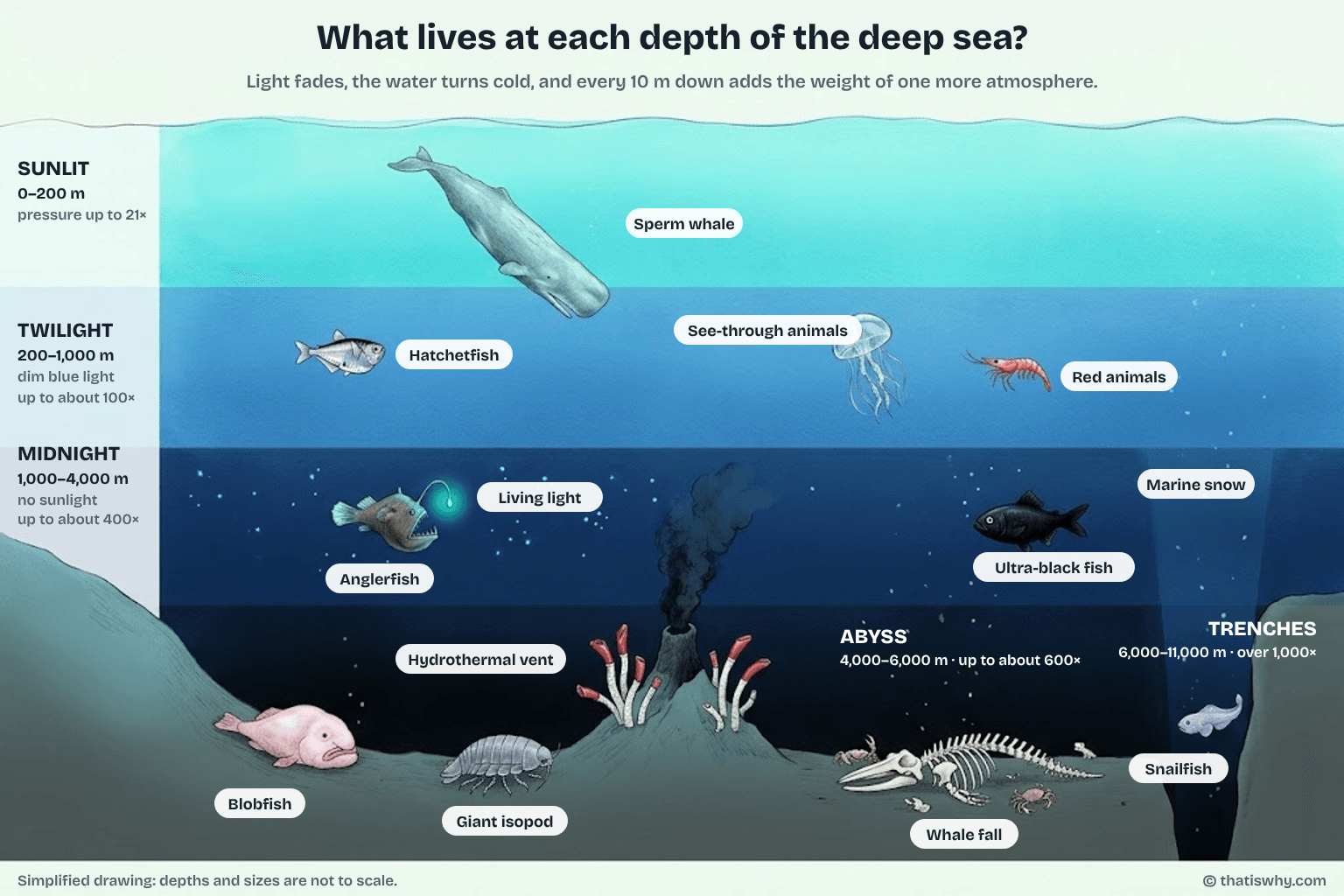
The sunlit zone (0 to 200 m). Water soaks up light, so sunlight only reaches about 200 meters down. A sperm whale dives through it on its way to hunt far below.
The twilight zone (200 to 1,000 m). Only dim blue light is left. Here animals hide by being see-through, silver like the hatchetfish, or red, which looks black once red light is gone.
The midnight zone (1,000 to 4,000 m). No sunlight reaches this deep. The only light comes from animals that make their own (bioluminescence), like the anglerfish and its glowing lure. Marine snow, the slow fall of dead bits from above, feeds much of the life down here.
The abyss and the trenches. The abyss runs from 4,000 to 6,000 meters, and the trenches of the hadal zone plunge to almost 11,000 meters. Not every source draws the lines in the same place: Woods Hole, for example, puts the abyss at 3,000 to 6,500 meters. A sunken whale (whale fall) can feed animals for years, and at hydrothermal vents bacteria make food from chemicals instead of sunlight (chemosynthesis).
Cold, dark water slows life down. The Greenland shark, which can dive to 2,200 meters, grows less than a centimeter a year and lives at least 272 years: see why Greenland sharks live for centuries.
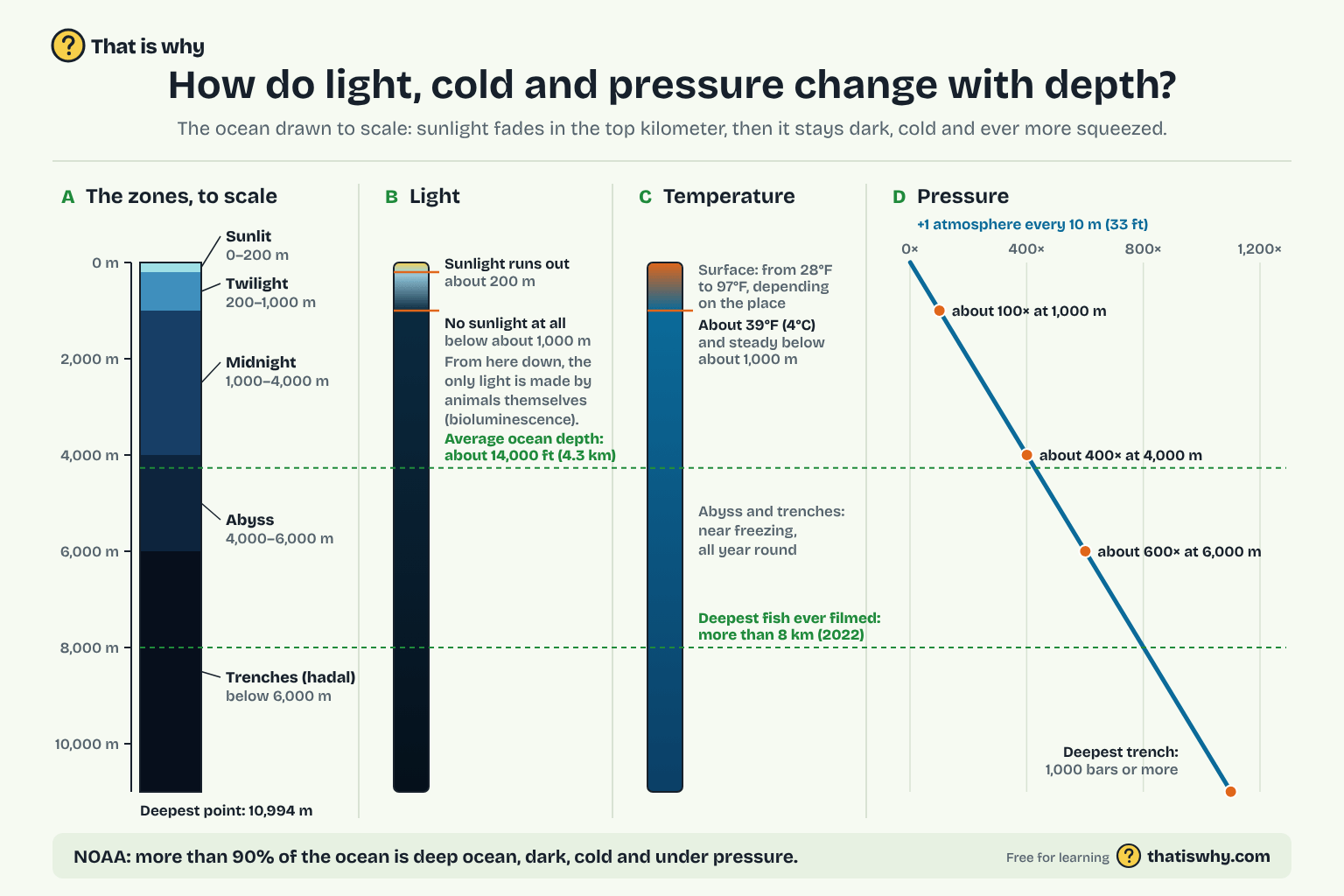
The drawing is simplified: depths and sizes are not to scale. The detailed chart below shows the real proportions, with light, temperature and pressure on one depth ruler.
Key numbers
| Fact | Value |
|---|---|
| Depth sunlight reaches | about 200 m |
| Twilight zone | 200 to 1,000 m |
| Midnight zone | 1,000 to 4,000 m |
| Abyss | 4,000 to 6,000 m |
| Trenches (hadal zone) | 6,000 m to almost 11,000 m |
| Pressure increase | 1 atmosphere every 10 m (33 ft) |
| Pressure in the deepest trench | 1,000 bars or more |
| Water temperature below about 1,000 m | about 39°F (4°C) |
| Surface water temperature | 28°F to 97°F, depending on the place |
| Average ocean depth | about 14,000 ft (4.3 km) |
| Deepest point | 10,994 m |
Common misconceptions
Myth The deep sea is empty because nothing can live there.
The truth Every zone has its own animals, from hatchetfish in the twilight zone to snailfish filmed more than 8 km down.
Myth The pressure in the deep sea would crush any animal.
The truth Pressure climbs about one atmosphere every 10 m, but animals with no air spaces inside are not crushed.
Questions to use in class
Tap a question to reveal a model answer.
1How deep does sunlight reach in the ocean?
Only to about 200 meters. Below that comes the dim twilight zone, and below about 1,000 meters there is no sunlight at all.
2How fast does pressure rise as you go down?
By about one atmosphere every 10 meters, so it is about 100 times surface pressure at 1,000 meters.
3What do animals in the deep sea eat?
Mostly marine snow sinking from above, plus rare feasts like a whale fall. At hydrothermal vents, bacteria make food from chemicals.
Key terms
- Ocean zones
- The layers scientists use to describe the ocean by depth: the sunlit zone (0 to 200 m), the twilight zone (200 to 1,000 m), the midnight zone (1,000 to 4,000 m), the abyss (4,000 to 6,000 m) and the hadal zone of the deep trenches (below 6,000 m). Exact lines vary a little between sources: Woods Hole, for example, puts the abyss at 3,000 to 6,500 m.
- Marine snow
- A slow shower of dead plants and animals, droppings and other bits, sinking from the sunlit surface to the deep sea. It is food for many deep-sea animals, and what is not eaten settles as a soft ooze on the seafloor.
- Bioluminescence
- Light made by a living thing through a chemical reaction. Most deep-sea bioluminescence is blue, the color that travels furthest in water.
- Chemosynthesis
- Making food from the energy in chemicals, such as hydrogen sulfide, instead of from sunlight. Bacteria at deep-sea vents use it to feed whole communities.
- Whale fall
- A dead whale that has sunk to the deep seafloor, and the community of life that feeds on it in stages, from scavengers to bone-dwelling bacteria, for years to decades.
Sources
- Layers of the ocean NOAA JetStream
- Ocean zones Woods Hole Oceanographic Institution
- How does pressure change with ocean depth? NOAA National Ocean Service
- The deep ocean NOAA Ocean Today
- Curious Kids: how do creatures living in the deep sea stay alive given the pressure? The Conversation
- How much of the ocean has been explored? NOAA Ocean Exploration
- Scientists break new record after finding world's deepest fish The University of Western Australia
- What is marine snow? NOAA National Ocean Service
- How long do Greenland sharks live? NOAA Ocean Service