Free teaching diagram
Glowing Waves Diagram: Why Waves Glow Blue at Night
A breaking wave jolts tiny plankton cells, and each one flashes in the color that travels farthest in the sea.
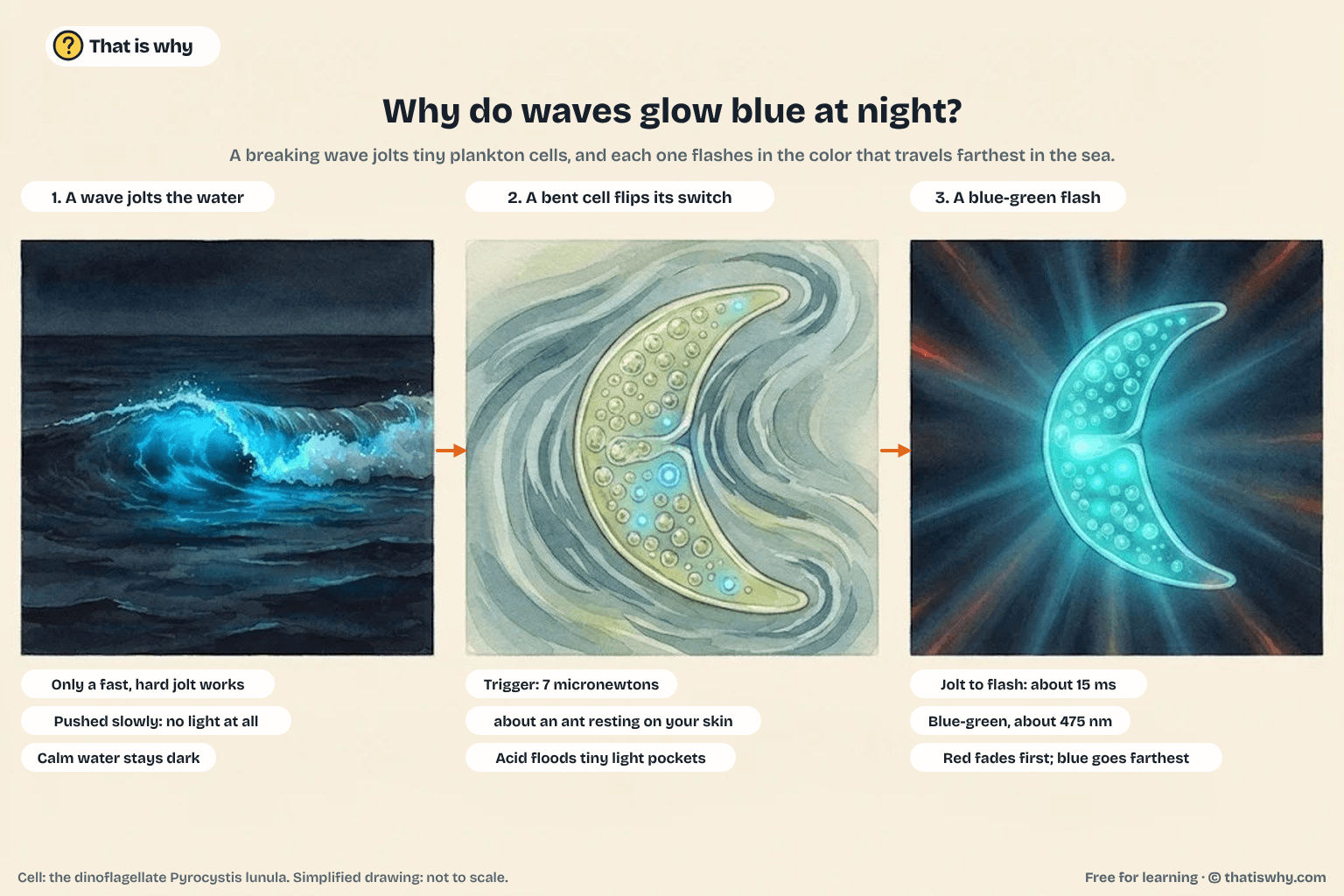
The detailed teaching diagram
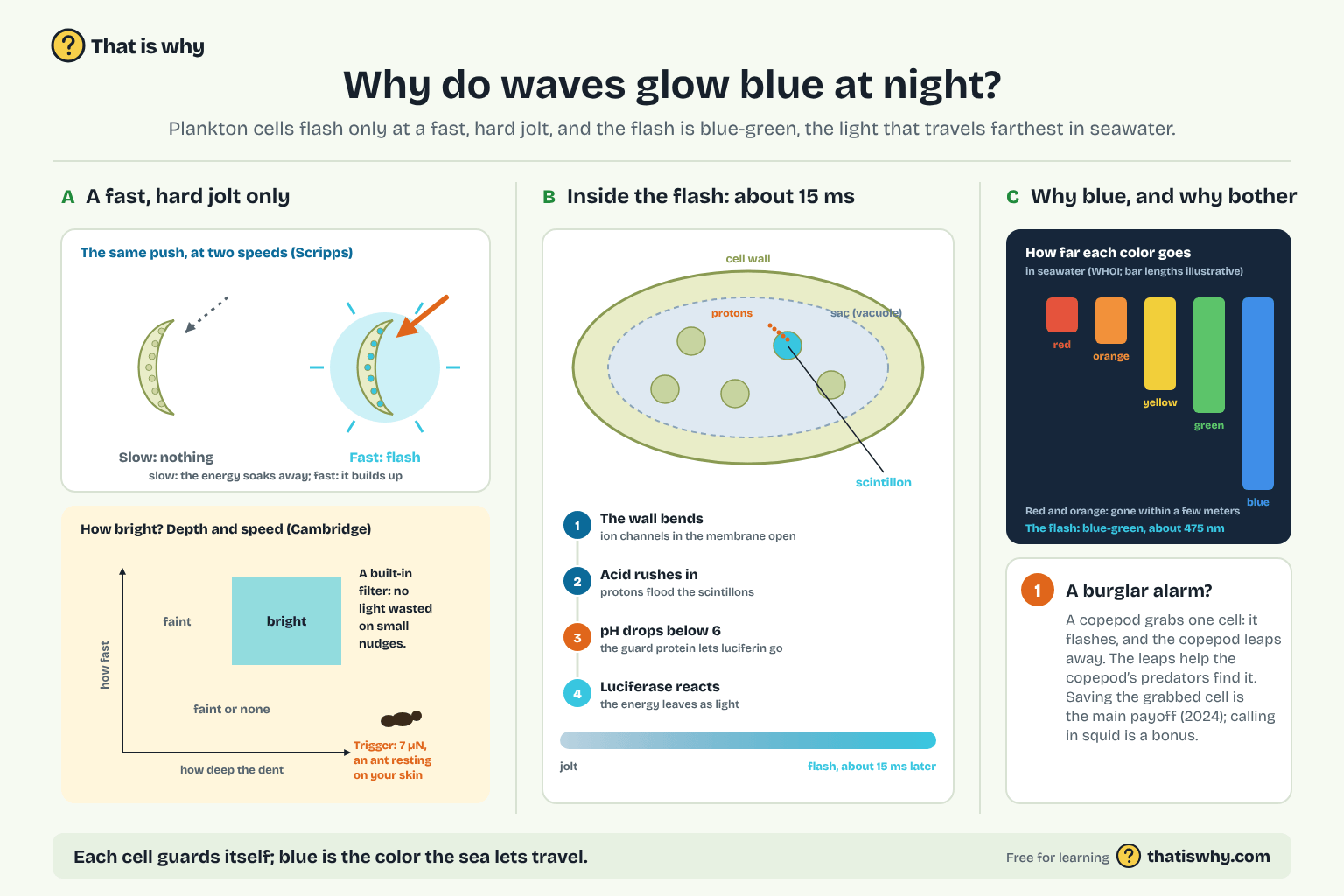
What the diagram shows
1. A wave jolts the water. Glowing waves are full of dinoflagellates, single-celled plankton that make their own light, a kind of bioluminescence. They flash only at a fast, hard jolt: in tests at Scripps, the same force applied slowly gave no light at all.
2. A bent cell flips its switch. When the cell wall bends, ion channels open and protons flood tiny light pockets called scintillons. The pH drops below 6, a guard protein lets go of the fuel, luciferin, and the enzyme luciferase turns it into light.
3. A blue-green flash. The flash arrives about 15 milliseconds after the jolt, at a wavelength of about 475 nanometers. Seawater swallows red and orange light within a few meters, while blue travels the farthest, so the glow we see is blue. When these plankton bloom by day, the water can turn reddish brown, a red tide.
Key numbers
| Fact | Value |
|---|---|
| Force that makes a cell flash | 7 micronewtons (an ant resting on your skin) |
| Time from jolt to flash | about 15 milliseconds |
| Color of the flash | blue-green, about 475 nm |
| pH that releases the luciferin | below 6 |
| Depth where red and orange are gone | a few meters |
Common misconceptions
Myth Glowing water shines all night, like a lamp.
The truth The sea stays dark until something jolts it. It flashes only where a breaking wave, a paddle or a hand disturbs the water.
Myth Any touch at all makes the plankton light up.
The truth The cells ignore slow pushes. In the Scripps experiments, the same force applied slowly produced no light; only a fast jolt did.
Myth The flash exists mainly to call in fish and squid.
The truth A 2024 study found the main benefit is protecting the single cell that gets grabbed. Attracting bigger predators seems to be a secondary bonus.
Questions to use in class
Tap a question to reveal a model answer.
1What makes waves glow at night?
Single-celled plankton called dinoflagellates. When a breaking wave jolts them, each cell makes a quick flash of blue-green light.
2How hard do you have to push a dinoflagellate to make it glow?
Scripps researchers found a force of just seven micronewtons, about the weight of an ant resting on your skin, was enough, but only when applied quickly.
3Why is the glow blue?
The flash is blue-green light of about 475 nanometers. Seawater absorbs red and orange within a few meters, while blue travels the farthest.
4Why do plankton make light?
Mostly to defend themselves: a grabbed cell flashes and startles the copepod that caught it. The flash may also draw in bigger predators that eat the attackers.
Key terms
- Dinoflagellate
- A single-celled plankton organism of the sea. Some kinds make their own light and flash blue-green when the water around them is jolted, which is what makes breaking waves glow at night.
- Bioluminescence
- Light made by a living thing through a chemical reaction. Most deep-sea bioluminescence is blue, the color that travels furthest in water.
- Scintillon
- A tiny light-making pocket inside a dinoflagellate cell, sitting in the cell's fluid-filled sacs (vacuoles). When protons flood in and the pH drops, the luciferin inside is released and the scintillon flashes.
- Luciferin
- The light-emitting substance in bioluminescence. When it reacts with oxygen, energy is released as light.
- Luciferase
- An enzyme that speeds up the reaction between luciferin and oxygen that produces bioluminescent light.
- Red tide
- A bloom of plankton such as dinoflagellates so dense that it tints the sea reddish brown by day. With light-making species, the same water glows blue in the breaking waves at night.
- Wavelength
- The distance between one wave peak and the next. For light it sets the color: red light has longer wavelengths (about 620 to 750 nm) than blue light (about 450 to 495 nm).
Sources
- Flashes bright when squeezed tight: how single-celled organisms light up the oceans University of Cambridge
- Research Highlight: The Force behind Nature's Light Scripps Institution of Oceanography, UC San Diego
- Unravelling the chemistry behind the sea's bioluminescent sparkle (Rachel Brazil) Chemistry World, Royal Society of Chemistry
- Revisiting the burglar alarm hypothesis (Huang, Ryderheim and Kiørboe, Functional Ecology 2024) Technical University of Denmark (DTU Orbit)
- Why is the ocean blue? Woods Hole Oceanographic Institution