Free teaching diagram
Transparent Animal Diagram: Why Its Stomach Is Red
A red stomach looks black in blue twilight and traps the glow of dinner, while the eyes stay the one part that can't be clear.
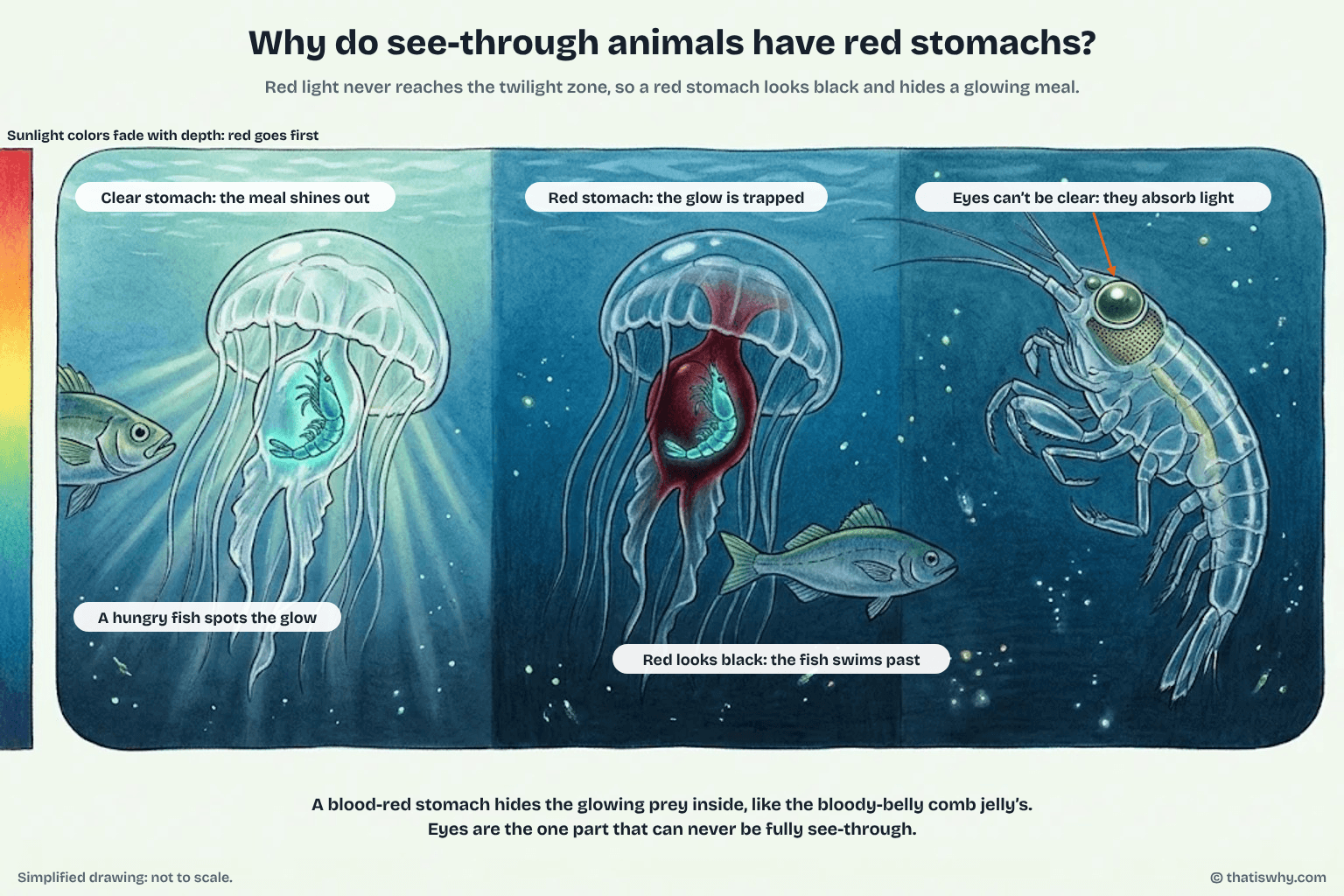
The detailed teaching diagram
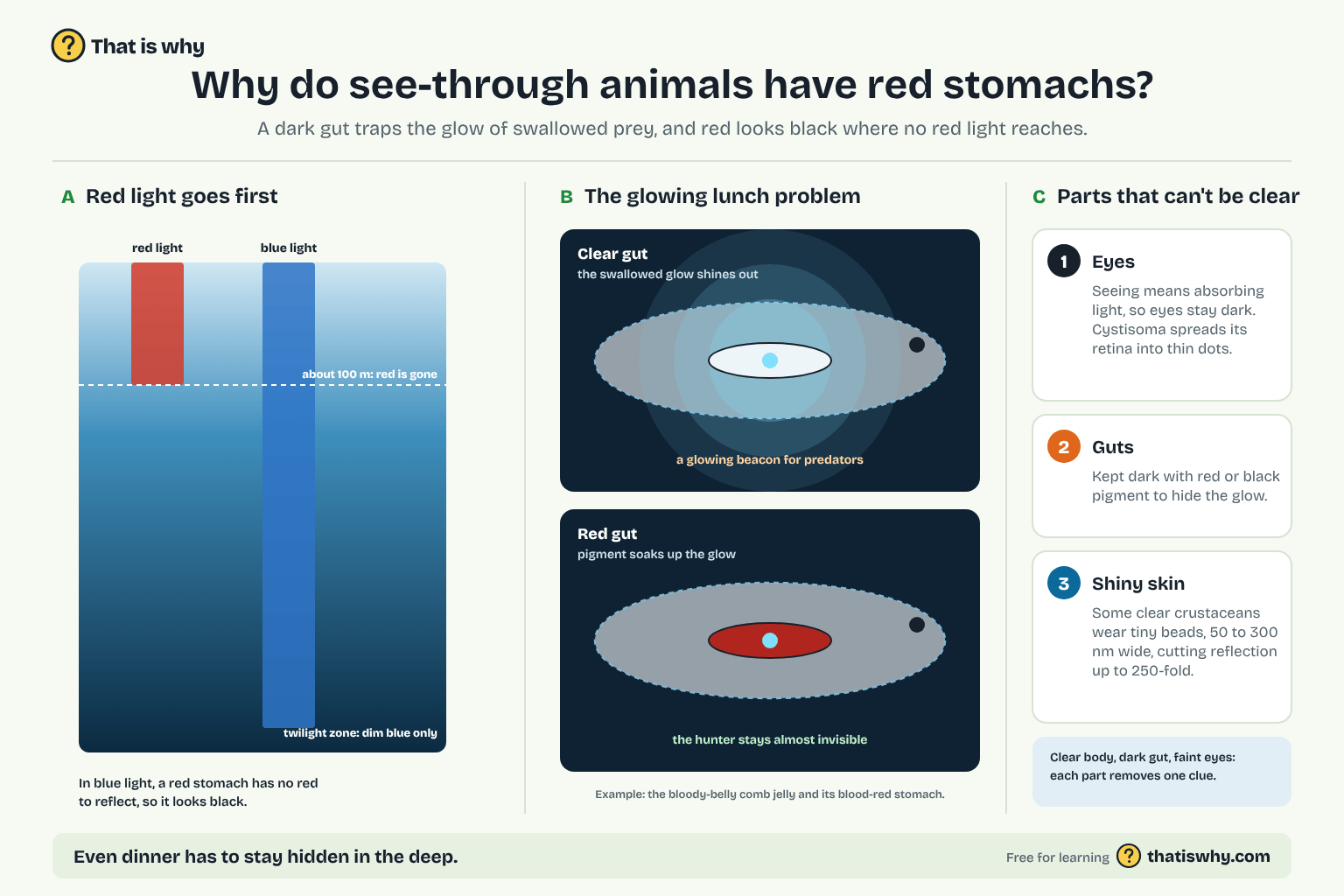
What the diagram shows
A. Red light goes first. As sunlight travels down through seawater, red light is absorbed first and is gone by about 100 m. In the twilight zone only dim blue light is left. A red surface has no red light to reflect there, so it looks black.
B. The glowing lunch problem. Many small deep-sea animals make their own light. If a see-through hunter swallows one, the glow could shine straight through its body like a beacon. A gut lined with red or black pigment soaks up that light, so the hunter stays almost invisible. The bloody-belly comb jelly is a good example: in MBARI's words, "The blood-red stomach disguises the glowing prey inside."
C. Parts that can't be clear. Transparency has limits. Eyes must absorb light to see, so they stay dark. The crystal amphipod Cystisoma is so clear that even its gut is see-through, but its huge eyes can't be. Its retinas are spread into a thin sheet of tiny dots, which shrinks its shadow. Guts are kept dark to hide the glow of food. And clear skin can still reflect light: some clear crustaceans are covered in tiny beads, 50 to 300 nanometers wide, that cut reflection up to 250-fold.
Key numbers
| Fact | Value |
|---|---|
| Depth where red sunlight is gone | about 100 m |
| Light left in the twilight zone | dim blue |
| Anti-reflective beads | 50 to 300 nm wide |
| Reduction in reflection | up to 250-fold |
Common misconceptions
Myth A red organ must be easy to see.
The truth Red sunlight is gone by about 100 m, so in the blue twilight zone a red stomach has nothing to reflect and looks black.
Myth A see-through body hides everything inside it.
The truth A swallowed glowing meal can shine straight through a clear body. A dark gut is needed to hide it.
Myth Transparent animals can make every part clear.
The truth Eyes must absorb light to see, so they stay dark. The crystal amphipod Cystisoma spreads its retina into a thin sheet of tiny dots to shrink its shadow.
Questions to use in class
Tap a question to reveal a model answer.
1Why does a red stomach look black in the twilight zone?
Red light is absorbed near the surface and is gone by about 100 m. With only blue light left, a red surface has no red light to reflect, so it looks black.
2What would happen if a transparent predator had a clear gut?
The glow of swallowed bioluminescent prey would shine through its body and reveal it to its own predators.
3Which body parts cannot be made transparent, and why?
Eyes, because seeing means absorbing light, and guts, which must hide the glow of food.
4How do some clear crustaceans cut reflection from their skin?
Tiny beads 50 to 300 nanometers wide on their bodies reduce reflection, in some cases up to 250-fold.
Key terms
- Transparency
- Being see-through: light passes through the body with little scattering, so an animal makes almost no outline. Eyes and guts cannot be made fully clear.
- Light absorption
- When a material takes in light energy instead of letting it pass or bounce off. Seawater absorbs red light first and blue light last.
- Bioluminescence
- Light made by a living thing through a chemical reaction. Most deep-sea bioluminescence is blue, the color that travels furthest in water.
- Wavelength
- The distance between one wave peak and the next. For light it sets the color: red light has longer wavelengths (about 620 to 750 nm) than blue light (about 450 to 495 nm).
Sources
- Why are so many deep-sea animals red in color? NOAA Ocean Exploration
- Midwater ocean creatures use nanotech camouflage (Bagge et al., 2016) Duke University
- Bloody-belly comb jelly MBARI
- Crystal amphipod MBARI
- Giant Eyes Smithsonian Ocean
- Squid and octopus can switch camouflage in the blink of an eye (Zylinski & Johnsen, 2011) Duke University