Free teaching diagram
Deep-Sea Invisibility Diagram: How Animals Hide in the Dark
Hunters catch every light, while prey let it pass straight through or give none back.
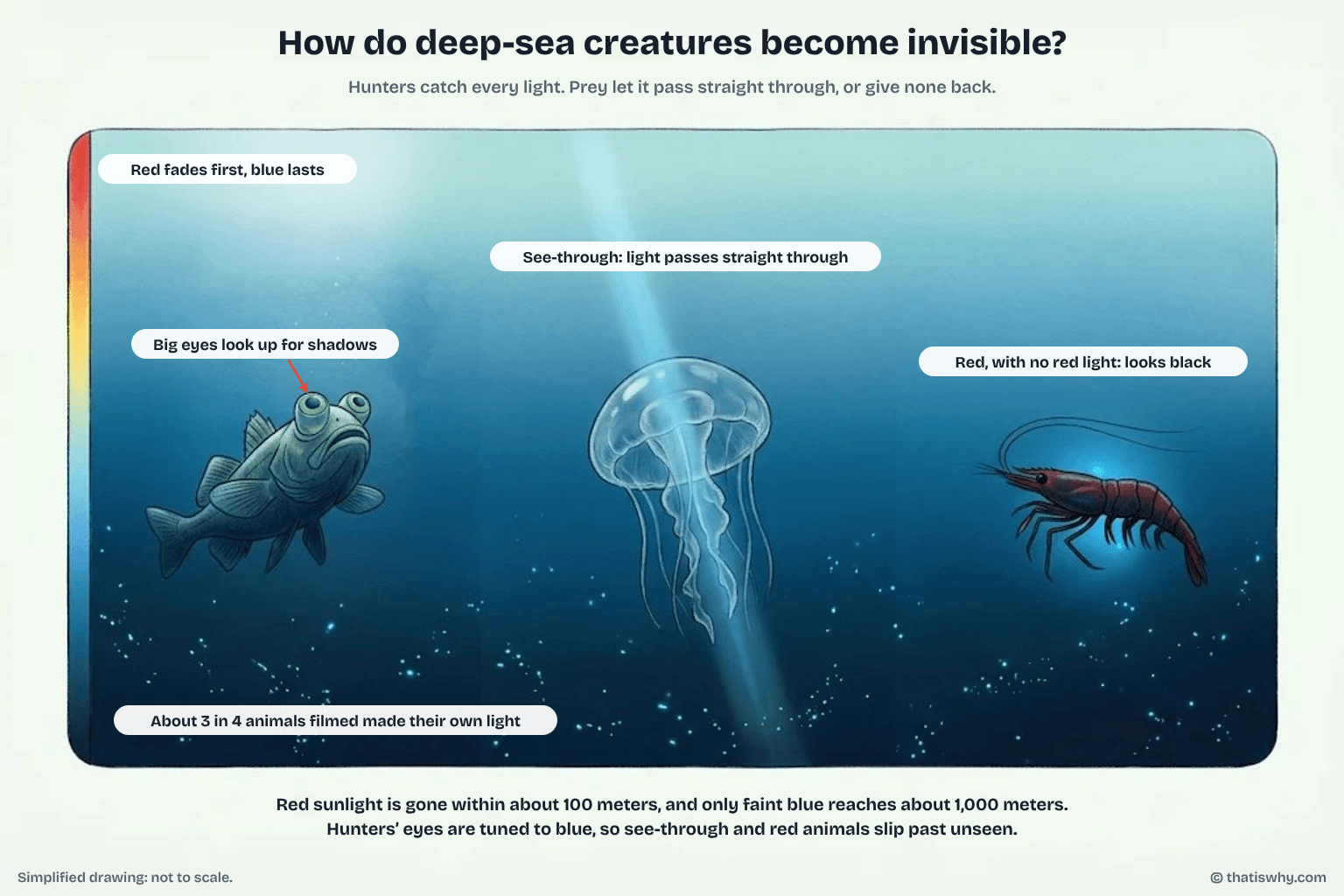
The detailed teaching diagram
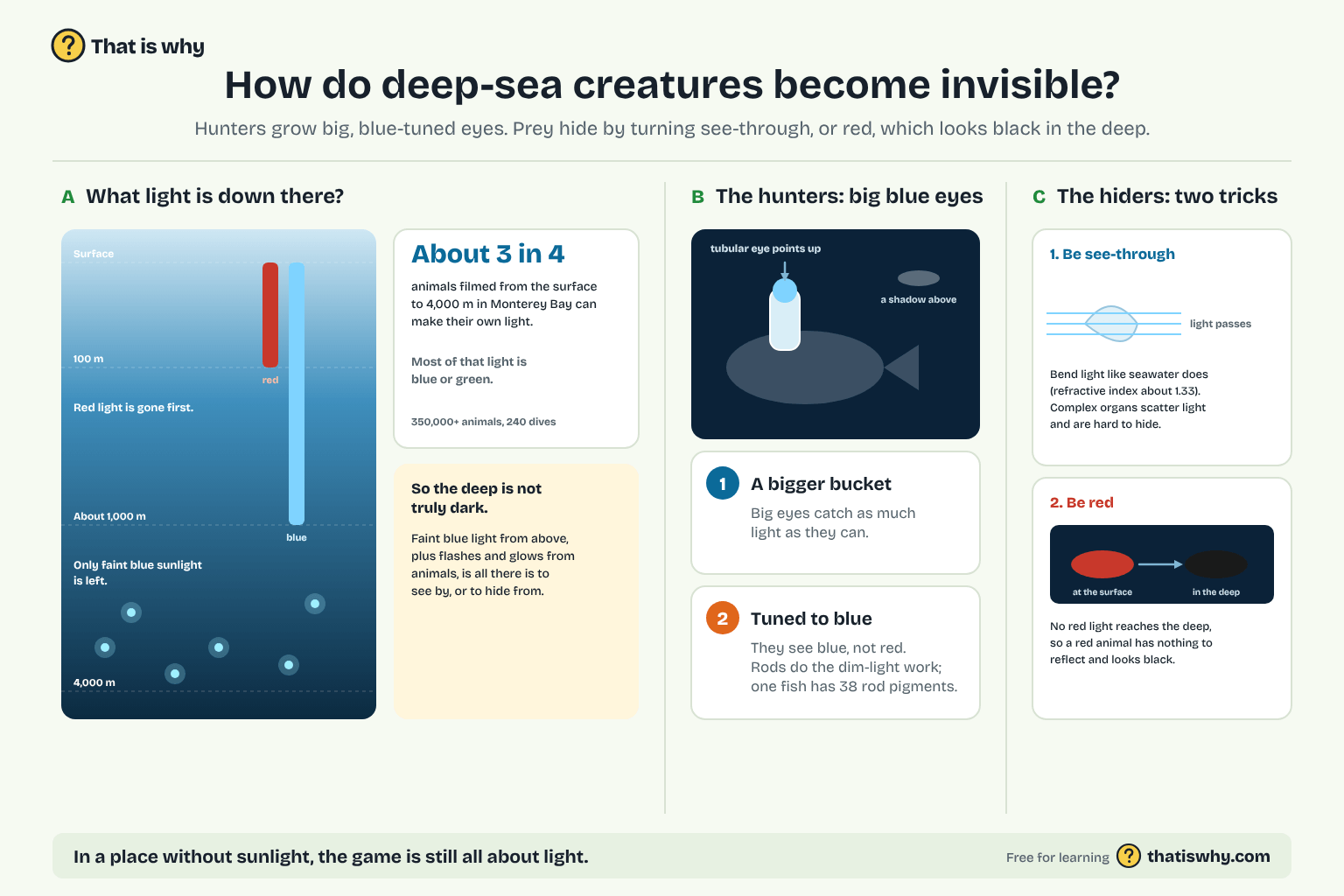
What the diagram shows
A. What light is down there? Red light is filtered out of seawater first. Around 1,000 meters, only faint blue sunlight is left. On top of that, about three in four animals filmed from the surface to 4,000 meters in Monterey Bay can make their own light, mostly blue or green (bioluminescence).
B. The hunters: big blue eyes. A bigger eye catches more light. Many deep-sea animals have tubular eyes pointing up to spot shadows against the faint light above, and their eyes generally see blue, not red. Rod cells do the dim-light work; most vertebrates have one kind of rod pigment, but the silver spinyfin has 38. The drawing is simplified.
C. The hiders: two tricks. See-through animals absorb and scatter very little light by keeping their refractive index close to seawater's, about 1.33, though complex organs scatter light and are hard to hide (transparency). Red animals vanish because no red light reaches the deep, so they have nothing to reflect and look black.
Key numbers
| Fact | Value |
|---|---|
| Animals that make light (Monterey Bay, surface to 4,000 m) | about 3 in 4 |
| Animals counted | over 350,000, in 240 dives |
| Depth where only faint blue sunlight is left | about 1,000 m |
| Refractive index of seawater | about 1.33 |
| Rod pigments in the silver spinyfin | 38 |
| Depth where a red fish is hard to see | 100 m |
Common misconceptions
Myth The deep sea is completely dark.
The truth Around 1,000 m faint blue sunlight still filters down, and about three in four animals filmed in Monterey Bay can make their own light.
Myth Red animals stand out in the deep sea.
The truth Red light is filtered out of seawater quickly, so a red animal at depth has nothing red to reflect and looks black.
Questions to use in class
Tap a question to reveal a model answer.
1Why do deep-sea animals have big eyes?
A bigger eye catches more of the faint light, and many deep-sea eyes are tuned to blue, the only color left.
2How does a transparent animal hide?
Its body absorbs and scatters very little light, with a refractive index close to seawater, about 1.33.
3Why is red a good color for hiding in the deep?
Red light does not reach the deep, so a red animal reflects nothing and looks black.
Key terms
- Bioluminescence
- Light made by a living thing through a chemical reaction. Most deep-sea bioluminescence is blue, the color that travels furthest in water.
- Rod cell
- A light-sensing cell in the eye that works in dim light. Almost all vertebrates have one kind of rod pigment, but the deep-sea silver spinyfin has 38.
- Transparency
- Being see-through: light passes through the body with little scattering, so an animal makes almost no outline. Eyes and guts cannot be made fully clear.
- Refraction
- The bending of a wave, such as light or sound, when its speed changes. In the sea, sound bends towards water where it travels more slowly.
Sources
- Deep Sea Sight (interview with Ron Douglas, City, University of London) The Naked Scientists
- Deep sea fish can detect colour in the dark (Musilova et al., Science 2019) The University of Western Australia
- Three quarters of deep-sea animals make their own light (Martini and Haddock, Scientific Reports 2017) Phys.org (MBARI)
- Staring into a crystal ball: understanding evolution and development of in vivo aquatic organismal transparency (Hotta et al., 2024) Frontiers in Ecology and Evolution
- Why are so many deep-sea animals red in color? NOAA Ocean Exploration