Free teaching diagram
Deep-Sea Camouflage Diagram: Hiding From Two Kinds of Hunters
Hunters find prey by its shadow or with a living searchlight, and deep-sea animals have a disguise for each.
The detailed teaching diagram
What the diagram shows
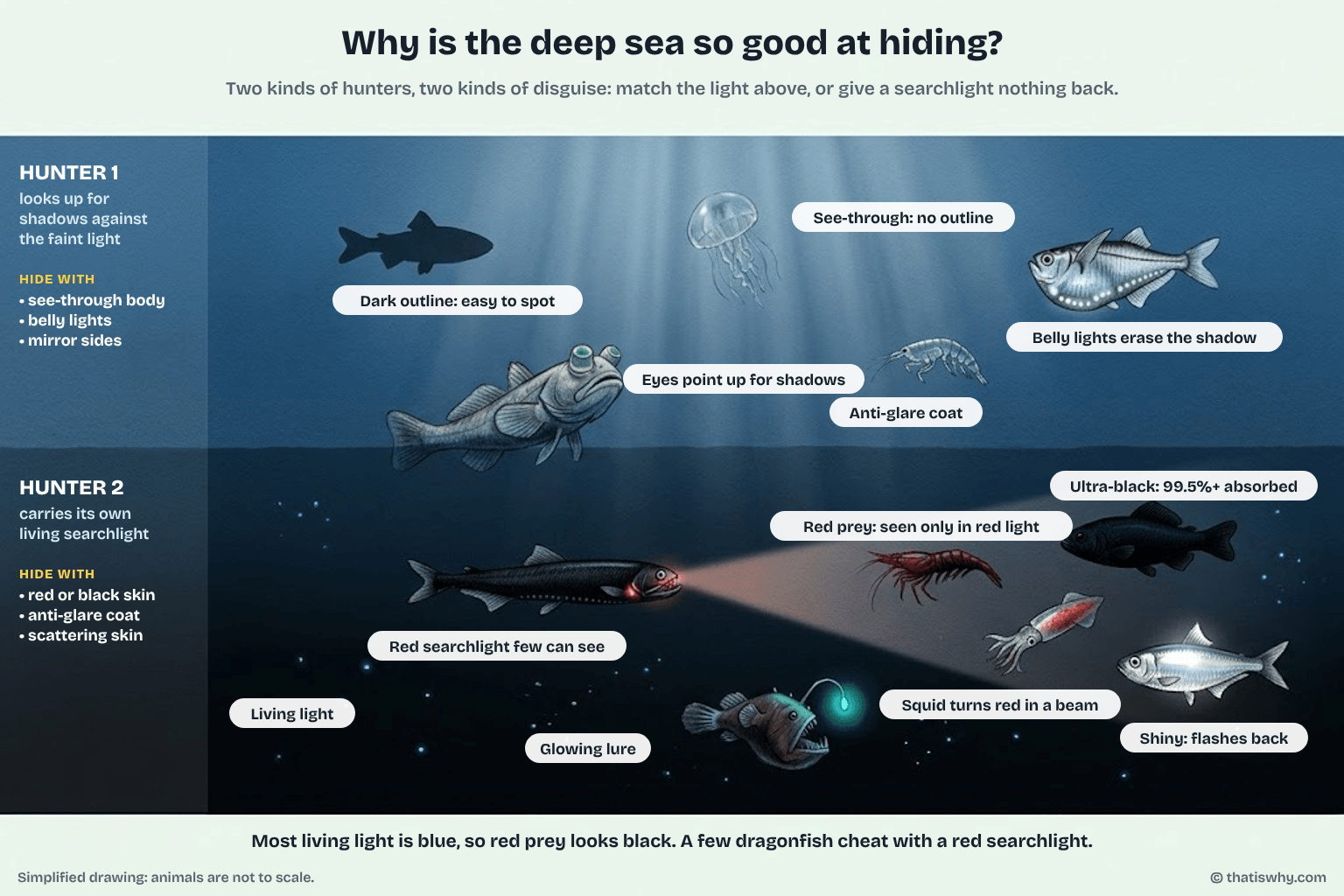
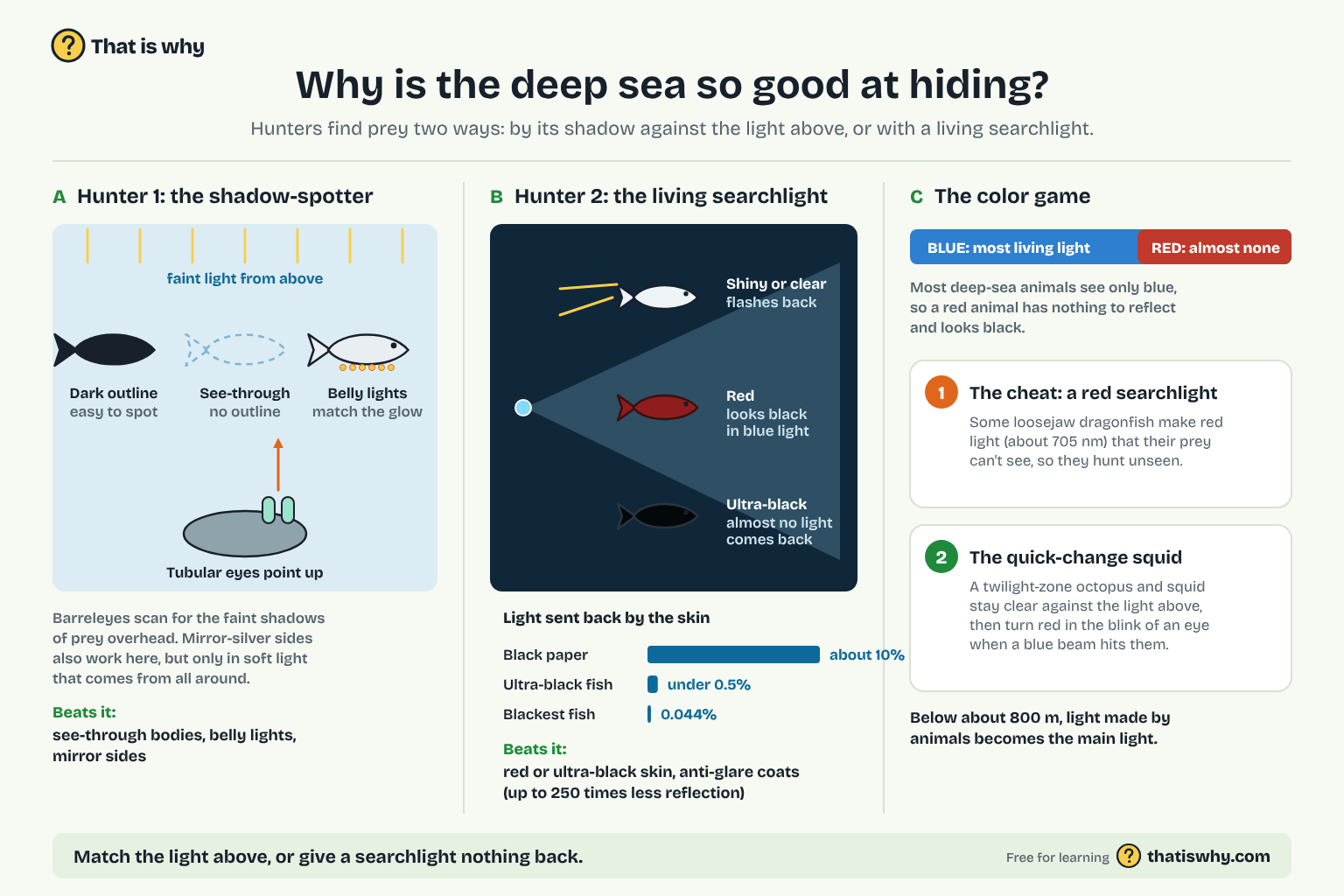
A. Hunter 1: the shadow-spotter. Many hunters in the twilight zone look up and search for the dark outline of prey against the faint light from above. The barreleye's tubular eyes point straight up for exactly this job. Prey beat it by letting light pass through (transparency), by lighting up their bellies to match the glow above (counterillumination), or with mirror-silver sides, which work only in soft light that comes from all around.
B. Hunter 2: the living searchlight. Other hunters carry their own light. In a beam, shiny and clear bodies flash back, so the winning disguise changes: red skin, which looks black in blue light, or ultra-black skin that sends back less than 0.5% of the light that hits it. Tiny clear amphipods add an anti-glare coat of nanoscale beads that can cut reflection up to 250 times.
C. The color game. Most living light is blue, and most deep-sea animals can only see blue, so a red animal has nothing to reflect and looks black. Some loosejaw dragonfish cheat: they make red light, about 705 nm, that their prey can't see. A twilight-zone octopus and squid play both sides, staying clear against the light above and turning red in the blink of an eye when a blue beam hits them. Below about 800 meters, light made by animals becomes the main light.
Key numbers
| Fact | Value |
|---|---|
| Light sent back by black paper | about 10% |
| Light sent back by ultra-black fish skin | less than 0.5% |
| Blackest fish | 0.044% |
| Ultra-black fish species found | 16 |
| Cut in reflection from anti-glare coats | up to 250 times |
| Dragonfish red light | about 705 nm |
| Where living light becomes the main light | below about 800 m |
| Barreleye depth | 600 to 800 m |
Common misconceptions
Myth Deep-sea animals use one trick to hide.
The truth They need one disguise for hunters that look for shadows against the light above, and another for hunters that carry their own searchlight.
Myth A see-through animal is invisible everywhere.
The truth Against the light above, yes, almost. In a searchlight beam, clear bodies can flash, which is why some octopuses and squid switch to red when a beam hits them.
Myth Red is a bright, easy-to-see color in the sea.
The truth Most deep-sea light is blue and most deep-sea animals see only blue, so a red animal has nothing to reflect and looks black.
Questions to use in class
Tap a question to reveal a model answer.
1What are the two ways deep-sea hunters find prey?
Some look up for the shadow of prey against the faint light above. Others carry their own living searchlight.
2How does the hatchetfish hide from a hunter below?
A row of lights on its belly glows as bright as the faint sunlight from above, so it casts no shadow.
3Why do some dragonfish make red light?
Most deep-sea animals can only see blue, so a red searchlight lets the dragonfish see its prey without being noticed.
4How much light does ultra-black fish skin send back?
Less than 0.5%. The blackest species reflected only 0.044%, compared with about 10% for black paper.
Key terms
- Transparency
- Being see-through: light passes through the body with little scattering, so an animal makes almost no outline. Eyes and guts cannot be made fully clear.
- Counterillumination
- Camouflage in which an animal makes light on its underside to match the light from above, so its silhouette disappears to anything looking up.
- Ultra-black
- A surface that reflects less than 0.5% of the light that hits it. At least 16 deep-sea fish species have ultra-black skin.
- Bioluminescence
- Light made by a living thing through a chemical reaction. Most deep-sea bioluminescence is blue, the color that travels furthest in water.
- Photophore
- A light-producing organ in an animal's skin. Some dragonfish have photophores under their eyes that shine red.
Sources
- Squid and octopus can switch camouflage in the blink of an eye (Zylinski & Johnsen, 2011) Duke University
- Hatchetfish scatter light to camouflage in the deep sea, Penn physicists report Penn Today
- Midwater ocean creatures use nanotech camouflage Duke University
- Barreleye fish with see-through head MBARI
- Scientists find first ultra-black color in deep-sea fishes Smithsonian Ocean
- Why are so many deep-sea animals red in color? NOAA Ocean Exploration
- Malacosteid fish and red luminescence The Bioluminescence Web Page (UC Santa Barbara)