Free teaching diagram
Deep-Sea Bioluminescence Diagram: Why the Ocean Glows Blue
Most open-ocean animals make their own light, and it is usually blue, the color that travels furthest in seawater.
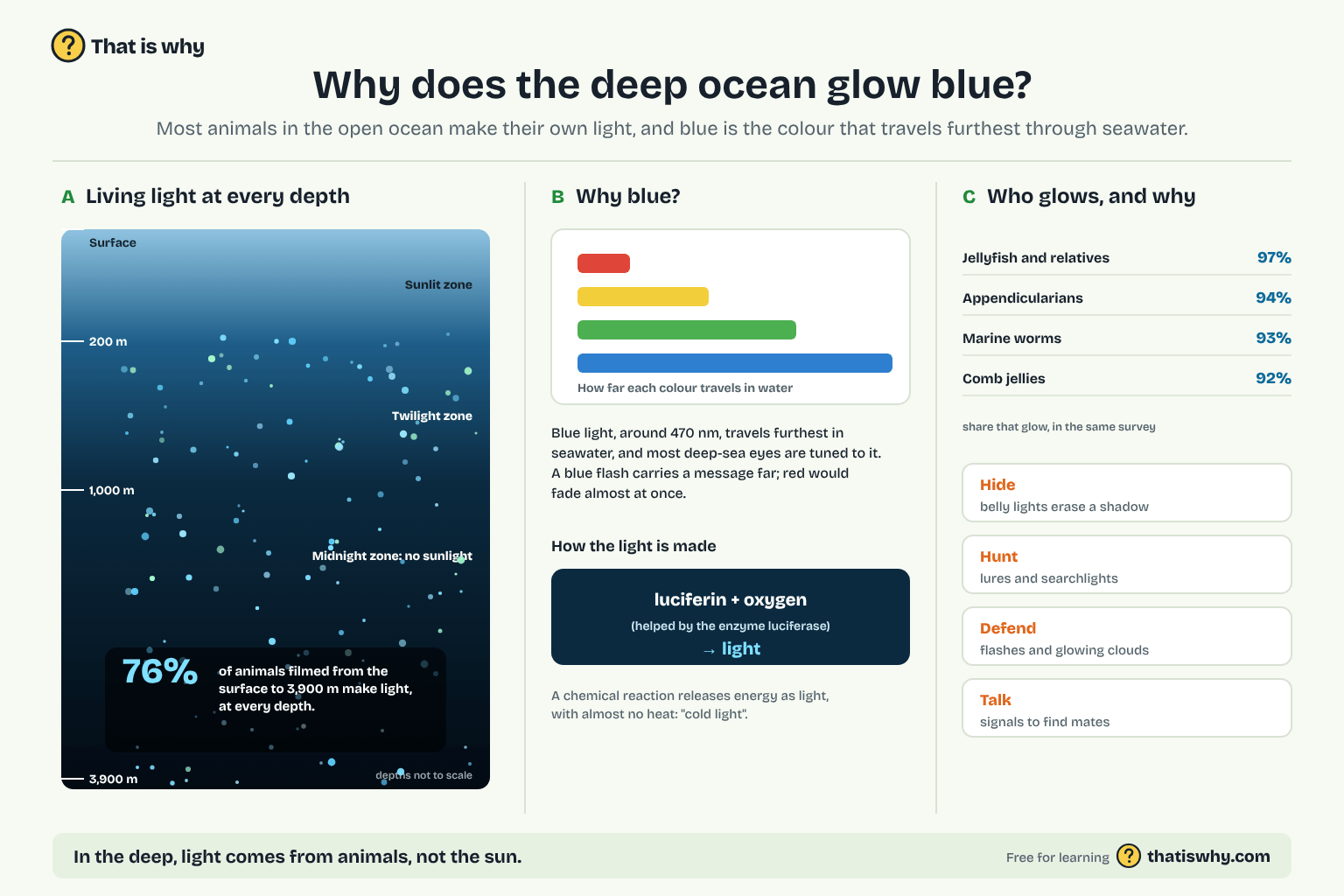
What the diagram shows
A. Living light at every depth. Below about 200 m, sunlight fades into the twilight zone, and below about 1,000 m it is gone. But the water is far from dark: tiny flashes and glows come from the animals themselves. A survey of 350,536 animals filmed by remotely operated vehicles off California, from the surface to 3,900 m, found that 76% could make light, and the share was remarkably similar at every depth.
B. Why blue? Blue light, around 470 nm in wavelength, travels furthest through seawater, and most deep-sea eyes are tuned to it. So most deep-sea light is blue. The light comes from a chemical reaction: a substance called luciferin reacts with oxygen, helped by an enzyme called luciferase, and the energy is released as light with almost no heat. This is bioluminescence.
C. Who glows, and why. In the same survey, about 97% of jellyfish and their relatives, 94% of appendicularians (small filter-feeders), 93% of marine worms and 92% of comb jellies could glow. Animals use light to hide (counterillumination), to hunt with lures and searchlights, to defend themselves with flashes and glowing clouds, and to signal to mates.
Key numbers
| Fact | Value |
|---|---|
| Animals that make light (survey) | 76% |
| Depths surveyed | surface to 3,900 m |
| Animals observed | 350,536, on 240 dives (1999 to 2016) |
| Typical deep-sea light color | blue, about 470 nm |
Common misconceptions
Myth The deep sea is completely dark.
The truth Sunlight runs out, but living light does not. Three quarters of the animals filmed in one large survey could make their own light.
Myth Glowing animals are rare oddities.
The truth In the open ocean, making light is the rule rather than the exception, from the surface to nearly 4,000 m.
Myth Bioluminescence works like a light bulb and makes heat.
The truth It is a chemical reaction that gives off light with almost no heat, which is why it is called cold light.
Questions to use in class
Tap a question to reveal a model answer.
1Why is most deep-sea bioluminescence blue rather than red or yellow?
Blue light travels furthest through seawater, and most deep-sea animals' eyes are tuned to blue, so a blue signal is seen from further away.
2Name the substance and the enzyme that react to make light.
Luciferin reacts with oxygen, helped by the enzyme luciferase.
3Give one way an animal can use light to hide.
Counterillumination: belly lights match the light from above so the animal's silhouette disappears to predators below.
4In the survey, 76% of animals made light. If a submersible spotted 200 animals, about how many would you expect to glow?
About 152 (200 × 0.76).
Key terms
- Bioluminescence
- Light made by a living thing through a chemical reaction. Most deep-sea bioluminescence is blue, the color that travels furthest in water.
- Luciferin
- The light-emitting substance in bioluminescence. When it reacts with oxygen, energy is released as light.
- Luciferase
- An enzyme that speeds up the reaction between luciferin and oxygen that produces bioluminescent light.
- Wavelength
- The distance between one wave peak and the next. For light it sets the color: red light has longer wavelengths (about 620 to 750 nm) than blue light (about 450 to 495 nm).
- Counterillumination
- Camouflage in which an animal makes light on its underside to match the light from above, so its silhouette disappears to anything looking up.
Sources
- Quantification of bioluminescence from the surface to the deep sea demonstrates its predominance as an ecological trait (Martini & Haddock, 2017) Scientific Reports
- Malacosteid fish and red luminescence The Bioluminescence Web Page, UC Santa Barbara