Free teaching diagram
Transparent Animals Diagram: How See-Through Sea Creatures Vanish
Light passes straight through, the anti-glare coat kills the shine, and only the dark eyes are left to see.
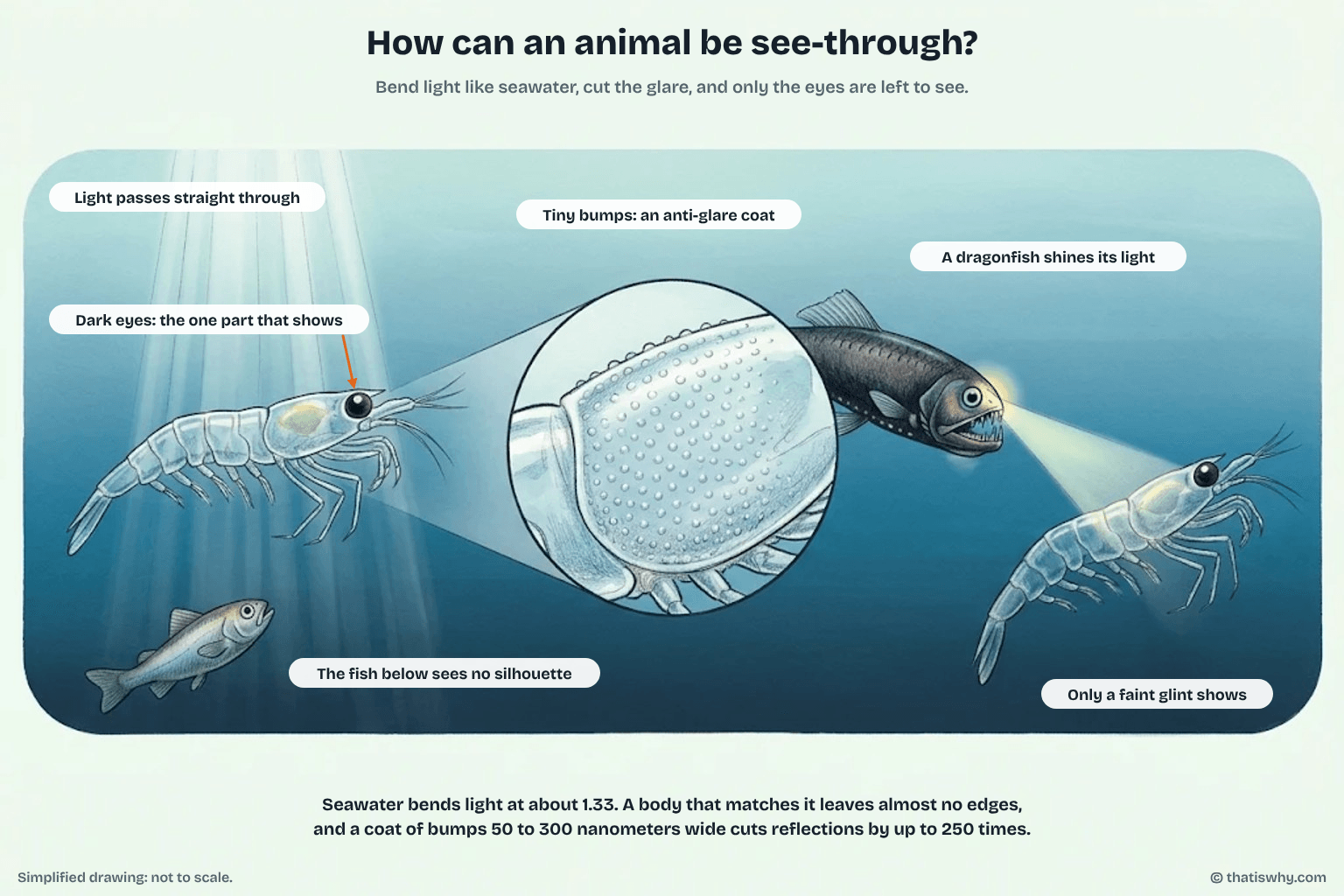
The detailed teaching diagram
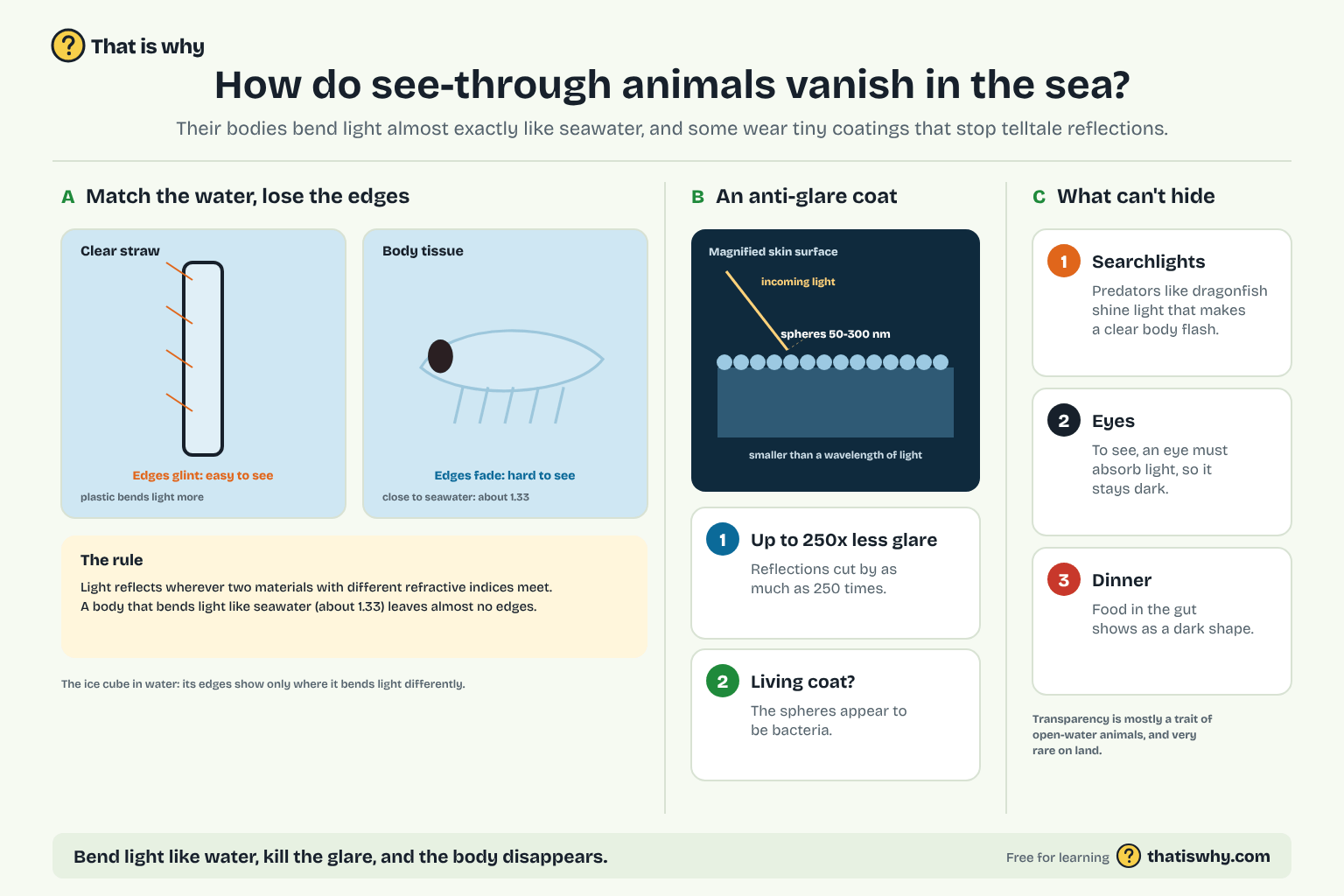
What the diagram shows
A. Match the water, lose the edges. Light reflects wherever two materials with different refractive indices meet, which is why a clear straw in water still shows its glinting edges. A see-through animal's body bends light close to seawater's refractive index of about 1.33, so it leaves almost no edges for a predator to spot.
B. An anti-glare coat. Seven species of see-through crustaceans called hyperiid amphipods, living in the twilight zone, are covered in spheres 50 to 300 nanometers across, smaller than a wavelength of light. The spheres appear to be living bacteria, and they cut reflections by as much as 250 times.
C. What can't hide. Predators such as dragonfish use bioluminescent searchlights that can make a clear body flash. Eyes must absorb light to see, so they stay dark, and food in the gut shows as a dark shape. Transparency is mostly a trait of open-water animals and very rare on land.
Key numbers
| Fact | Value |
|---|---|
| Refractive index of seawater | about 1.33 |
| Size of anti-reflective spheres | 50 to 300 nanometers |
| Reduction in reflection | up to 250 times |
| Amphipod species studied | 7 |
| Length of Cystisoma | up to six inches |
Common misconceptions
Myth Anything clear is invisible underwater.
The truth A clear straw in water still shows, because it bends light differently; light reflects wherever refractive indices differ.
Myth See-through animals can hide from every predator.
The truth Predators with bioluminescent searchlights can make a clear body flash, which is why some animals wear anti-glare coatings.
Myth Transparent animals are common everywhere.
The truth Transparency is mostly a trait of open-water animals and is very rare on land.
Questions to use in class
Tap a question to reveal a model answer.
1Why can you see a clear object in water?
Light reflects wherever two materials with different refractive indices meet, so its edges glint.
2What refractive index does a see-through sea animal need?
Close to seawater's, about 1.33.
3How do some see-through crustaceans stop reflections?
A coat of spheres 50 to 300 nanometers across, apparently bacteria, cuts reflections by up to 250 times.
4Which body parts can't be made see-through?
The eyes, which must absorb light to see, and food in the gut.
Key terms
- Refraction
- The bending of a wave, such as light or sound, when its speed changes. In the sea, sound bends towards water where it travels more slowly.
- Transparency
- Being see-through: light passes through the body with little scattering, so an animal makes almost no outline. Eyes and guts cannot be made fully clear.
- Refractive index
- A number that describes how much a material slows and bends light. Seawater's is about 1.33; light reflects wherever two materials with different refractive indices meet.
Sources
- Midwater ocean creatures use nanotech camouflage (Bagge et al., Current Biology 2016) Duke University
- Hidden in plain sight: the ecology and physiology of organismal transparency (Johnsen, 2001) The Biological Bulletin (Biodiversity Heritage Library)
- Staring into a crystal ball: understanding evolution and development of in vivo aquatic organismal transparency (Hotta et al., 2024) Frontiers in Ecology and Evolution