Free teaching diagram
Deep-Sea Fish Color Diagram: Why So Many Are Red
Red light never reaches the deep sea, so red animals reflect nothing and look black.
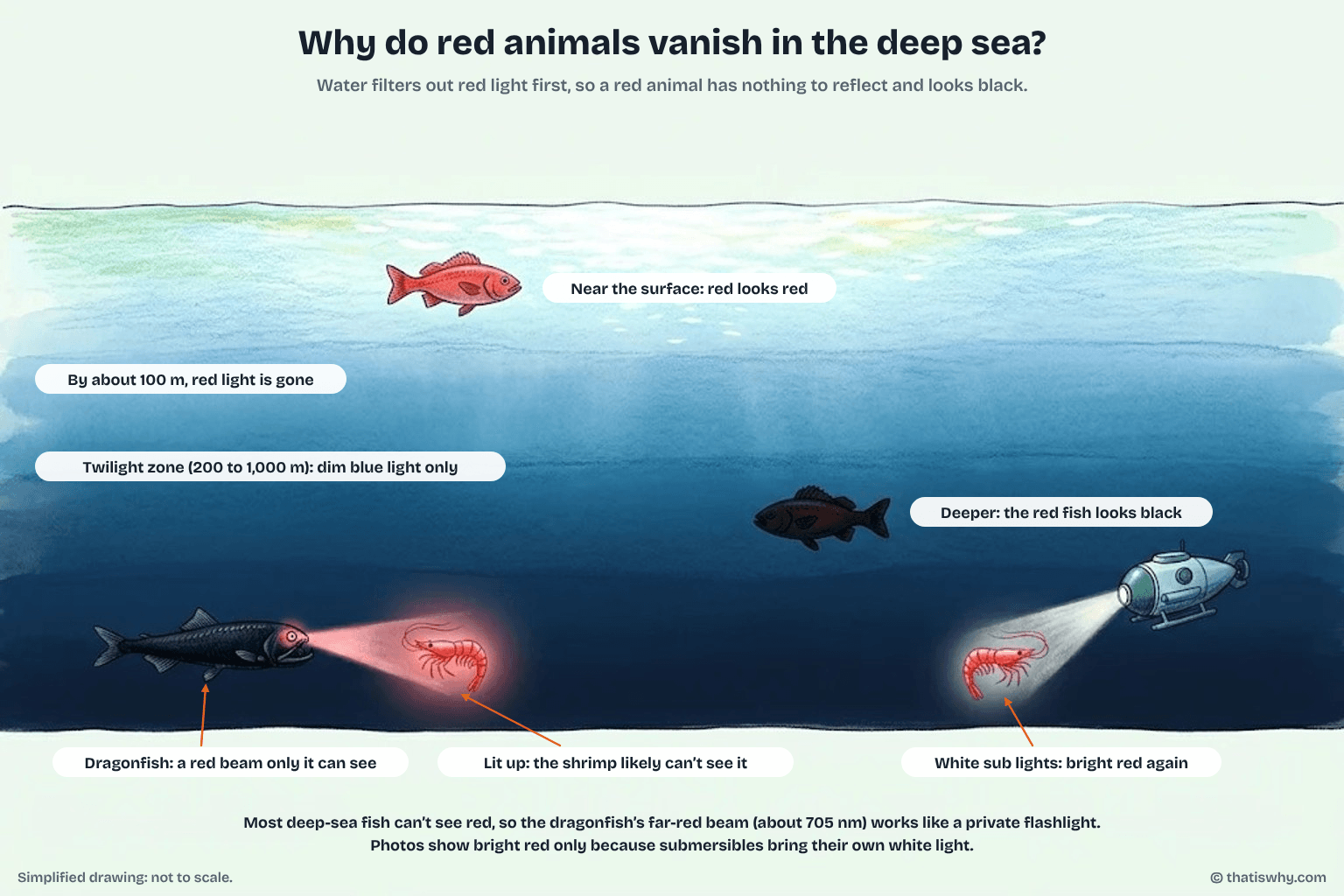
The detailed teaching diagram
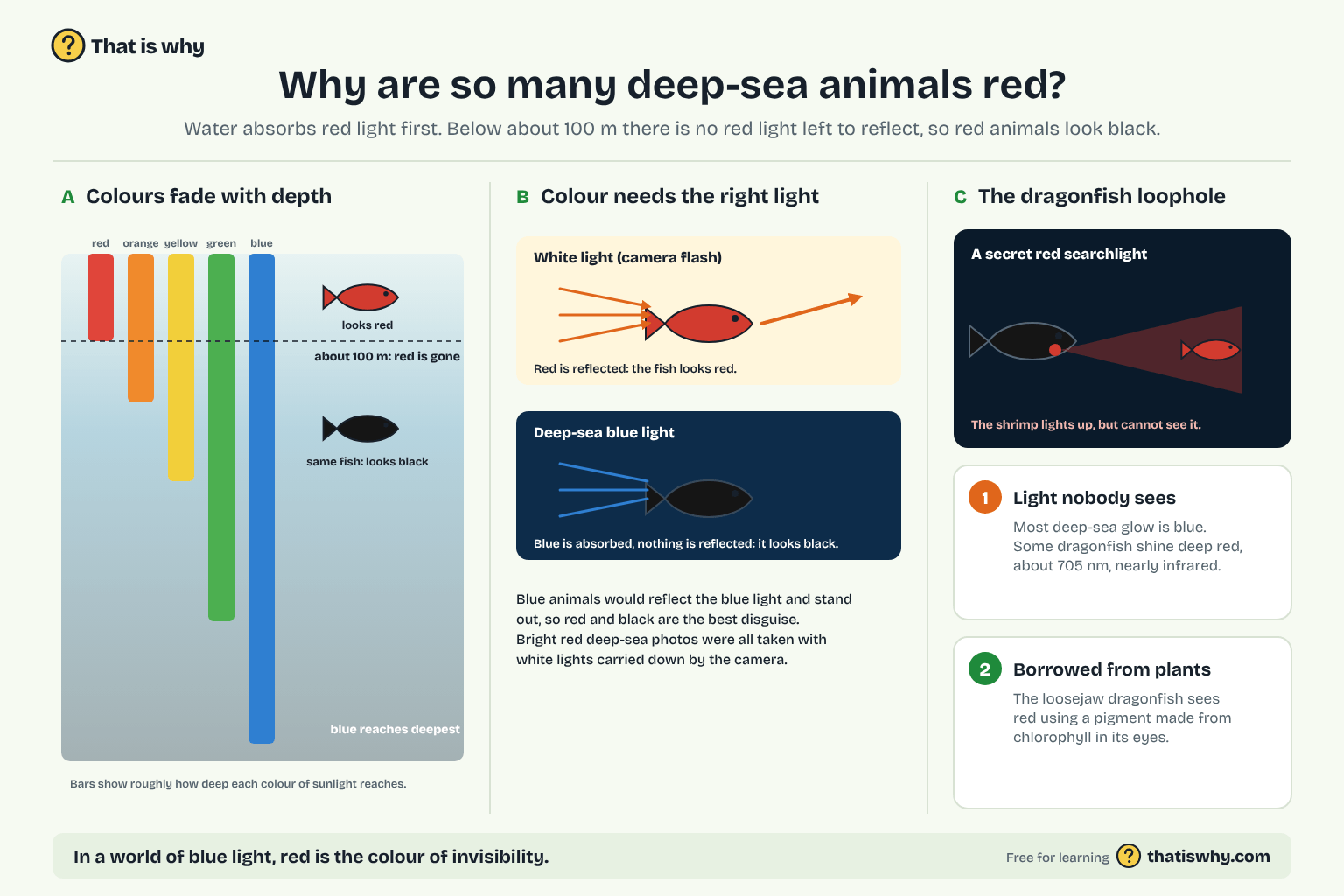
What the diagram shows
A. Colors fade with depth. Sunlight contains every color, but water absorbs them at different rates. Red is absorbed first and is gone by about 100 m, followed by orange and yellow. Blue travels deepest. A red fish near the surface looks red; take the same fish below about 100 m and it looks black.
B. Color needs the right light. An object looks red because it reflects red light and absorbs the rest. Under a white camera flash, a red fish reflects red and looks red. In the blue light of the deep, there is no red to reflect, so it absorbs the blue and reflects nothing: it looks black, the best disguise in the dark. A blue animal, by contrast, would reflect the blue light and stand out, which is why blue animals are rare in midwater. The bright red deep-sea photos we see were all taken with white lights brought down by the camera.
C. The dragonfish loophole. Most deep-sea bioluminescence is blue, around 470 nm, and most deep-sea eyes can only see blue. A few dragonfish break the rule. Light organs (photophores) under their eyes shine deep red, about 705 nm, close to infrared. The loosejaw dragonfish Malacosteus sees that red using a pigment made from chlorophyll in its eyes, so it can light up red prey that cannot see the beam.
Key numbers
| Fact | Value |
|---|---|
| Depth where red sunlight is gone | about 100 m |
| Color that reaches deepest | blue |
| Typical deep-sea glow | blue, about 470 nm |
| Dragonfish red light | about 705 nm |
Common misconceptions
Myth Deep-sea animals are red so they stand out.
The truth In the deep there is no red light, so red animals reflect nothing and look black. Red works as camouflage.
Myth Photos show what deep-sea animals look like at home.
The truth The bright reds in photos come from white lights carried down by submersibles and cameras. In their natural darkness these animals never look red.
Myth No deep-sea animal can see red.
The truth Most cannot, but a few dragonfish make and see red light, which lets them spot prey that has no idea it is lit up.
Questions to use in class
Tap a question to reveal a model answer.
1Why does a red object look black where there is only blue light?
A red object reflects red light and absorbs other colors. With no red light around, it absorbs the blue and reflects nothing, so it looks black.
2Why would a blue animal be easy to see in the deep sea?
It would reflect the blue light that is still present, so it would stand out against the dark water.
3How deep does red light reach in the ocean?
Not far. Red is the first color water absorbs, and by about 100 meters red light no longer gets through, according to NOAA Ocean Exploration.
4Why is a red searchlight such an advantage for a dragonfish?
Its prey cannot see red light, so the dragonfish can light up and spot prey without warning it.
Key terms
- Light absorption
- When a material takes in light energy instead of letting it pass or bounce off. Seawater absorbs red light first and blue light last.
- Wavelength
- The distance between one wave peak and the next. For light it sets the color: red light has longer wavelengths (about 620 to 750 nm) than blue light (about 450 to 495 nm).
- Bioluminescence
- Light made by a living thing through a chemical reaction. Most deep-sea bioluminescence is blue, the color that travels furthest in water.
- Photophore
- A light-producing organ in an animal's skin. Some dragonfish have photophores under their eyes that shine red.
Sources
- Dragon fish see using chlorophyll (Douglas et al., Nature 1998) Nature (via RePEc)
- Malacosteid fish and red luminescence The Bioluminescence Web Page, UC Santa Barbara
- Why are so many deep-sea animals red in color? NOAA Ocean Exploration
- Why is the ocean blue? NOAA National Ocean Service
- Light in the Deep Sea (educator activity) Smithsonian Ocean