Free teaching diagram
Whale Fall Diagram: How a Dead Whale Feeds the Deep Sea
A sunken whale feeds the deep sea in stages, from scavengers to bacteria living off the bones, for years to decades.
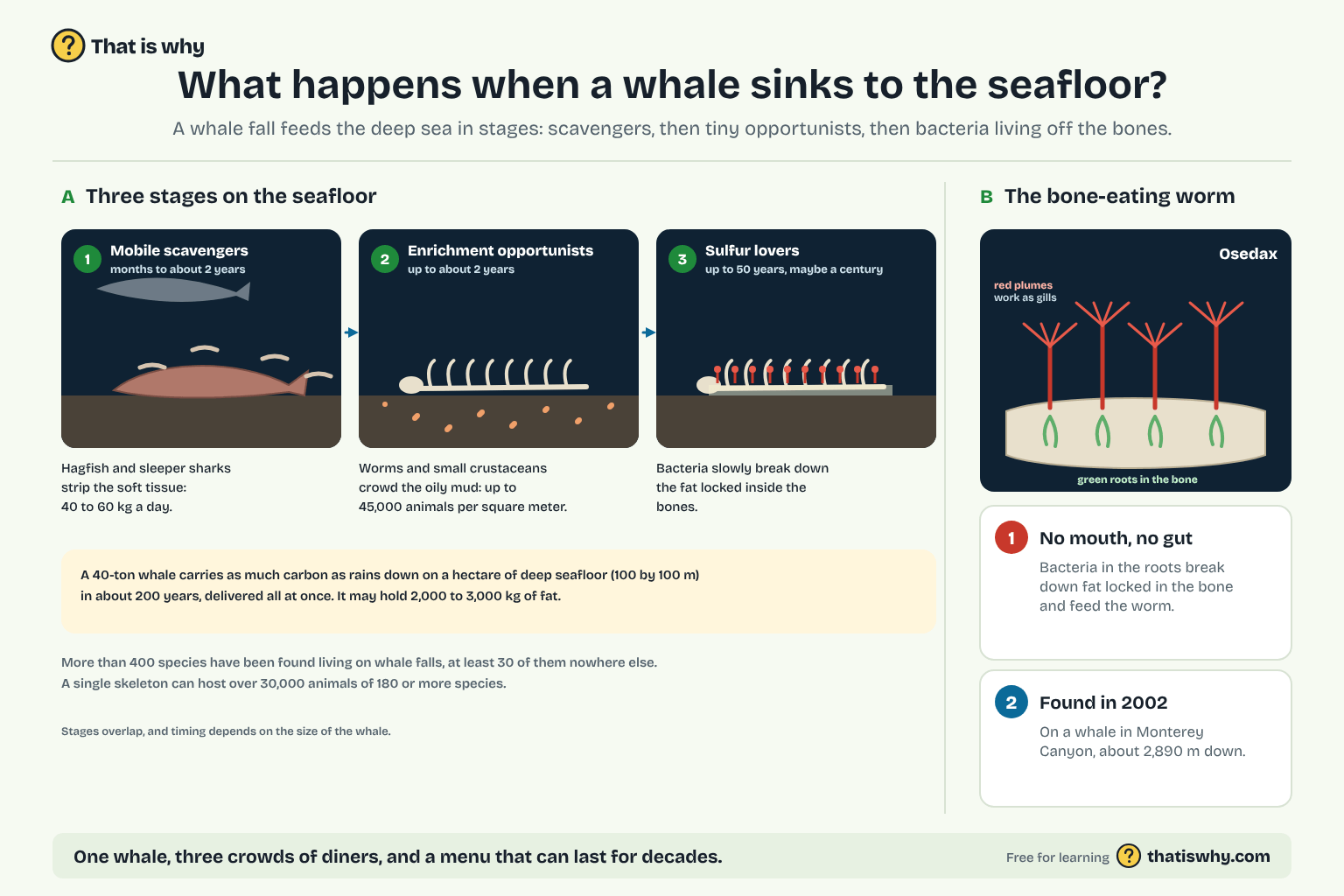
What the diagram shows
A. Three stages on the seafloor. When a whale sinks, a whale fall feeds the deep sea in overlapping stages that depend on the size of the whale. First come mobile scavengers such as hagfish and sleeper sharks, which strip the soft tissue at 40 to 60 kg a day for months up to about two years. Next, worms and small crustaceans crowd the oily mud around the skeleton, up to 45,000 animals per square meter, for up to about two years. Finally, bacteria slowly break down the fat locked inside the bones, a stage that can last up to 50 years, perhaps a century, for a large whale.
How much food? A 40-ton whale carries as much organic carbon as reaches a hectare (100 by 100 m) of deep seafloor in about 200 years, delivered all at once, and it may hold 2,000 to 3,000 kg of fat. More than 400 species have been found on whale falls, at least 30 of them nowhere else, and a single skeleton can host more than 30,000 animals of 180 or more species.
B. The bone-eating worm. Osedax worms have no mouth or gut. Their red plumes work as gills, and their green roots grow into the bone, where bacteria break down the fat locked inside. They were found in 2002 on a whale in Monterey Canyon, about 2,890 m down.
Key numbers
| Fact | Value |
|---|---|
| Flesh eaten by scavengers | 40 to 60 kg a day |
| Scavenger and opportunist stages | up to about 2 years each |
| Bone (sulfur-loving) stage | up to 50 years, perhaps a century |
| Carbon in a 40-ton whale | as much as a hectare of seafloor gets in about 200 years |
| Species found on whale falls | more than 400 |
Common misconceptions
Myth A dead whale is eaten in a few days.
The truth Scavengers can take up to about two years to strip the soft tissue, and the bones can feed life for up to 50 years, maybe a century.
Myth Only big scavengers feed on a whale fall.
The truth After the scavengers come crowds of worms and crustaceans, then bacteria living off the fat in the bones.
Myth Bones are of no use to anyone.
The truth Bone-eating Osedax worms grow roots into them, and bacteria in those roots digest the fat locked inside.
Questions to use in class
Tap a question to reveal a model answer.
1What is a whale fall?
A dead whale that has sunk to the deep seafloor, and the life that feeds on it in stages.
2How fast do scavengers eat a whale?
Hagfish and sleeper sharks can consume 40 to 60 kg of flesh a day.
3How long can a whale fall feed deep-sea life?
For a large whale, the bone stage can last up to 50 years, perhaps a century.
4How much food is a whale fall?
A 40-ton whale carries as much carbon as reaches a hectare of deep seafloor in about 200 years.
5What is Osedax?
A bone-eating worm with no mouth or gut; bacteria in its roots digest fat inside whale bones.
Key terms
- Whale fall
- A dead whale that has sunk to the deep seafloor, and the community of life that feeds on it in stages, from scavengers to bone-dwelling bacteria, for years to decades.
- Osedax
- Deep-sea worms with no mouth or gut that grow green roots into whale bones; bacteria in the roots break down the fat locked in the bone. Found on a whale carcass in Monterey Canyon in 2002 and first described in 2004.
- Chemosynthesis
- Making food from the energy in chemicals, such as hydrogen sulfide, instead of from sunlight. Bacteria at deep-sea vents use it to feed whole communities.
Sources
- Life at the Bottom: The Prolific Afterlife of Whales Scientific American
- Faunal succession on replicate deep-sea whale falls: time scales and vent-seep affinities (Smith, Baco & Glover, 2002) Cahiers de Biologie Marine (VLIZ)
- Whale carcass yields bone-devouring worms MBARI