Free teaching diagram
Scaly-Foot Snail Diagram: A Shell Made of Iron
A vent home, a snail fed by bacteria, and a three-layer shell coated in iron sulfide.
The detailed teaching diagram
What the diagram shows
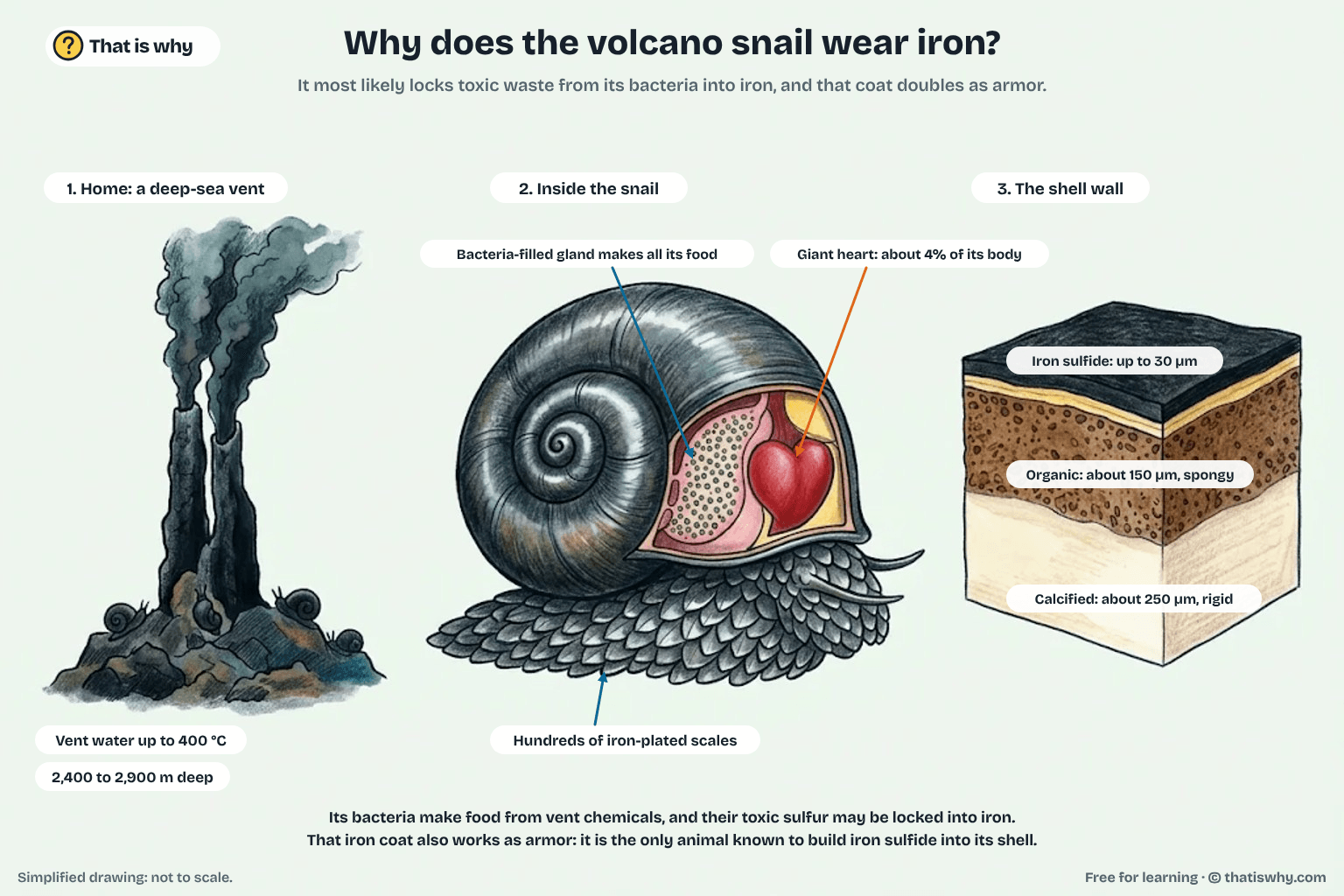
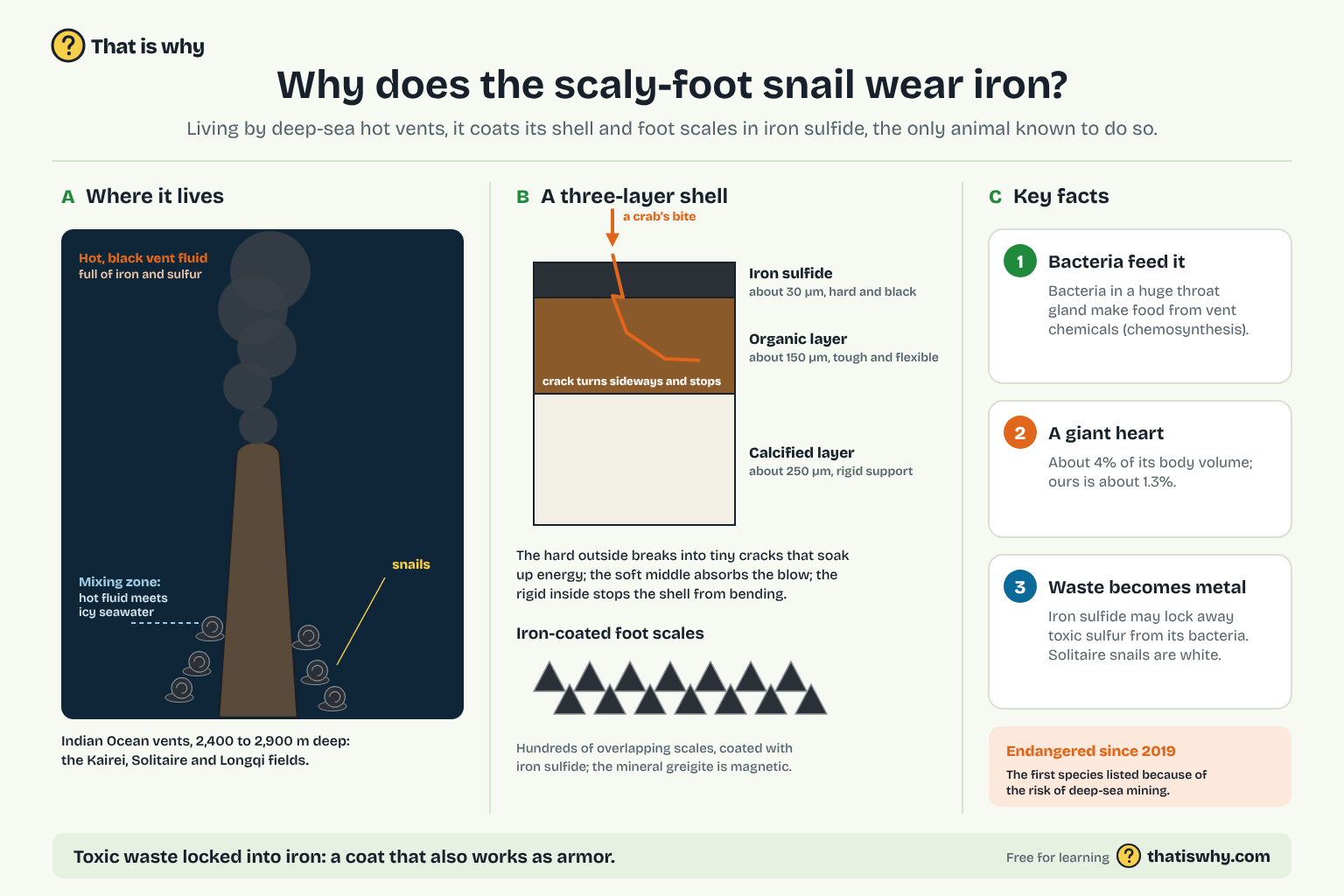
A. Where it lives. The scaly-foot snail, Chrysomallon squamiferum, is known from only three hydrothermal vent fields in the Indian Ocean, Kairei, Solitaire and Longqi, 2,400 to 2,900 m deep. It lives beside black-smoker chimneys, where vent water can reach 400 °C.
B. A three-layer shell. Its shell is built like modern body armor:
- Iron sulfide outside, up to 30 µm thick, containing the magnetic mineral greigite: the thinnest but toughest layer, it breaks into tiny cracks that soak up energy.
- An organic layer in the middle, about 150 µm: soft and spongy, it absorbs the force of a blow.
- A calcified layer inside, about 250 µm: rigid, it keeps the shell from bending.
Its foot is covered in hundreds of overlapping scales coated with iron sulfide. It is the only animal known to build iron sulfide into its shell.
C. Key facts. The adult never eats: bacteria in a huge gland in its throat make its food from vent chemicals (chemosynthesis), a partnership called symbiosis. To supply them, it has a giant heart, about 4% of its body volume, against about 1.3% in humans. The snail expert Chong Chen thinks the iron coat mainly locks away toxic waste from those bacteria, and also works as armor. Snails at Solitaire are white, because the chemistry there is different. In 2019, it became the first vent animal listed as endangered, because its homes are under deep-sea mining exploration licences.
Key numbers
| Fact | Value |
|---|---|
| Depth | about 2,400 to 2,900 m |
| Shell layers | up to 30 µm iron sulfide, about 150 µm organic, about 250 µm calcified |
| Shell length | up to 45 mm |
| Heart size | about 4% of body volume (humans about 1.3%) |
| Vent fields where it lives | 3 |
Common misconceptions
Myth The volcano snail lives in lava.
The truth It lives beside deep-sea hot vents, in the zone where hot vent fluid mixes with near-freezing seawater, not in the fluid itself.
Myth Its iron coat is armor against crabs, and nothing else.
The truth It does resist attacks well, but the snail expert Chong Chen says its main job is removing toxins from the snail's symbiotic bacteria.
Myth Every scaly-foot snail is black and iron-coated.
The truth Snails from the Solitaire vent field are white, because the chemistry of their water is different.
Questions to use in class
Tap a question to reveal a model answer.
1Why is a shell made of a hard layer over a soft layer harder to break than one made of a single hard layer?
The hard outside breaks into tiny cracks that soak up energy, and the softer middle absorbs the blow before it reaches the inside.
2There are no plants at a deep-sea vent. How does the scaly-foot snail get food?
Bacteria living in a large gland in its throat make food from chemicals in the vent water, a process called chemosynthesis. The snail lives on what they produce.
3What does the white form of the snail tell us about its iron coat?
Snails at a vent field with different water chemistry are white, so the coat depends on what is in the water around them.
4Why might deep-sea mining be a particular threat to this snail?
It is known from only a few small vent fields in the Indian Ocean, so damaging one field could wipe out a large share of all the snails that exist.
Key terms
- Hydrothermal vent
- A crack in the seafloor where water heated by volcanic rock gushes out, loaded with dissolved minerals. Black smokers are vents whose fluid looks like dark smoke.
- Iron sulfide
- A mineral made of iron and sulfur. The scaly-foot snail coats its shell and foot scales with iron sulfides such as greigite and pyrite.
- Chemosynthesis
- Making food from the energy in chemicals, such as hydrogen sulfide, instead of from sunlight. Bacteria at deep-sea vents use it to feed whole communities.
- Symbiosis
- A close, long-lasting partnership between two different kinds of living thing, such as the scaly-foot snail and the bacteria that live inside it and make its food.
- Aragonite
- A form of calcium carbonate, the white mineral that most mollusc shells and corals are built from.
Sources
- Protection mechanisms of the iron-plated armor of a deep-sea hydrothermal vent gastropod (Yao et al., PNAS 2010) PNAS (author copy via iMechanica)
- The heart of a dragon: 3D anatomical reconstruction of the 'scaly-foot gastropod' (Chen et al., 2015) Frontiers in Zoology
- Celebrate Endangered Species Day: Meet the Scaly-Foot Snail, the Most Metal Animal in the World Scientific American
- The scaly-foot snail's shell is made of actual iron, and it's magnetic Australian Geographic
- First animal officially endangered by deep-sea mining Australian Museum