Free teaching diagram
Solar Salamander Diagram: Algae Inside Salamander Eggs
Algae grow in spotted salamander eggs and even inside embryo cells, trading oxygen and sugar for waste.
The detailed teaching diagram
What the diagram shows
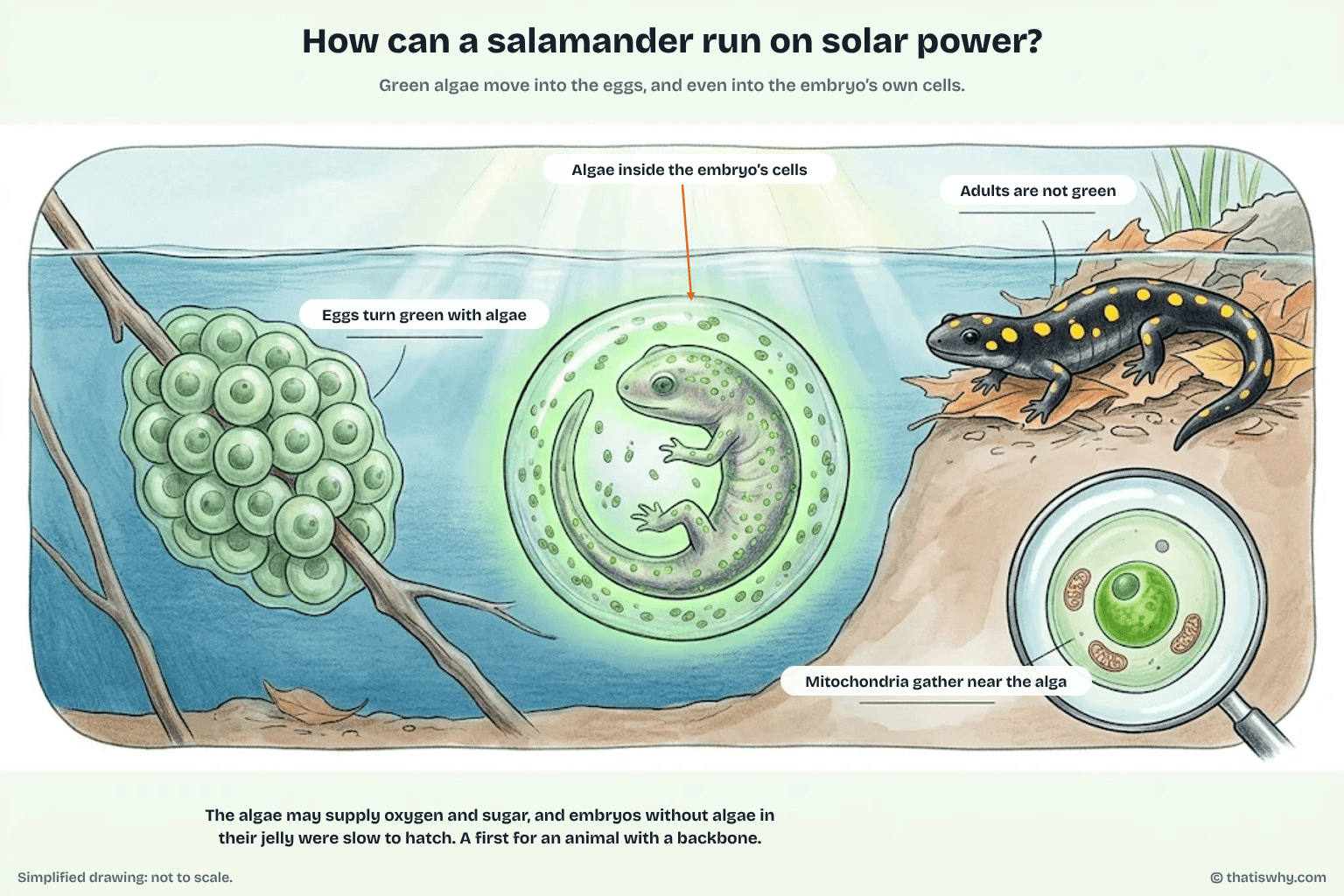
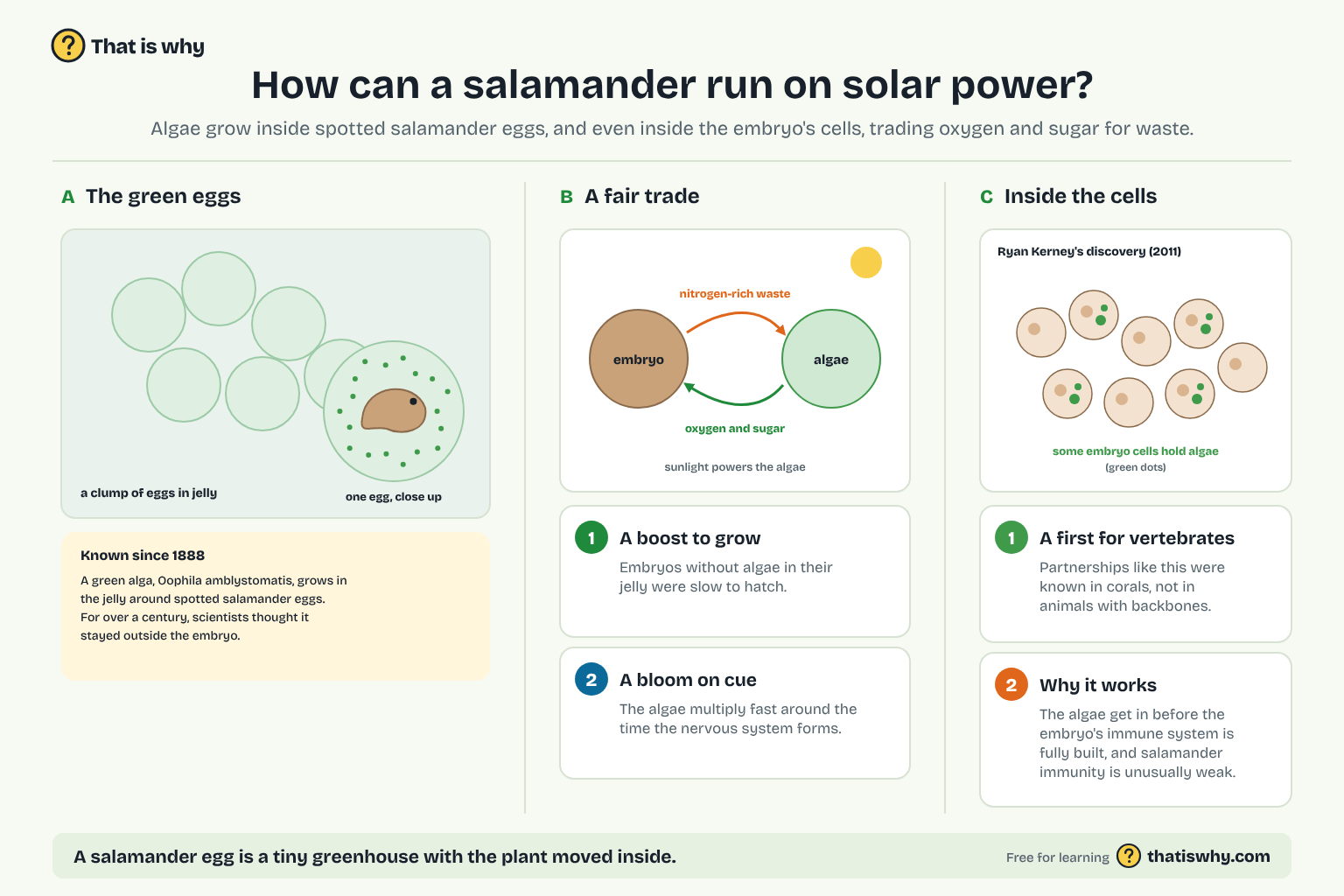
A. The green eggs. Spotted salamanders lay their eggs in clumps of jelly, and a single-celled green alga, Oophila amblystomatis, grows there. In 1888, Henry Orr noticed the eggs' green color but thought the algae stayed outside the embryos, and that view held for over a century.
B. A fair trade. The embryo's nitrogen-rich waste feeds the algae, and the algae, powered by sunlight through photosynthesis, supply oxygen and sugar in return. This kind of partnership is called symbiosis. Earlier work found that embryos without algae in their jelly were slow to hatch, and the algae multiply fast around the time the embryo's nervous system forms.
C. Inside the cells. In 2011, Ryan Kerney and his colleagues showed that the algae get inside some of the embryo's cells, making them endosymbionts. Partnerships like this were known in invertebrates such as corals, but not in animals with backbones. The algae get in before the embryo's immune system is fully built, and salamanders have unusually weak immune systems.
Key numbers
| Fact | Value |
|---|---|
| Green algae first noted in the eggs | 1888 (Henry Orr) |
| Algae found inside embryo cells | 2011 (Kerney and colleagues) |
Common misconceptions
Myth The algae just sit on the outside of the eggs.
The truth That was the view for over a century; in 2011, Ryan Kerney found algae inside the embryo's cells.
Myth The salamander photosynthesizes by itself.
The truth The algae do the photosynthesis and share oxygen and sugar; the embryo supplies nitrogen-rich waste.
Myth Animals with backbones always destroy invaders like this.
The truth The algae get in before the embryo's immune system is fully built, and salamanders have unusually weak immune systems.
Questions to use in class
Tap a question to reveal a model answer.
1What alga lives in spotted salamander eggs?
Oophila amblystomatis, a single-celled green alga.
2What do the algae and the embryo trade?
The embryo gives nitrogen-rich waste; the algae give oxygen and sugar from photosynthesis.
3What did Ryan Kerney discover?
That the algae are not only around the embryo but inside some of its cells, a first for an animal with a backbone.
4Does it help the salamander?
Earlier work found that embryos without algae in their jelly were slow to hatch.
Key terms
- Symbiosis
- A close, long-lasting partnership between two different kinds of living thing, such as the scaly-foot snail and the bacteria that live inside it and make its food.
- Endosymbiont
- An organism that lives inside the cells or body of another, to the benefit of both. Green algae living inside spotted salamander embryo cells are the first known case in an animal with a backbone.
- Photosynthesis
- The process plants use to turn sunlight, water and carbon dioxide into sugar, releasing oxygen. It takes place mainly in leaves and needles.
Sources
- Solar salamander: photosynthetic algae found inside the cells of a vertebrate Scientific American
- Solar salamanders have algae in their cells National Geographic
- Intracellular invasion of green algae in a salamander host (Kerney et al., PNAS 2011) Ewha Womans University research portal