Free teaching diagram
Cactus Spines Diagram: Why Cacti Have Spines Instead of Leaves
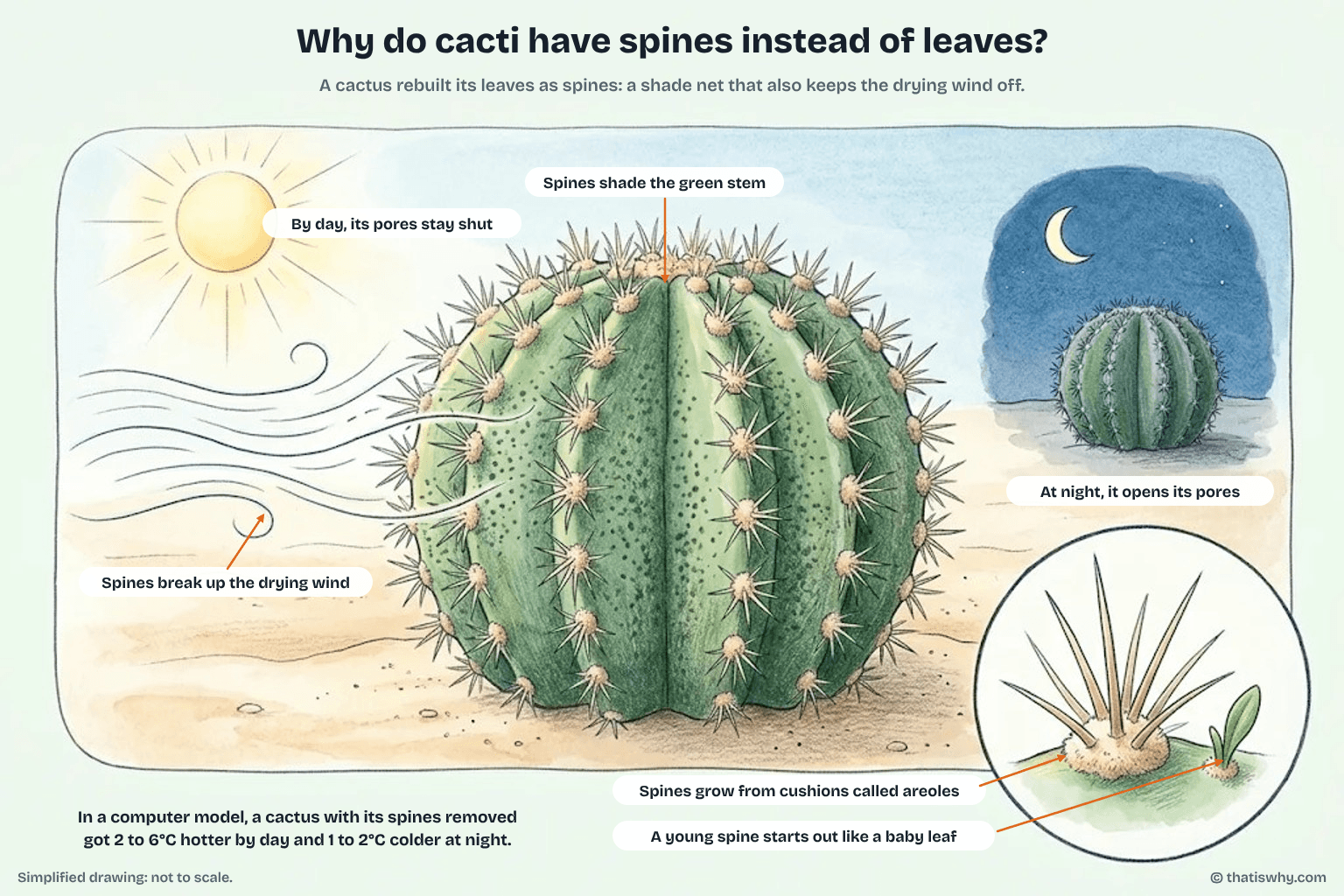
Spines shade the green stem and break up the drying wind, the pores open only at night, and every spine starts out like a baby leaf.
The detailed teaching diagram
What the diagram shows
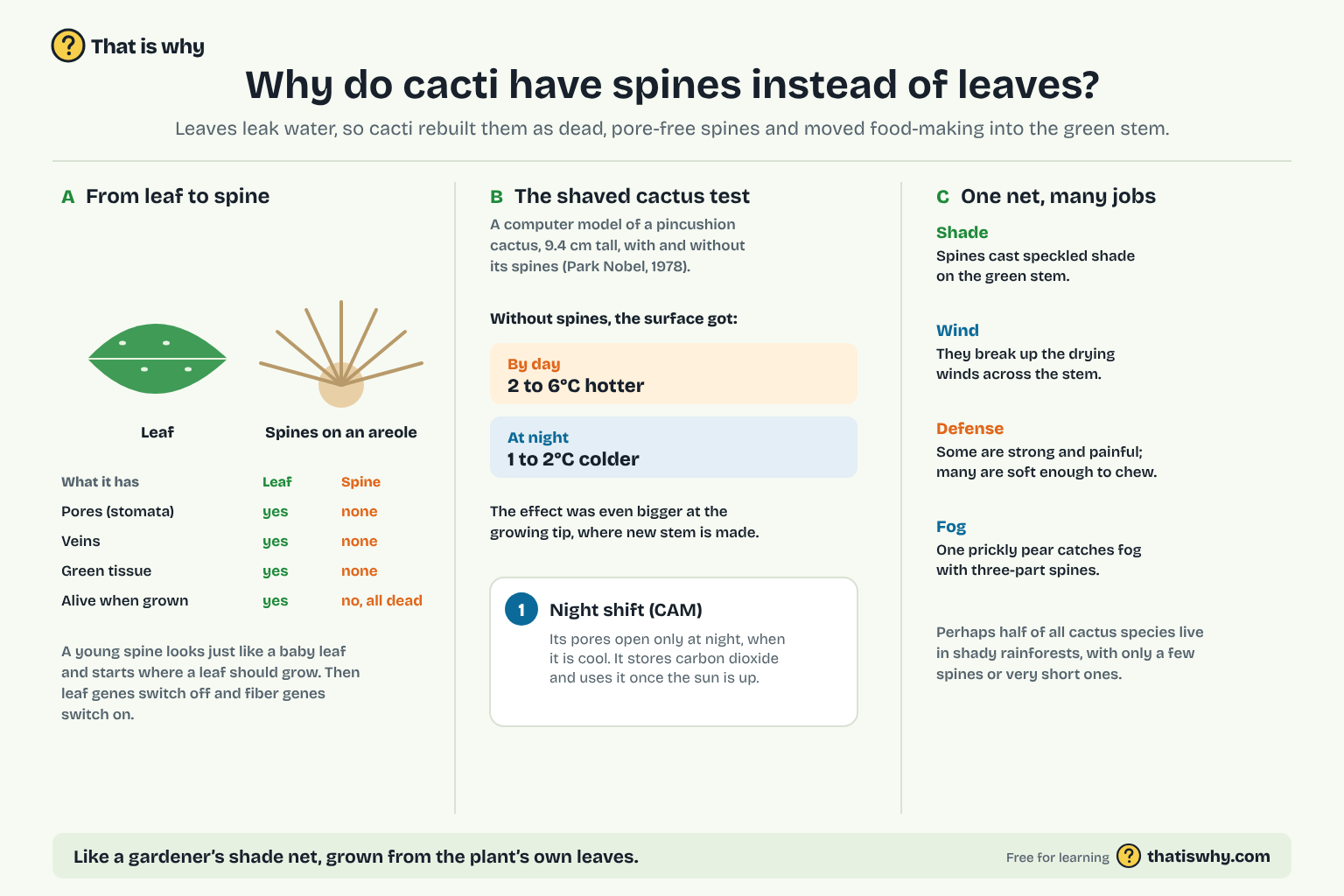
A. From leaf to spine. A leaf is a thin sheet dotted with stomata, pores that let carbon dioxide in and water vapor out. In most cacti, leaves are absent or greatly reduced, and the spines grow from small cushions called areoles. A young spine looks just like a baby leaf and starts where a leaf should grow, but then its leaf genes switch off and fiber genes switch on. A finished spine has no pores, no veins and no green tissue, and every cell in it is dead.
B. The shaved cactus test. In 1978, botanist Park Nobel built a computer model of a 9.4 cm pincushion cactus. Without its spines, the cactus surface got 2 to 6°C hotter by day and 1 to 2°C colder at night, and the effect was even bigger at the growing tip. The green stem now does the photosynthesis, on a night shift called crassulacean acid metabolism (CAM): its pores open only at night, when it is cool, and it stores carbon dioxide to use once the sun is up.
C. One net, many jobs. Spines cast shade on the stem and break up the drying winds. Some are strong and painful enough to protect the plant, but many are soft enough for a hungry animal to chew through. One small prickly pear, Opuntia microdasys, even catches fog with clusters of three-part spines. Perhaps half of all cactus species live in shady rainforests, where they have only a few spines or very short ones.
Key numbers
| Fact | Value |
|---|---|
| Height of the modeled cactus | 9.4 cm |
| Without spines, by day | 2 to 6°C hotter |
| Without spines, at night | 1 to 2°C colder |
| Living cells in a mature spine | none |
| Share of cactus species in rainforests | perhaps as many as half |
| Parts of each fog-catching spine | 3 |
Common misconceptions
Myth Spines are only there to stop animals.
The truth Many spines are soft enough to chew through, and some flat, papery ones are good only for shade.
Myth A cactus spine is alive.
The truth A mature spine is completely dead; only its base has living cells while it grows.
Myth Every cactus is covered in spines.
The truth Peyote has no spines, and many shady rainforest cacti have only a few spines or very short ones.
Questions to use in class
Tap a question to reveal a model answer.
1What is a cactus spine made from?
A leaf. A young spine looks just like a baby leaf, then grows into fibers instead of green tissue.
2How much do spines cool a cactus?
In a computer model, a cactus without spines got 2 to 6°C hotter by day and 1 to 2°C colder at night.
3When does a cactus open its pores?
Only at night, when it is cool. It stores carbon dioxide and uses it once the sun is up (CAM).
4Where do cactus spines grow from?
From small, cushionlike bumps called areoles.
Key terms
- Areole
- A small, cushionlike bump on a cactus stem. In almost all cacti, the spines grow from areoles, and so do the flowers and branches.
- Stomata
- Tiny pores on leaves that open to let in carbon dioxide and let out water vapor and oxygen. Pine needles keep theirs sunk in pits, away from drying wind.
- Crassulacean acid metabolism
- A night-shift way of making food used by cacti and other succulents. The plant opens its pores only at night, stores carbon dioxide as a chemical, and uses it for photosynthesis once the sun is up, so it loses far less water.
- Photosynthesis
- The process plants use to turn sunlight, water and carbon dioxide into sugar, releasing oxygen. It takes place mainly in leaves and needles.
Sources
- Cactus Spines (James D. Mauseth, research on cacti) The University of Texas at Austin
- Surface Temperatures of Cacti: Influences of Environmental and Morphological Factors (Park S. Nobel, Ecology 1978) Ecological Society of America (AGRIS record, FAO)
- Cacti / Desert Succulents U.S. National Park Service, Arches National Park
- Cactus summary Encyclopaedia Britannica
- A multi-structural and multi-functional integrated fog collection system in cactus (Ju et al., Nature Communications 2012) Nature Communications (RePEc record)