Free teaching diagram
Lotus Effect Diagram: Why Water Rolls Off Lotus Leaves
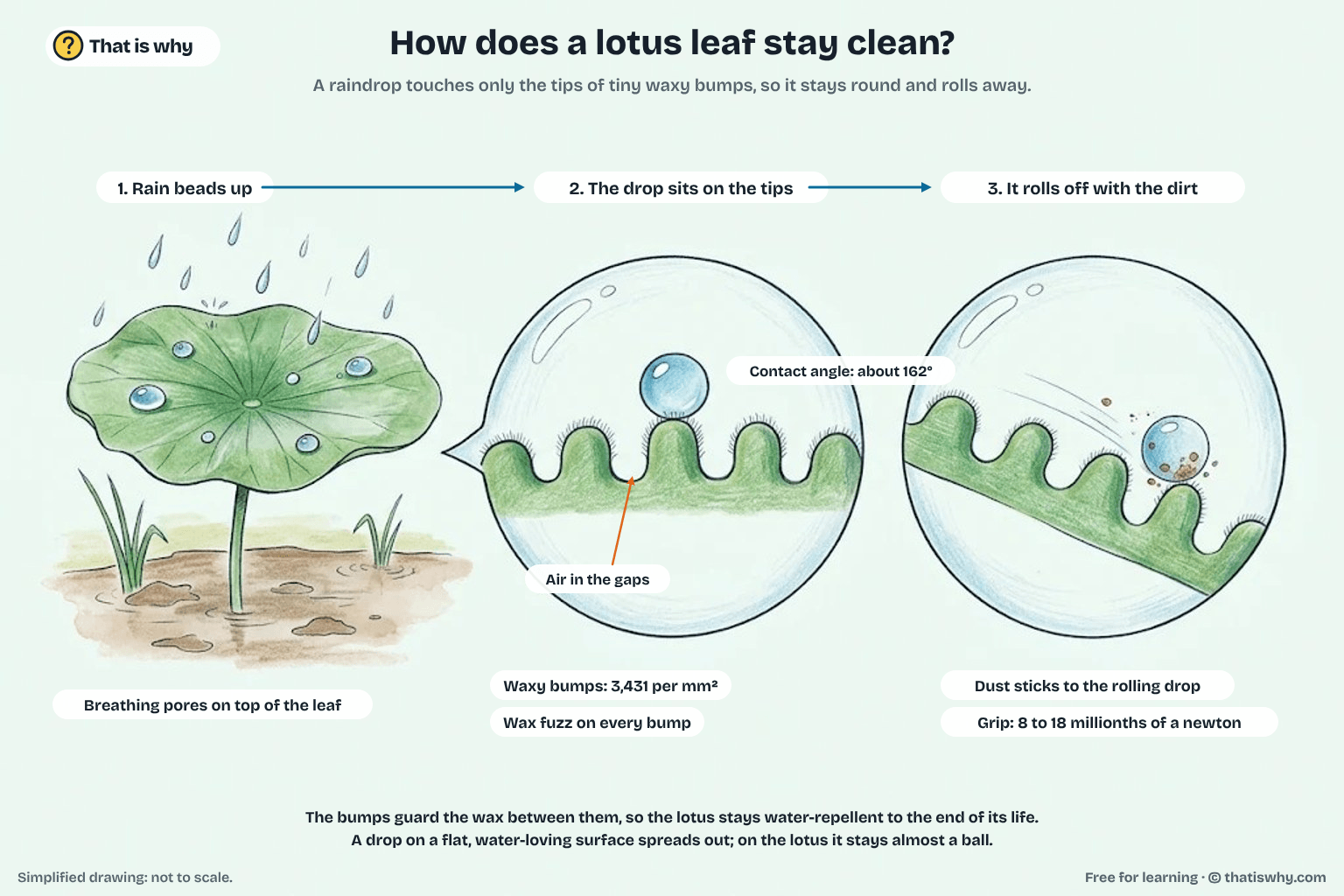
Rain beads up, sits on the tips and rolls off with the dirt.
The detailed teaching diagram
What the diagram shows
1. Rain beads up. Raindrops on a lotus leaf gather into shiny beads instead of spreading. That matters because the lotus keeps its breathing pores, the stomata, on the top of the leaf.
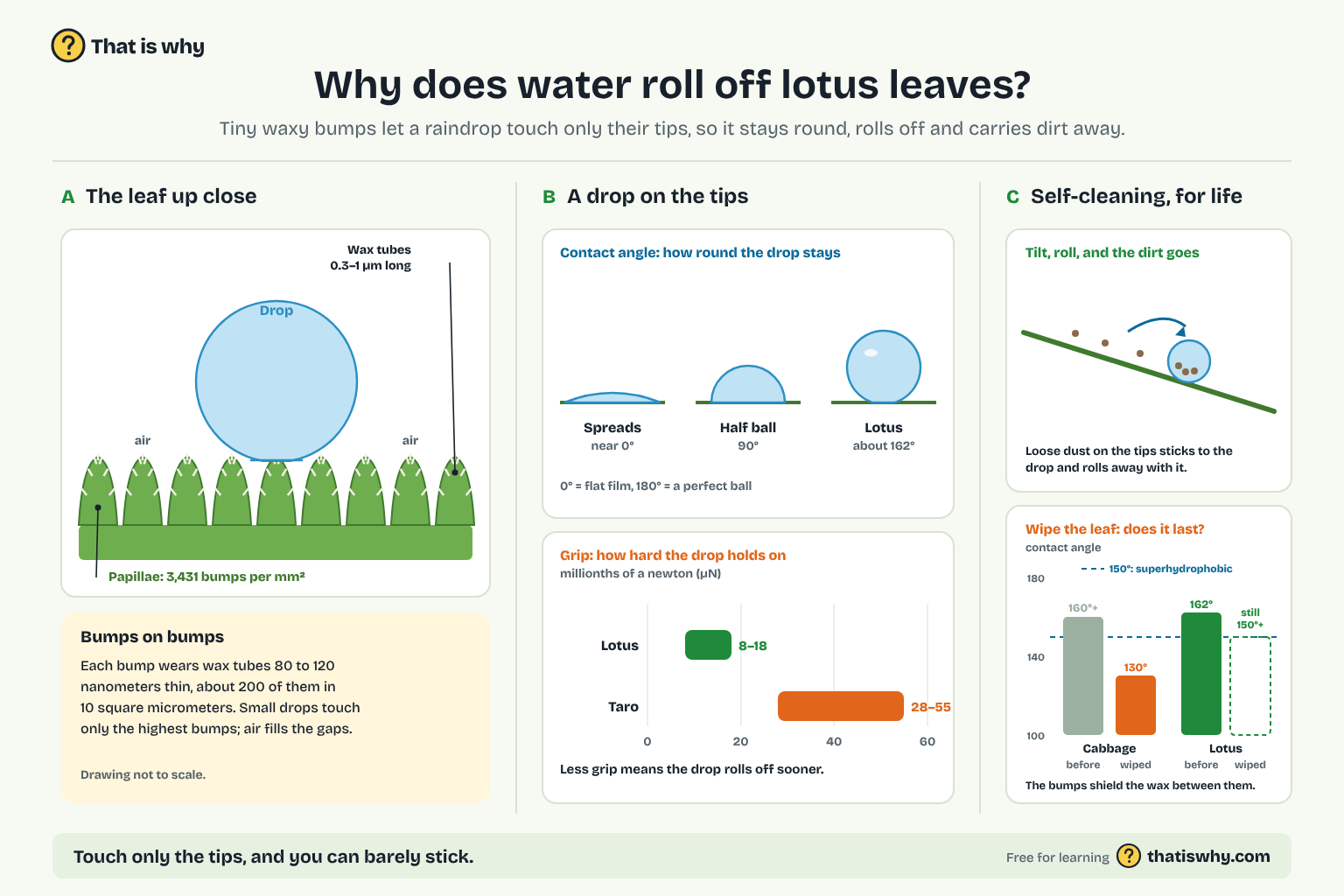
2. The drop sits on the tips. The leaf is covered in 3,431 pointed bumps per square millimeter, each coated in wax tubes far thinner than a hair. A small drop touches only the highest bumps, with air trapped in the gaps, so surface tension pulls it into a near-ball with a contact angle of about 162 degrees.
3. It rolls off with the dirt. Tilt the leaf and the drop rolls, gripping with only 8 to 18 millionths of a newton. Dust resting loosely on the tips sticks to the drop and leaves with it. Copying this trick in paint and other materials is an example of biomimicry.
Key numbers
| Fact | Value |
|---|---|
| Bumps (papillae) per square millimeter | 3,431 |
| Contact angle of water on lotus | about 162 degrees |
| Drop grip on lotus vs taro | 8 to 18 vs 28 to 55 millionths of a newton |
| Wiped cabbage leaf contact angle | falls from 160 to about 130 degrees |
Common misconceptions
Myth Lotus leaves are smooth like plastic.
The truth They are rough with 3,431 tiny bumps per square millimeter, and that roughness keeps water away.
Myth The lotus is the most water-repellent leaf.
The truth Taro scored even higher (165 degrees). The lotus stands out because its water-repellence lasts.
Myth A thick coat of wax is enough.
The truth Shape matters too: the bumps protect the wax between them, so wiping doesn't ruin the effect.
Questions to use in class
Tap a question to reveal a model answer.
1How many bumps are on a lotus leaf?
About 3,431 per square millimeter, the densest of the leaves compared in the study.
2What is the contact angle of water on a lotus leaf?
About 162 degrees, close to a perfect ball (180 degrees).
3How does the leaf clean itself?
Rolling raindrops pick up dust resting loosely on the bump tips and carry it off the leaf.
4Why does the lotus need a dry top surface?
Its breathing pores, the stomata, are on the upper side of the leaf.
Key terms
- Surface tension
- The pull that makes a liquid's surface behave like a stretched skin, drawing it to the smallest area. In a warm hive it pulls soft wax walls straight into hexagons.
- Cuticle
- A waxy, waterproof layer on the outside of leaves and needles that slows water loss. Conifer needles have a particularly thick one.
- Stomata
- Tiny pores on leaves that open to let in carbon dioxide and let out water vapor and oxygen. Pine needles keep theirs sunk in pits, away from drying wind.
- Biomimicry
- Copying ideas from living things to solve human problems, such as buildings cooled by airflow inspired by termite mounds.
Sources
- Superhydrophobicity in perfection: the outstanding properties of the lotus leaf (Ensikat, Ditsche-Kuru, Neinhuis and Barthlott, Beilstein Journal of Nanotechnology 2011) Beilstein Journal of Nanotechnology
- Keeping It Clean AskNature (Biomimicry Institute)
- StoColor Lotusan Paint AskNature (Biomimicry Institute)
- How do lotus leaves clean themselves? CORDIS, European Commission
- Superhydrophobicity: The Lotus Effect TeachEngineering (Duke University)