Free teaching diagram
Pitcher Plant Diagram: How the Wet Rim Traps Insects
Dry rim, wet rim, no grip: how a pitcher plant turns a film of water into a trap.
The detailed teaching diagram
What the diagram shows
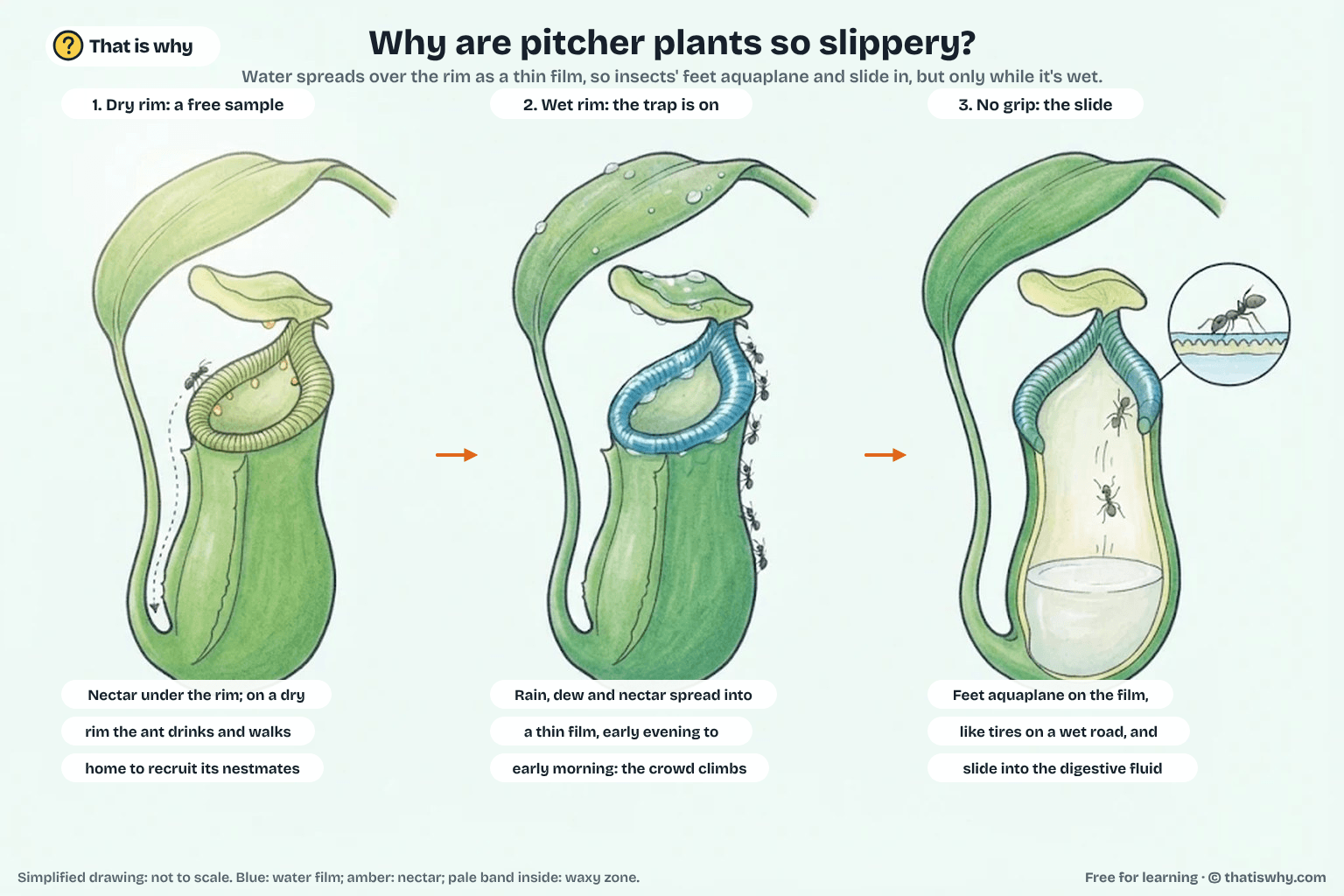
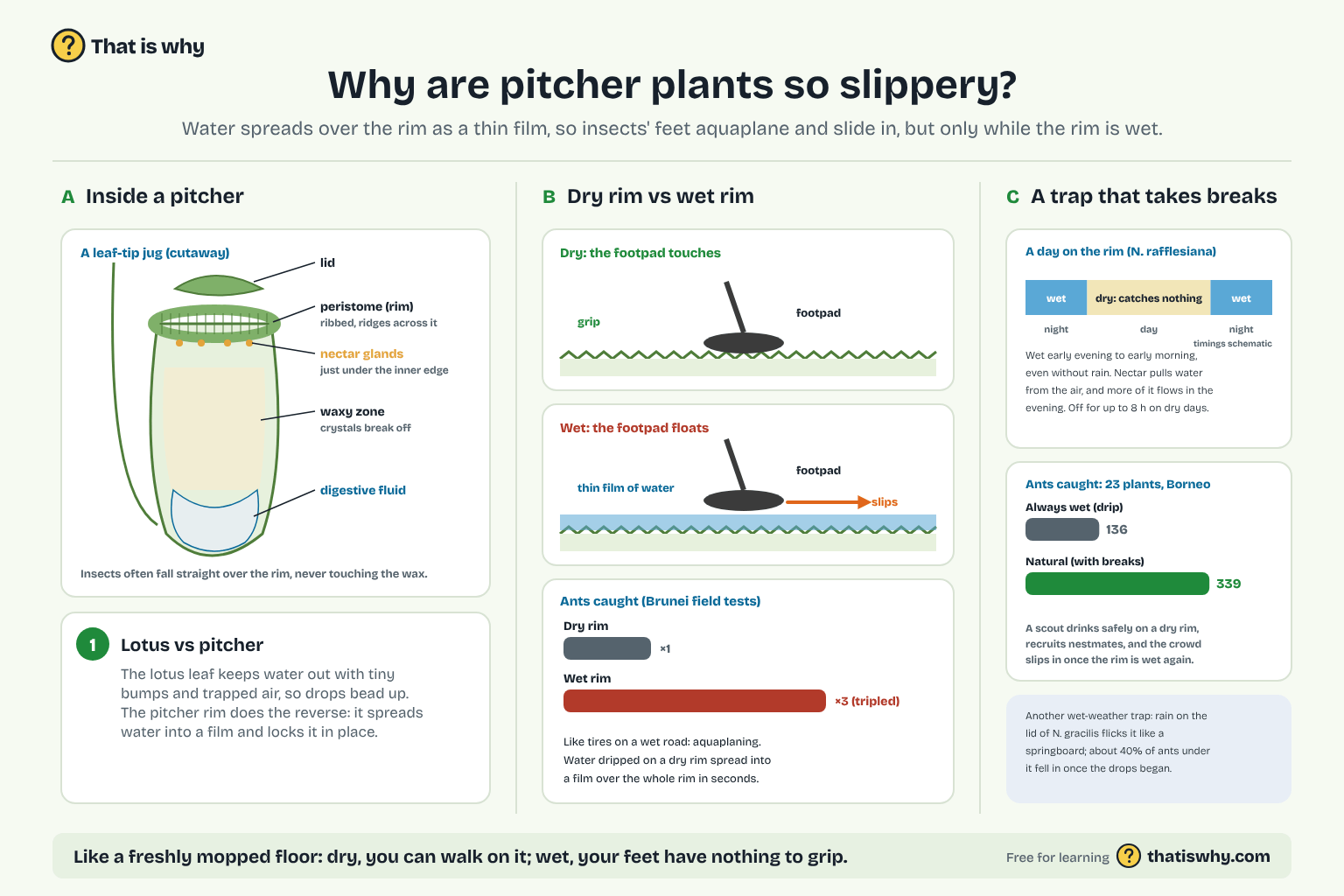
1. Dry rim, a free sample. A pitcher is a carnivorous plant's leaf-tip jug. Nectar glands sit just under the inner edge of its ribbed rim, the peristome. On a dry rim, an ant drinks safely and walks home to recruit its nestmates.
2. Wet rim, the trap is on. Rain, dew and the plant's own nectar spread across the rim as a thin film. Sensors showed rims wet from early evening to early morning, even without rain, and dry for most of the day.
3. No grip, the slide. On the film, an insect's footpads can't touch the plant. They glide on water, called aquaplaning, like tires on a wet road, and the insect slides into the digestive fluid. Engineers copied the rim's locked-in liquid layer for a slippery coating, a case of biomimicry.
Key numbers
| Fact | Value |
|---|---|
| Capture rate, wet rim vs dry rim (Brunei) | tripled |
| Time for dripped water to spread over a dry rim | seconds |
| Longest dry, "switched off" spell on dry days | up to 8 hours |
| Wild plants in the drip experiment (Borneo) | 23 |
| Ants caught by always-wet pitchers | 136 |
| Ants caught by natural pitchers with breaks | 339 |
| Ants trapped under the springboard lid of N. gracilis | about 40% |
Common misconceptions
Myth The rim of a pitcher plant is always slippery.
The truth It is slippery only when wet. On dry days it can stay harmless for up to eight hours, and that pause helps the plant catch more ants.
Myth Wax is what makes insects slip.
The truth Many pitchers have a waxy inner wall, but the main trap is the wet rim. Insects often fall straight over the rim without ever touching the wax.
Myth A trap that works all the time would catch more.
The truth Pitchers kept wet nonstop with hospital drips caught 136 ants; pitchers left to the weather caught 339, mostly in a few big batches.
Questions to use in class
Tap a question to reveal a model answer.
1How do pitcher plants trap insects?
Their rim, the peristome, spreads rain, dew and nectar into a thin, even film of water. Insects' sticky footpads aquaplane on that film and slide into the pool of digestive fluid inside the pitcher.
2Why is a pitcher plant only slippery when it's wet?
A dry rim gives insects' footpads a surface to grip. Once water spreads over it as a film, the pads float on the water instead, like car tires aquaplaning on a wet road.
3Why does a pitcher plant switch its trap off?
On a dry rim, scout ants drink nectar safely and go home to recruit nestmates. When the rim gets wet again, the whole crowd of followers can be caught at once.
4When are pitcher plant rims wet?
Sensors on Nepenthes rafflesiana showed a daily cycle, wet from early evening to early morning even when it hadn't rained, helped by nectar that pulls moisture from the air.
Key terms
- Peristome
- The ribbed, nectar-producing rim around the mouth of a Nepenthes pitcher plant. When it is wet, water spreads over it as a thin film and insects slip off it into the pitcher.
- Aquaplaning
- Sliding on a thin layer of water that stops a tire, or an insect's sticky footpad, from touching the surface underneath. A wet pitcher plant rim makes insects aquaplane into the trap.
- Carnivorous plant
- A plant that traps and digests animals, mostly insects, to get nutrients its poor soil lacks. Pitcher plants and the Venus flytrap are carnivorous plants.
- Biomimicry
- Copying ideas from living things to solve human problems, such as buildings cooled by airflow inspired by termite mounds.
Sources
- Pitcher plants: devious hunters (Stephanie Pain, New Scientist 2008) New Scientist, copy hosted by the University of Cambridge Department of Zoology
- Pitcher plants 'switch off' traps to capture more ants (Bauer et al., Proceedings of the Royal Society B 2015) University of Bristol
- Tricky pitcher plants lure ants into a false sense of security Science News
- Pitcher plant uses rain drops to capture prey University of Cambridge
- Slippery slope: Researchers take advice from carnivorous plant Wyss Institute, Harvard University