Free teaching diagram
Owl Wing Diagram: How Owls Fly Silently
A comb, a velvet coat and a soft fringe on every flight feather, plus big wings for flying slowly.
The detailed teaching diagram
What the diagram shows
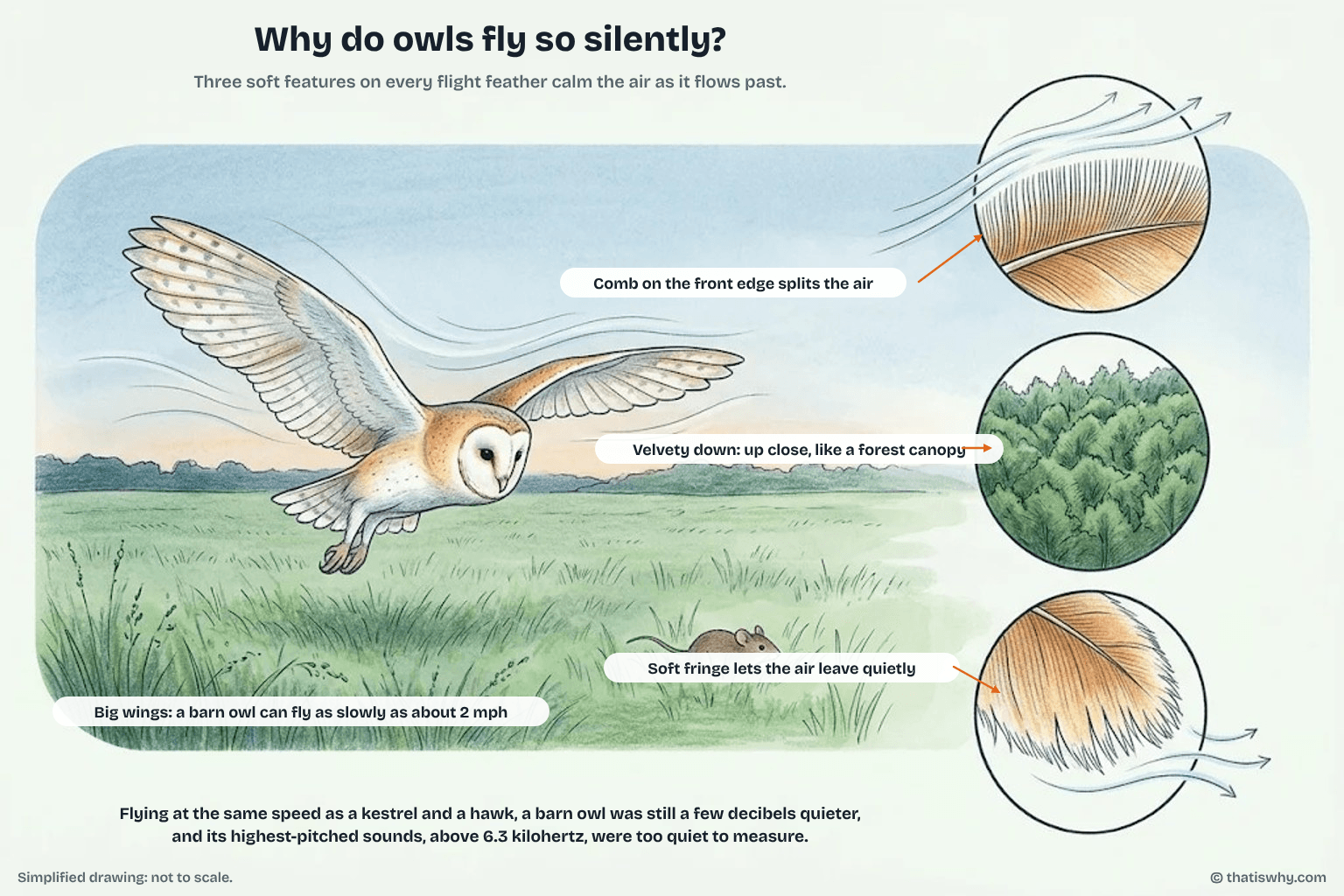
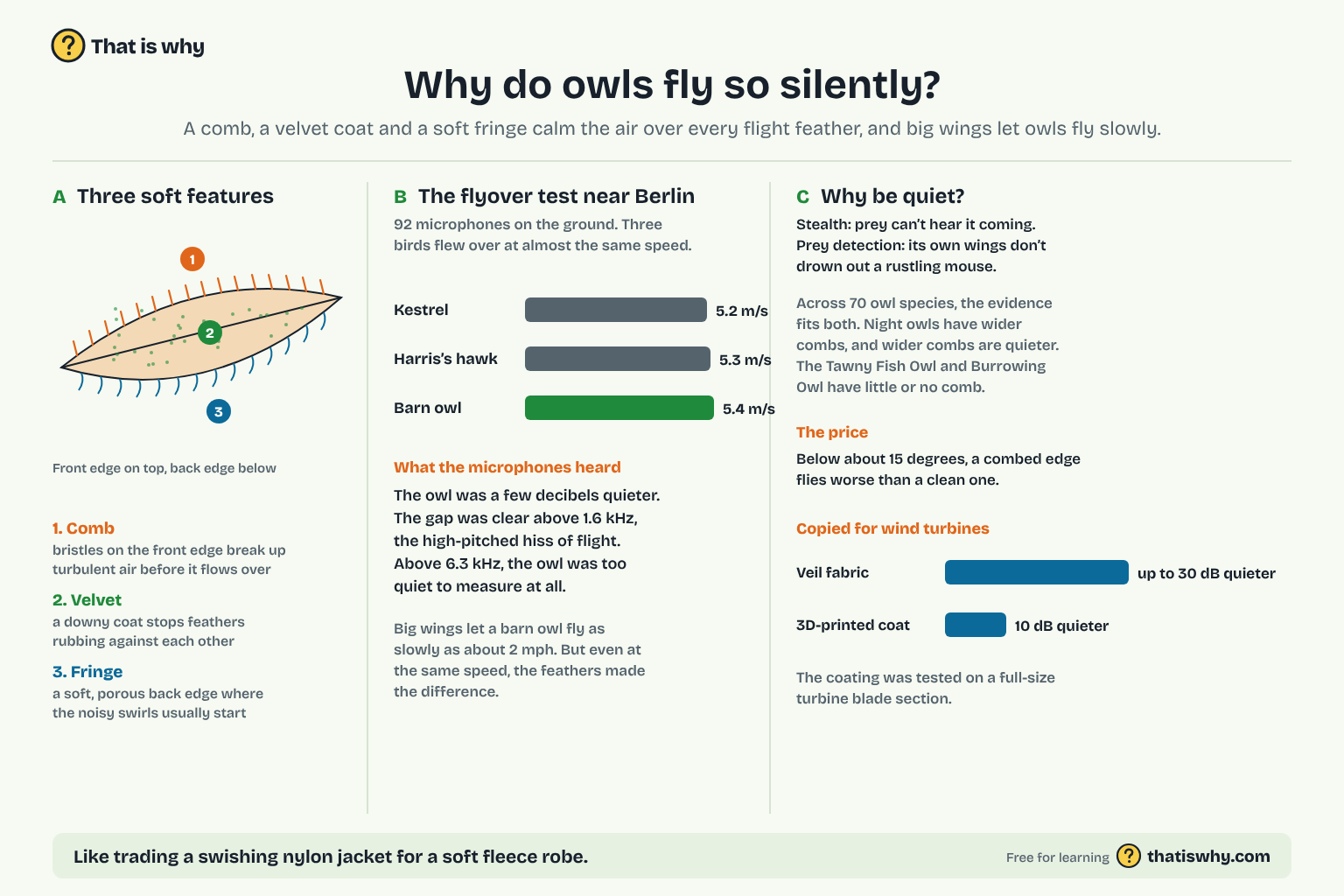
A. Three soft features. Most wing noise comes from turbulence, air tumbling into swirls, and much of it starts at the wing's back edge. An owl's flight feathers fight it front to back: a leading-edge comb of flexible bristles breaks up turbulent air before it flows over the wing, a downy velvet coat stops feathers rubbing against each other, and a soft, porous fringe along the back edge lets the air leave quietly.
B. The flyover test near Berlin. Researchers placed 92 microphones on the ground in a wildlife park and flew a kestrel, a Harris's hawk and a barn owl over them at almost the same speed, about 5 meters per second. The owl was a few decibels quieter, with the gap clearest above 1.6 kilohertz (hertz counts vibrations per second), the higher-pitched hiss of flight. Above 6.3 kilohertz, the owl was too quiet to measure. Big wings also let a barn owl fly as slowly as about 2 mph.
C. Why be quiet? Quiet flight could keep prey from hearing the owl coming, or keep the owl's own wings from drowning out a rustling mouse. Across 70 owl species, the evidence fits both: night owls have wider combs, and wider combs are quieter, while the Tawny Fish Owl and the Burrowing Owl have little or no comb. Quiet has a price, too: below about 15 degrees, a combed edge flies worse than a clean one. Engineers are now copying the owl, an example of biomimicry: a 3D-printed coating cut the noise of a full-size wind turbine blade section by 10 decibels.
Key numbers
| Fact | Value |
|---|---|
| Microphones in the flyover test | 92 |
| Flight speeds (kestrel, hawk, owl) | 5.2, 5.3 and 5.4 m/s |
| Owl's noise advantage | a few decibels |
| Gap clear above | 1.6 kHz |
| Owl too quiet to measure above | 6.3 kHz |
| Slowest barn owl flight | about 2 mph |
| Owl species studied for comb shape | 70 |
| Wind turbine coating noise cut | 10 dB |
Common misconceptions
Myth Owls make no sound at all.
The truth A barn owl was a few decibels quieter than a kestrel and a hawk, not silent.
Myth Owls are quiet only because they fly slowly.
The truth At the same speed as a kestrel and a hawk, the barn owl was still quieter. Its feathers do real work.
Myth Every owl flies silently.
The truth The Tawny Fish Owl and the Burrowing Owl have little or no comb, and day-hunting owls have narrower combs.
Questions to use in class
Tap a question to reveal a model answer.
1What are the three soft features on an owl's flight feathers?
A comb of bristles on the front edge, a velvety downy surface and a soft fringe on the back edge.
2Where does most wing noise start?
At the back edge of the wing, where turbulent air leaves it.
3How do we know the feathers matter, not just the slow speed?
In a flyover test, a kestrel, a hawk and a barn owl flew at almost the same speed, and the owl was still quieter.
4How are engineers copying owls?
A 3D-printed coating inspired by owl feathers cut the noise of a full-size wind turbine blade section by 10 decibels.
Key terms
- Leading-edge comb
- A row of tiny, flexible bristles along the front edge of an owl's outermost flight feather. It breaks up turbulent air flowing over the wing, one of the features that make owl flight so quiet.
- Turbulence
- Air or water that tumbles into messy, swirling eddies instead of flowing smoothly. Much of the noise a wing makes starts where turbulent air leaves its back edge.
- Hertz (Hz)
- The number of vibrations or cycles per second. A cat's purr sits at about 25 to 150 Hz, a very low hum.
- Biomimicry
- Copying ideas from living things to solve human problems, such as buildings cooled by airflow inspired by termite mounds.
Sources
- Silent Owl Flight: Bird Flyover Noise Measurements (Sarradj, Fritzsche and Geyer, AIAA 2010-3991) Brandenburg University of Technology Cottbus
- Silent flights: How owls could help make wind turbines and planes quieter University of Cambridge
- The Silent Flight of Owls, Explained Audubon
- The Evolution of Quiet Flight in Owls (Strigiformes) and Lesser Nighthawks (Krista Le Piane, doctoral dissertation, 2020) University of California, Riverside (eScholarship)
- Evidence that the Dorsal Velvet of Barn Owl Wing Feathers Decreases Rubbing Sounds during Flapping Flight (LePiane and Clark, Integrative and Comparative Biology, 2020) Integrative and Comparative Biology (library record)
- Owls' wings could hold the key to beating wind turbine noise ScienceDaily (IOP Publishing)