Free teaching diagram
Cat Purr Diagram: How and Why Cats Purr
A purr is a very low hum made in the voice box, heard when cats are content, stressed or hurt.
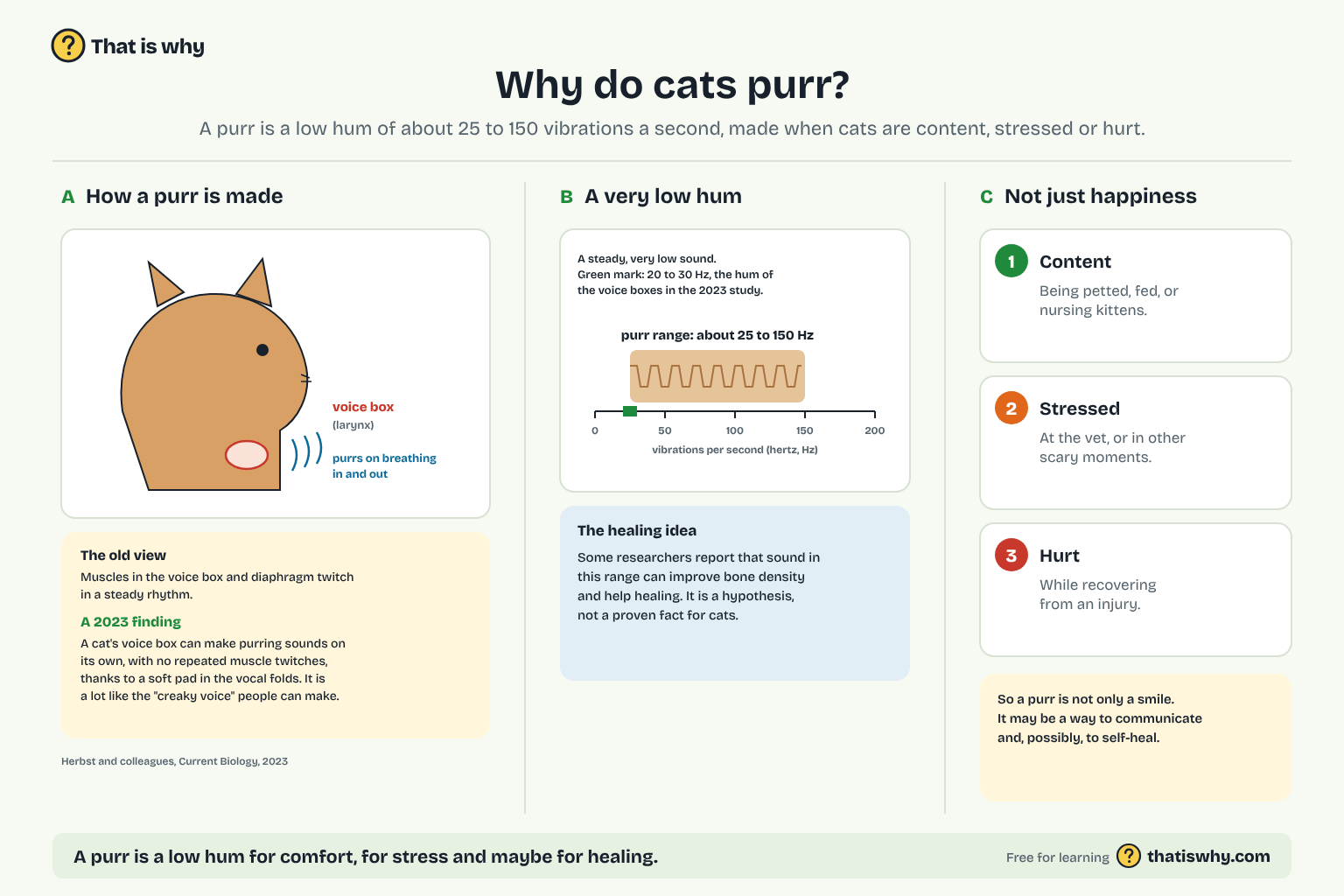
What the diagram shows
A. How a purr is made. Cats purr in the voice box, or larynx, while breathing both in and out. The long-standing explanation is that muscles in the voice box and diaphragm twitch in a steady rhythm. In 2023, researchers found that a cat's voice box can make purring sounds of 20 to 30 Hz on its own, with no repeated muscle twitches, thanks to a soft pad in the vocal folds. The sound is a lot like the "creaky voice" or "vocal fry" people can make.
B. A very low hum. Purrs fall in a steady range of about 25 to 150 hertz, or vibrations per second. Some researchers report that sound in this range can improve bone density and promote healing. For cats, that remains a hypothesis.
C. Not just happiness. Cats purr when they are content (being petted, fed, or nursing kittens), when they are stressed, such as at the vet, and while recovering from injury. That suggests the purr may be a way to communicate and, possibly, a source of self-healing.
Key numbers
| Fact | Value |
|---|---|
| Purr frequency range | about 25 to 150 Hz |
| Voice boxes in the 2023 study | 20 to 30 Hz |
| When cats purr | breathing in and breathing out |
Common misconceptions
Myth Cats only purr when they are happy.
The truth Cats also purr when stressed, for example at the vet, and while recovering from injury.
Myth Purring is proven to heal bones.
The truth Some researchers report that sound in the purr range can improve bone density and healing, but for cats this is still a hypothesis.
Myth A cat has to twitch its muscles in rhythm to purr.
The truth A 2023 study found a cat's voice box can make purring sounds on its own, thanks to a soft pad in the vocal folds.
Questions to use in class
Tap a question to reveal a model answer.
1What frequency is a cat's purr?
About 25 to 150 vibrations per second (hertz).
2Where is the purr made?
In the voice box (larynx); cats purr while breathing both in and out.
3When do cats purr?
When content (petted, fed or nursing kittens), when stressed, and while recovering from injury.
4Can purring help healing?
Some researchers report that sound in this range can improve bone density and promote healing; it is a hypothesis, not proven for cats.
Key terms
- Larynx
- The voice box in the throat, where the vocal folds sit. A cat's larynx can make purring sounds of 20 to 30 Hz on its own, thanks to a soft pad in its vocal folds.
- Hertz (Hz)
- The number of vibrations or cycles per second. A cat's purr sits at about 25 to 150 Hz, a very low hum.
Sources
- Why do cats purr? Scientific American
- Cats purr differently than previously thought (Herbst et al., Current Biology 2023) University of Vienna