Free teaching diagram
Humpback Whale Song Diagram: How a Song Crosses the Pacific
A new song starts off eastern Australia and hops east from island group to island group in about two years.
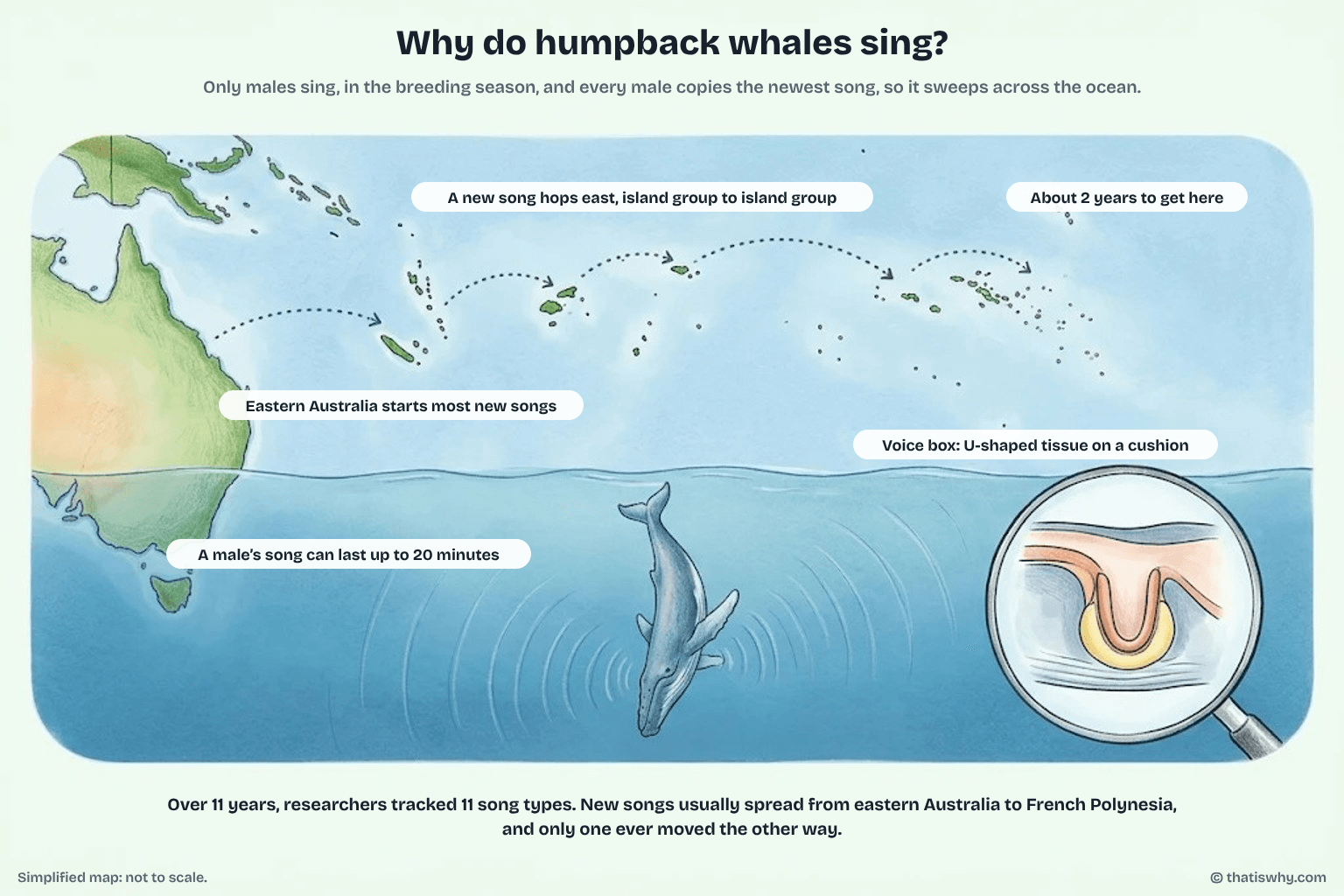
The detailed teaching diagram
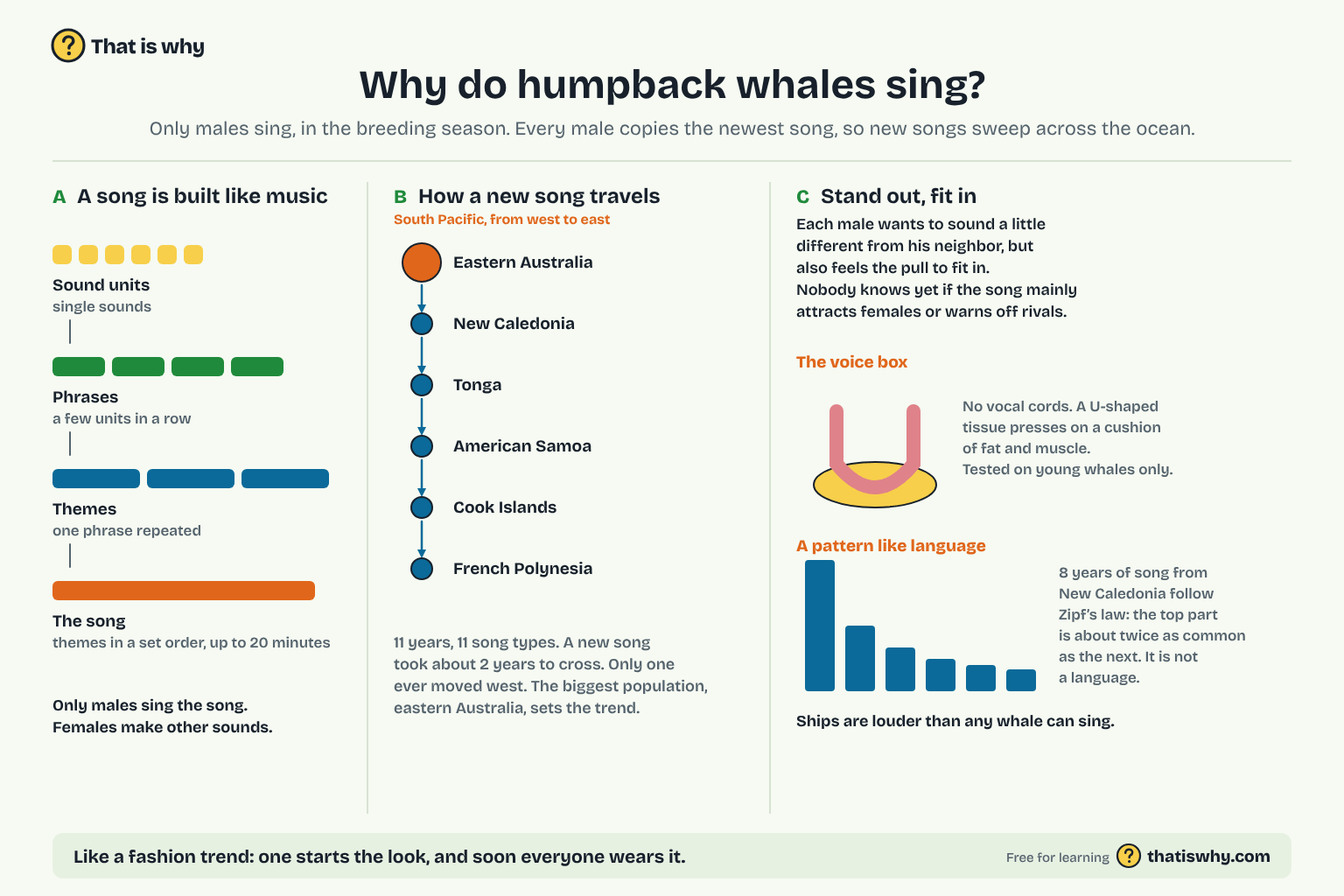
What the diagram shows
A. A song is built like music. Single sounds form short phrases. A phrase repeated over and over makes a theme, and themes strung together in a set order make the full song, which can last up to 20 minutes. Only males sing it; females make other sounds.
B. How a new song travels. Researchers compared 11 years of recordings from six South Pacific populations and tracked 11 song types. A new song usually appeared off eastern Australia, then hopped east, one population at a time, reaching French Polynesia in about two years. Only one song ever moved west. Eastern Australia has the biggest population, so it seems to set the trend. Passing on a behavior by learning like this is called cultural transmission.
C. Stand out, fit in. Each male seems to want to sound a little different from the whale next to him, but he also feels a strong pull to sing the same tune as everyone else. Scientists still debate whether the song mainly attracts females or warns off rival males. Baleen whales have no vocal cords: they push a U-shaped tissue in the larynx against a cushion of fat and muscle, a finding based on the voice boxes of young whales. Eight years of song from New Caledonia follow Zipf's law, a pattern found across human languages, though the researchers stress this does not mean whales have language. Modeling also suggests whales cannot sing louder than ship noise.
Key numbers
| Fact | Value |
|---|---|
| Populations compared | 6 |
| Years of recordings | 11 |
| Song types tracked | 11 |
| Time for a song to cross the region | about 2 years |
| Songs that moved west | 1 |
| Longest song | up to 20 minutes |
| Years of New Caledonia song analyzed for Zipf's law | 8 |
Common misconceptions
Myth Female humpbacks sing just as much as males.
The truth Females make sounds too, but only males sing the long, patterned song.
Myth Every whale makes up its own song.
The truth All the males in a population sing the same song, and they change it together.
Myth Whale song is a secret language.
The truth It shares a statistical pattern with human language, but the researchers say it does not mean whales have language.
Questions to use in class
Tap a question to reveal a model answer.
1Which humpbacks sing?
Only the males sing the long, patterned song, mostly during the breeding season.
2Which way do new songs travel in the South Pacific?
Usually east, from eastern Australia to French Polynesia, in about two years. Only one song moved west in 11 years.
3Why might the biggest population set the trend?
Eastern Australia has far more whales than the island groups, so it has the greatest influence on which song spreads.
4How do baleen whales make sound without vocal cords?
They push a U-shaped tissue in the larynx against a cushion of fat and muscle.
Key terms
- Cultural transmission
- Passing a behavior from animal to animal by learning rather than through genes. Male humpback whales pick up new songs from each other, so a song can spread across a whole ocean region.
- Social learning
- Picking up information by watching or hearing other animals instead of learning it from your own experience, such as which human face is dangerous.
- Larynx
- The voice box in the throat, where the vocal folds sit. A cat's larynx can make purring sounds of 20 to 30 Hz on its own, thanks to a soft pad in its vocal folds.
- Zipf's law
- A pattern found across human languages: the most common word appears about twice as often as the second most common, three times as often as the third, and so on. The recurring parts of humpback whale song follow it too.
Sources
- Humpback whales spread songs across the Pacific (Garland et al., Current Biology 2011) The University of Queensland
- Humpback whale songs spread eastward like the latest pop tune ScienceDaily (materials from Cell Press)
- How do whales sing? Scientists point to a specialized voice box that other animals don't have (Elemans et al., Nature 2024) PBS NewsHour (Associated Press)
- Acoustic Monitoring NOAA Hawaiian Islands Humpback Whale National Marine Sanctuary
- Humpback Whales: Song of the Sea PBS Nature
- Humpback whale songs spread from west to east Smithsonian Magazine
- Team looks to infant speech development to understand whale song's language-like structure (Arnon et al., Science 2025) Scimex