Free teaching diagram
Crow Face Memory Diagram: How a Grudge Spreads
One bad encounter ties a face to danger in a crow's brain, and the warning spreads to crows that were never trapped.
What the diagram shows
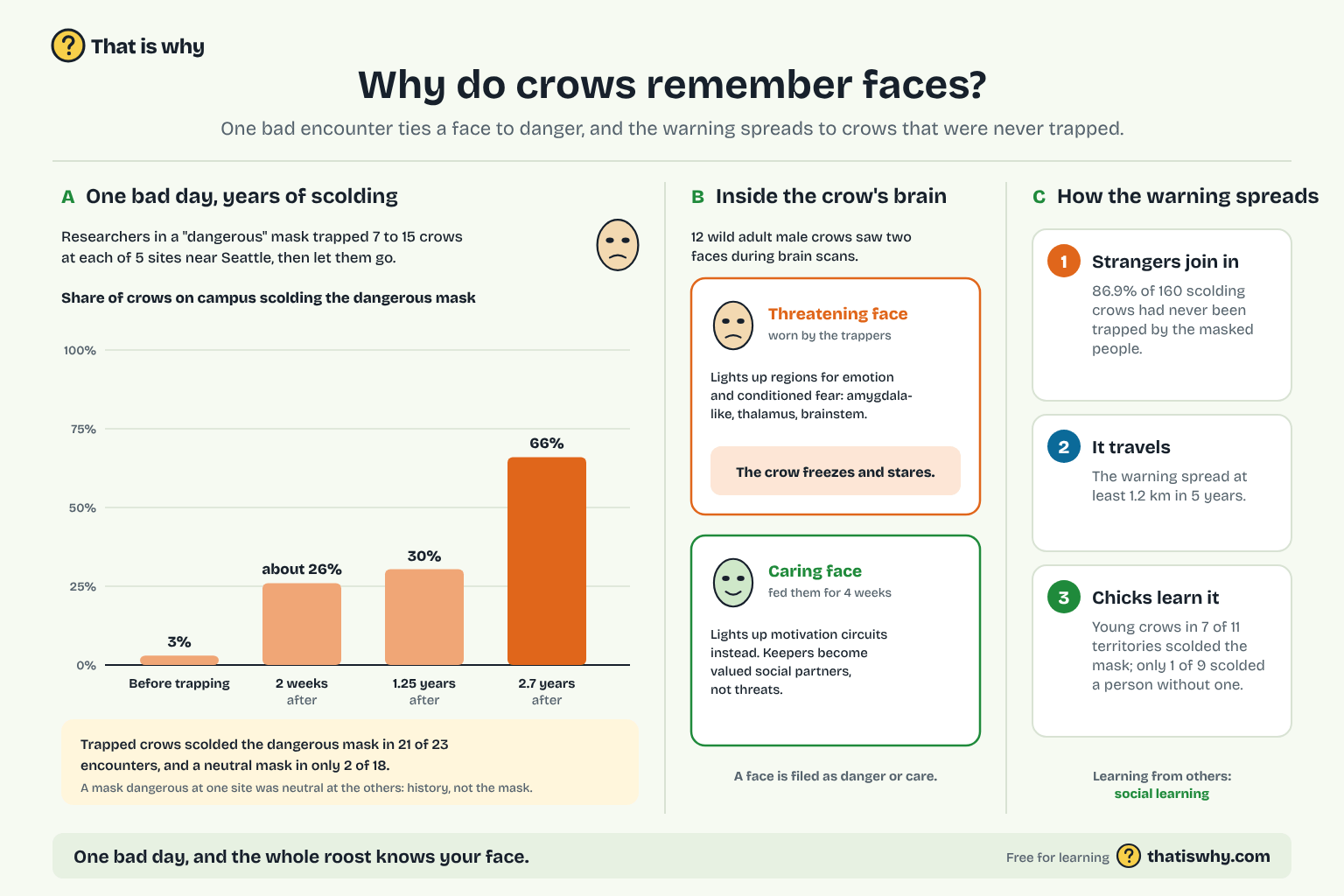
A. One bad day, years of scolding. Researchers at the University of Washington wore a "dangerous" mask while they trapped, banded and released 7 to 15 crows at each of 5 sites near Seattle, holding each bird for 10 to 30 minutes. Before the trapping, only 3% of crows on campus scolded that mask. Two weeks later about 26% did, 30% after 1.25 years and 66% after 2.7 years. Trapped crows scolded the dangerous mask in 21 of 23 encounters, and a neutral mask in only 2 of 18. A mask that was dangerous at one site was neutral at the others, so the crows were reacting to history, not to the mask.
B. Inside the crow's brain. In a brain-imaging study, 12 wild adult male crows saw two faces. The threatening face, worn by the people who trapped them, lit up regions tied to emotion and fear conditioning, including the crow's version of the amygdala, the thalamus and the brainstem, and the crows froze and stared. A caring face, worn by people who fed them for 4 weeks, lit up motivation circuits instead.
C. How the warning spreads. 86.9% of the 160 scolding crows had never been trapped by the masked people. The warning spread at least 1.2 km in 5 years, and young crows in 7 of 11 territories scolded the mask after watching their parents, compared with 1 of 9 for a person without a mask. Picking up information from others like this is called social learning.
Key numbers
| Fact | Value |
|---|---|
| Crows trapped per site | 7 to 15, at 5 sites |
| Crows scolding the dangerous mask | 3% before, about 26% at 2 weeks, 30.4% at 1.25 years, 66% at 2.7 years |
| Scolding crows never trapped | 86.9% of 160 |
| Spread of the warning | at least 1.2 km in 5 years |
| Crows in the brain study | 12 adult males |
Common misconceptions
Myth Crows hold grudges because they are spiteful.
The truth The studies show fear, not spite: crows froze and stared, and fear and emotion regions of the brain lit up. Scolding is an alarm.
Myth Only the crow that was hurt dislikes the person.
The truth 86.9% of the 160 scolding crows had never been trapped by the masked people. They learned the face from others.
Myth Crows scold anyone in a mask.
The truth Trapped crows scolded the dangerous mask in 21 of 23 encounters but a neutral mask in only 2 of 18.
Questions to use in class
Tap a question to reveal a model answer.
1Why did the researchers use masks instead of their own faces?
A mask lets anyone play the 'dangerous' person, and a mask that was dangerous at one site was neutral at the others, so the crows were reacting to their history with that face, not to the mask itself.
2How did the share of crows scolding the dangerous mask change over time?
It rose from 3% before trapping to about 26% after 2 weeks, 30% after 1.25 years and 66% after 2.7 years.
3What evidence shows that crows learn from each other?
Most scolding crows (86.9% of 160) had never been trapped by the masked people, and young crows scolded the mask after watching their parents do it.
4What happened in the crows' brains when they saw the threatening face?
Regions linked to emotion and conditioned fear lit up, including amygdala-like areas, the thalamus and the brainstem, and the crows froze and stared.
Key terms
- Amygdala
- A brain structure that stores negative associations, such as a face linked to danger, as memories. Birds appear to have a region that works like the mammalian amygdala.
- Fear conditioning
- Learning to fear something that was neutral before, such as a face or a mask, because it became linked to a bad experience.
- Social learning
- Picking up information by watching or hearing other animals instead of learning it from your own experience, such as which human face is dangerous.
- Mobbing
- When a group of birds gangs up on a predator, calling loudly and diving at it to drive it away. It also alerts other birds and can teach young ones which enemies to fear.
Sources
- Social learning spreads knowledge about dangerous humans among American crows (Cornell, Marzluff & Pecoraro, Proceedings of the Royal Society B, 2012) The Royal Society
- Brain imaging reveals neuronal circuitry underlying the crow's perception of human faces (Marzluff et al., PNAS, 2012) Proceedings of the National Academy of Sciences
- Crows react to threats in human-like way University of Washington News