Free teaching diagram
Waggle Dance Diagram: How Honeybees Give Directions
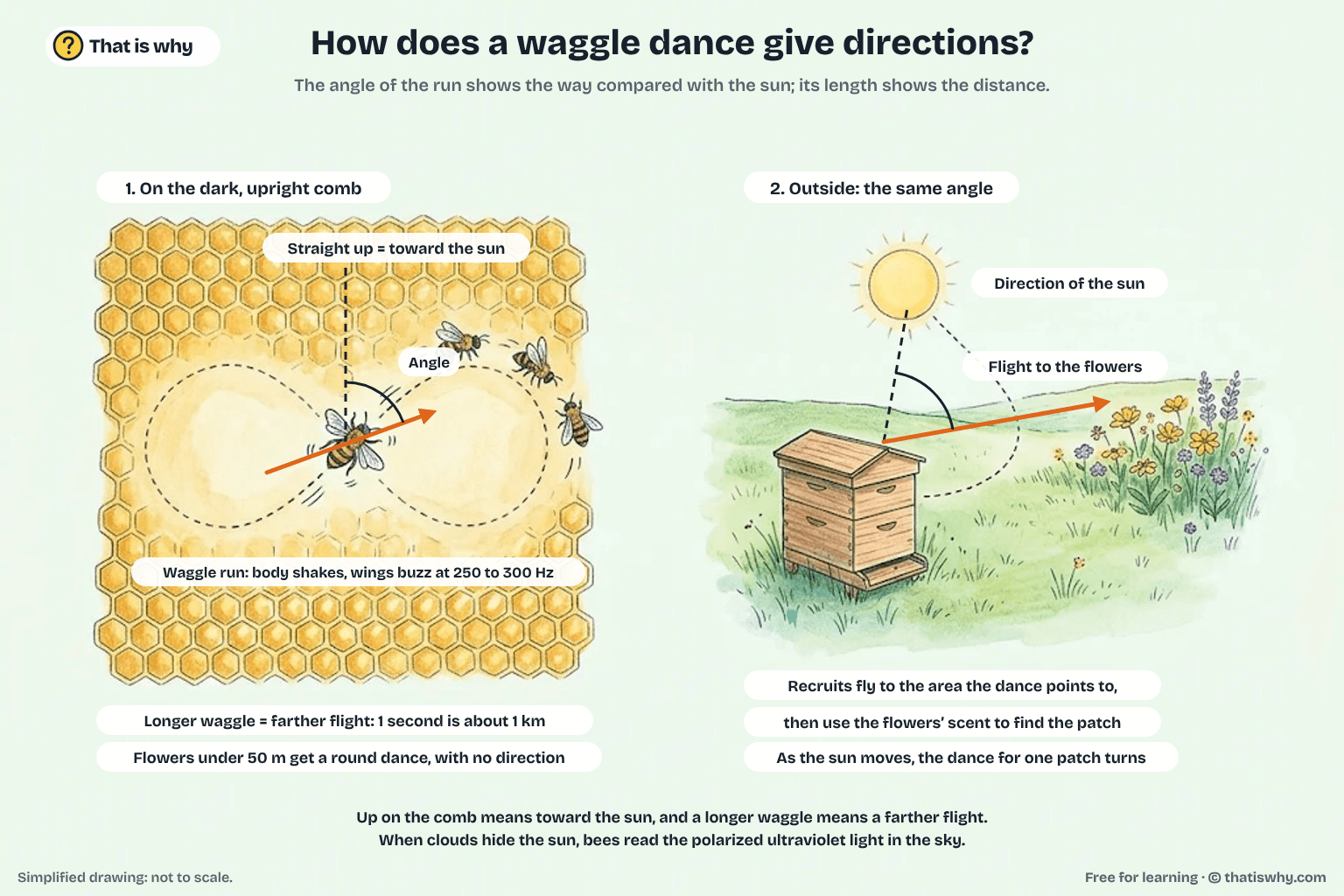
The angle of the waggle run copies the angle between the sun and the flowers.
The detailed teaching diagram
What the diagram shows
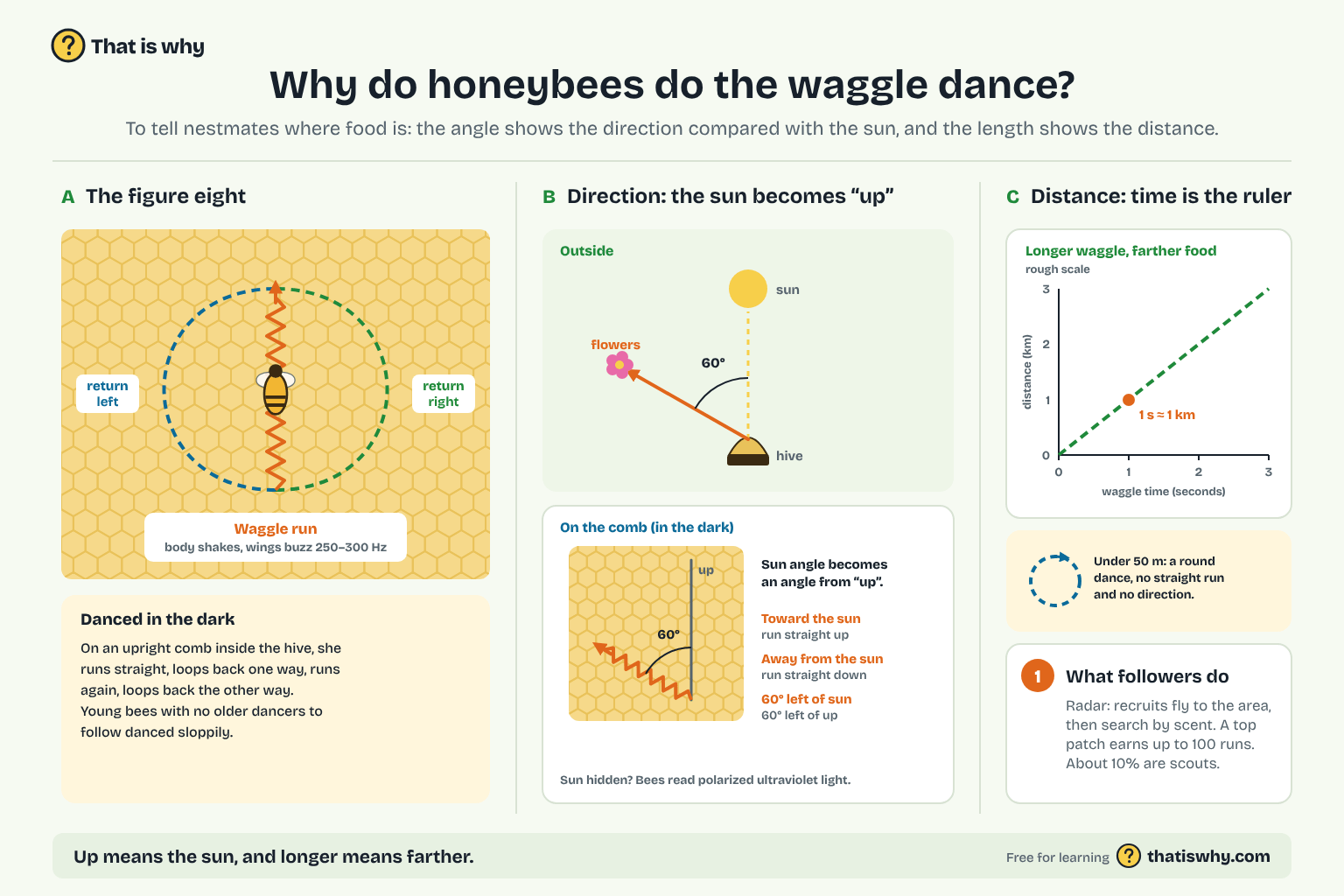
1. On the dark, upright comb. A forager traces a figure eight. The straight middle part, the waggle run, carries the message: her body shakes from side to side and her wings buzz at 250 to 300 hertz. The angle of that run from straight up matches the angle of the flowers from the sun, so straight up on the comb works like a sun compass turned into gravity.
2. Outside: the same angle. Recruits leave the hive at that angle to the sun. A longer waggle means a farther flight, about one kilometer for every second of waggling. Radar tracking showed recruits flying straight to the area, then searching, using the flowers' scent to find the exact patch.
The dance is partly learned. Young bees that never followed older dancers danced far more sloppily and kept a wrong distance code for life, an example of social learning in an insect.
Key numbers
| Fact | Value |
|---|---|
| Wing buzz during the waggle run | 250 to 300 hertz |
| Waggle time per distance | about 1 second per kilometer |
| Round dance (no direction) | food under 50 meters |
| Waggle runs for a top patch | up to 100 |
| Share of foragers that are scouts | about 10 percent |
Common misconceptions
Myth Bees dance for fun, or to celebrate a good find.
The truth The dance carries one kind of message, and that message is location.
Myth Bees can only dance on sunny days.
The truth When the sun is hidden, bees read the polarized ultraviolet light in the sky.
Myth The dance leads recruits right to the flower.
The truth It sends them to the right area. Radar tracking shows they then search, using the flowers' scent.
Questions to use in class
Tap a question to reveal a model answer.
1How does a bee show direction in the waggle dance?
The angle of the waggle run from straight up on the comb matches the angle of the food from the sun.
2How does a bee show distance?
By how long each waggle run lasts: about one second for every kilometer.
3What is a round dance?
A short circling dance for food less than 50 meters away. It gives no direction.
4Why does the dance change during the day?
The dance is pinned to the sun, and the sun moves across the sky, so the dance for one patch slowly turns.
Key terms
- Waggle dance
- A figure-eight dance a honeybee forager performs on the comb to show nestmates where food is. The angle of the straight, waggling run gives the direction compared with the sun, and its length gives the distance, about one second for every kilometer.
- Time-compensated sun compass
- Steering by the sun while correcting for the time of day, since the sun moves across the sky. Monarchs watch the sun with their eyes, keep time with clocks in their antennae, and combine both in the brain.
- Social learning
- Picking up information by watching or hearing other animals instead of learning it from your own experience, such as which human face is dangerous.
Sources
- The Honey Bee Dance Language (Tarpy and Keller, AG-646) NC State Extension
- The Honey Bee Dance Language (information sheet by Francis Ratnieks) Laboratory of Apiculture and Social Insects, University of Sussex
- Waggle Dance Controversy Resolved By Radar Records Of Bee Flight Paths (Riley et al., Nature 2005) ScienceDaily (BBSRC press release)
- Complex Learned Social Behavior Discovered in Bee's 'Waggle Dance' (Dong et al., Science 2023) UC San Diego Today