Free teaching diagram
Monarch Migration Diagram: How Monarchs Use the Sun
Monarchs steer by the sun, correct for the time of day with clocks in their antennae, and fall back on a magnetic compass when the sky is hidden.
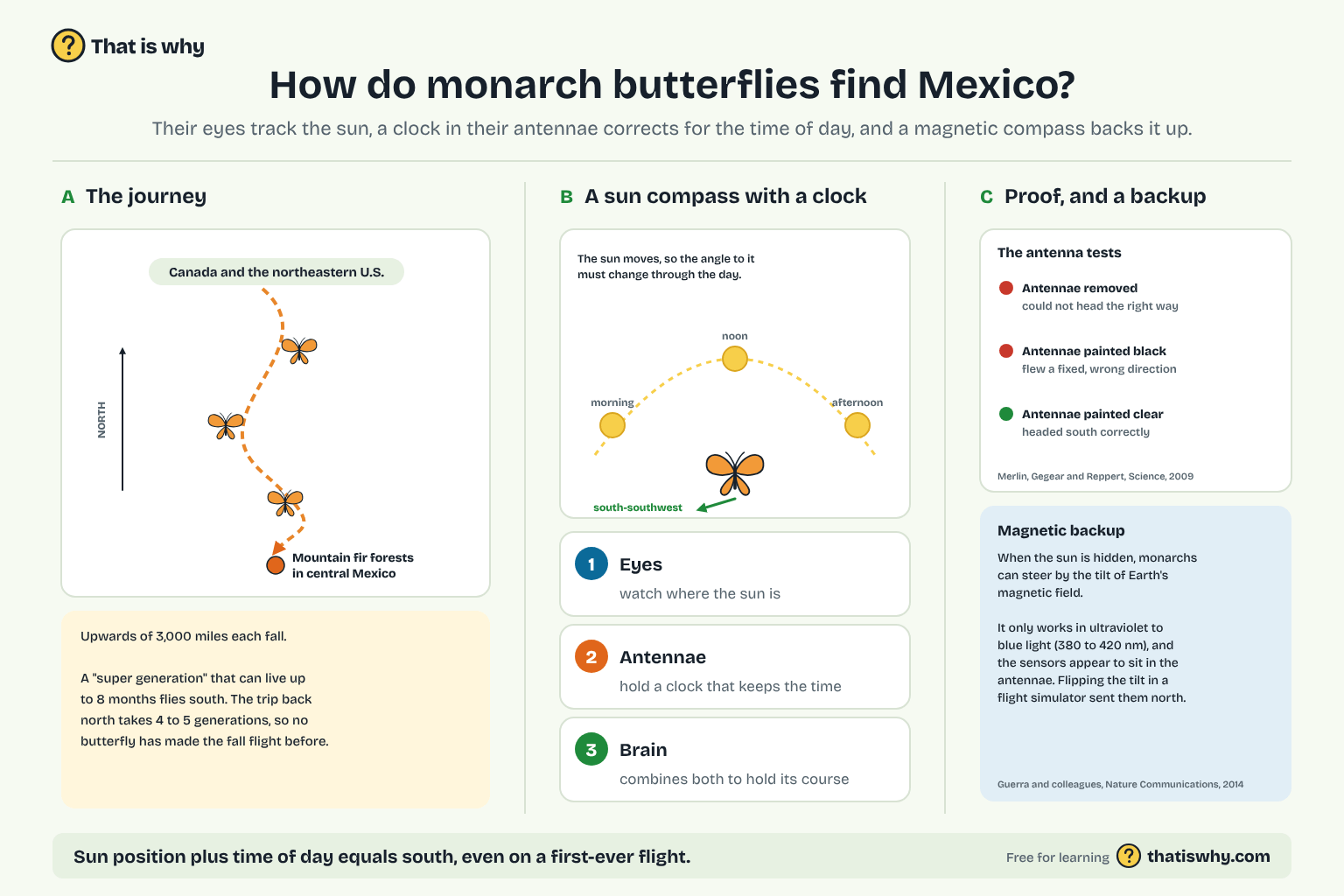
What the diagram shows
A. The journey. Each fall, monarchs fly upwards of 3,000 miles from Canada and the northeastern U.S. to a few high mountains in central Mexico. A "super generation" that can live up to 8 months makes the flight south, while the trip back north takes 4 to 5 generations, so the butterflies heading south have never made the journey before.
B. A sun compass with a clock. The sun moves across the sky, so a butterfly cannot simply fly toward it. Monarchs use a time-compensated sun compass: their eyes watch where the sun is, circadian clocks in their antennae keep the time of day, and the brain combines both to hold a south-southwest course.
C. Proof, and a backup. In 2009, monarchs with their antennae removed could not head the right way, those with antennae painted black flew a fixed, wrong direction, and those with antennae painted clear headed south correctly. When the sun is hidden, monarchs can steer by the tilt of Earth's magnetic field, a form of magnetoreception that only works in ultraviolet to blue light (380 to 420 nm); the sensors appear to sit in the antennae, and reversing the field's tilt in a flight simulator sent the butterflies north.
Key numbers
| Fact | Value |
|---|---|
| Migration distance | upwards of 3,000 miles |
| Life span of the migrating generation | up to 8 months |
| Generations to return north | 4 to 5 |
| Light needed for the magnetic compass | 380 to 420 nm (ultraviolet to blue) |
Common misconceptions
Myth Monarchs follow older butterflies or remember the route.
The truth The trip north takes 4 to 5 generations, so the butterflies flying south in the fall have never made the trip before.
Myth Monarchs just fly toward the sun.
The truth The sun moves across the sky, so monarchs use clocks in their antennae to correct their angle to it through the day.
Myth Without the sun, monarchs are lost.
The truth A magnetic compass that works in ultraviolet to blue light may guide them when the sun is hidden.
Questions to use in class
Tap a question to reveal a model answer.
1How far do monarch butterflies migrate?
Upwards of 3,000 miles, from Canada and the northeastern U.S. to mountain forests in central Mexico.
2What do the antennae do?
They hold circadian clocks that keep time, so the butterfly can correct for the sun's movement.
3What happened when the antennae were painted black?
The butterflies flew in a fixed, wrong direction; with clear paint they headed south correctly.
4What happens on cloudy days?
Monarchs can steer by the tilt of Earth's magnetic field, a compass that works in ultraviolet to blue light.
Key terms
- Time-compensated sun compass
- Steering by the sun while correcting for the time of day, since the sun moves across the sky. Monarchs watch the sun with their eyes, keep time with clocks in their antennae, and combine both in the brain.
- Circadian clock
- An internal timer that runs on a roughly 24-hour cycle. Monarch butterflies keep one in their antennae and use it to correct for the sun's movement across the sky.
- Magnetoreception
- The ability to sense Earth's magnetic field. It is well known in many birds and sea turtles; in dogs it is suggested but not confirmed.
Sources
- Monarch Butterflies Migrate 3,000 Miles—Here's How National Geographic
- Scientists crack secrets of the monarch butterfly's internal compass (Shlizerman et al., Cell Reports 2016) University of Washington
- Monarch butterflies' antennae help them navigate (Merlin, Gegear & Reppert, Science 2009) ScienceDaily / University of Massachusetts Medical School
- Scientists show that monarch butterflies employ a magnetic compass during migration (Guerra et al., Nature Communications 2014) University of Massachusetts Medical School