Free teaching diagram
Dog Circling Diagram: Do Dogs Line Up North-South?
In one study, dogs tended to line up north-south to poop, but only when Earth's magnetic field was calm. The finding is still debated.
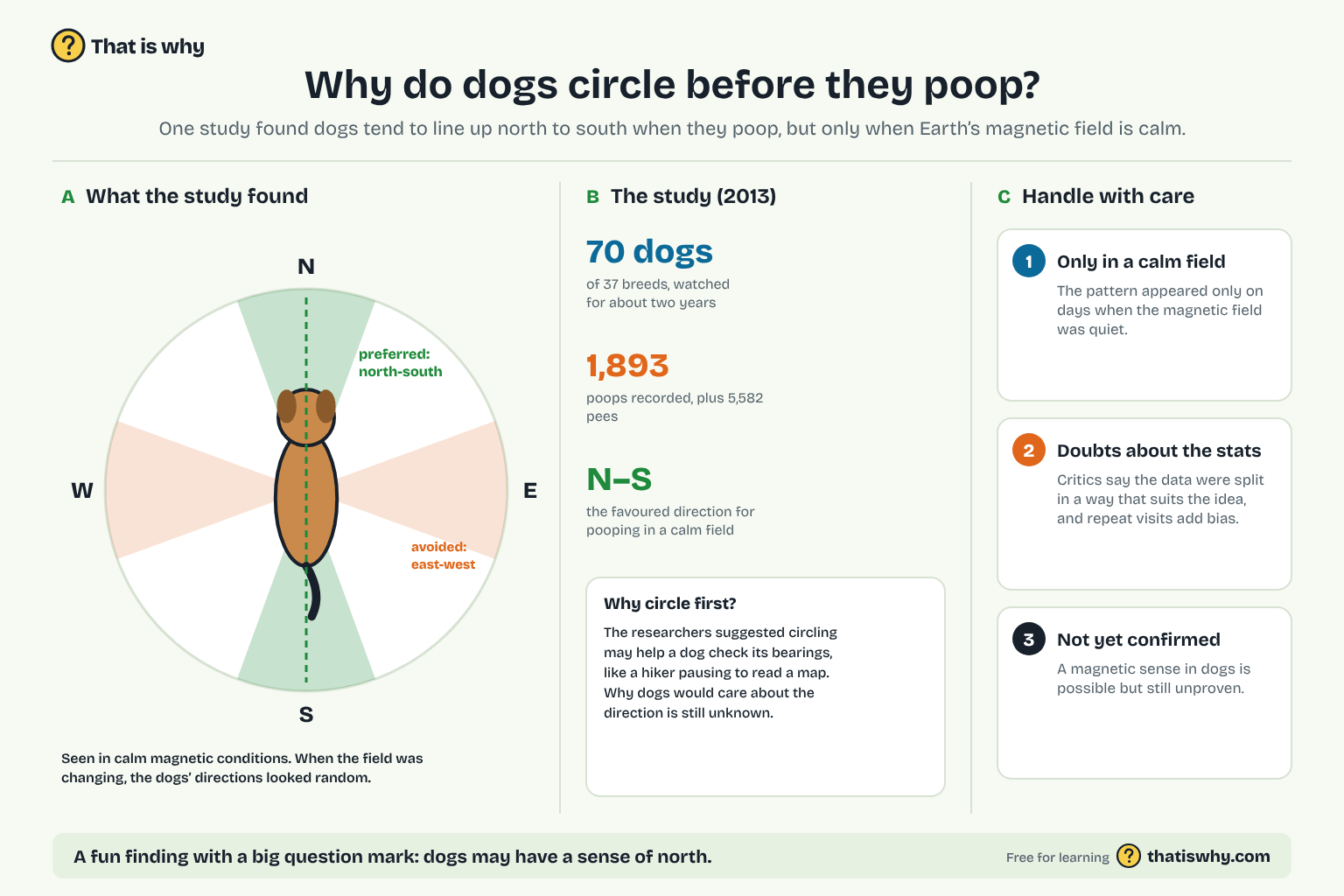
What the diagram shows
A. What the study found. In 2013, researchers reported that dogs tend to line up their bodies along a north-south axis when they poop, and avoid facing east-west. The pattern only showed up when Earth's magnetic field (the geomagnetic field) was calm. When the field's direction was shifting (changes in magnetic declination), the dogs' directions looked random.
B. The study. The team watched 70 dogs of 37 breeds for about two years, recording 1,893 poops and 5,582 pees. They suggested that circling before pooping may help a dog check its bearings, like a hiker pausing to read a map. Why a dog would care about direction at that moment is still unknown.
C. Handle with care. This is one study, and the pattern appeared only in a subset of the data. Statisticians have argued that the data were split in a way that suits the idea, and that repeat visits by the same dogs to the same spots break the assumptions of the tests used. A magnetic sense (magnetoreception) in dogs is possible, as it is known in many birds, but it is not yet confirmed.
Key numbers
| Fact | Value |
|---|---|
| Dogs | 70, of 37 breeds |
| Study length | about two years |
| Poops recorded | 1,893 |
| Pees recorded | 5,582 |
| Preferred axis (calm field) | north-south |
Common misconceptions
Myth Science has proven dogs poop facing north.
The truth One study found a north-south preference, and only when the magnetic field was calm. Statisticians have questioned the analysis, and it has not been confirmed.
Myth Dogs always line up the same way.
The truth When the magnetic field was changing, the dogs' directions looked random in the data.
Myth If dogs sense magnetism, we know how they do it.
The truth No sense organ for magnetism has been found in dogs. How they might detect it is unknown.
Questions to use in class
Tap a question to reveal a model answer.
1Why did the researchers split their data by the state of the magnetic field?
Earth's magnetic field shifts slightly over time. Looking at all the data, directions seemed random; only when they kept the calm periods did a north-south pattern appear.
2Why might repeat visits to the same spot be a problem for the study?
A dog that always uses the same patch may face the same way because of the patch itself, so observations are not independent, which can make a pattern look stronger than it is.
3Name another animal thought to sense Earth's magnetic field.
Many migrating birds, sea turtles and salmon are thought to use the magnetic field to find their way.
4Design a simple test to check the idea with your own dog.
Record the compass direction each time it poops for several weeks, note whether a geomagnetic storm was reported that day, and see whether calm days show a north-south pattern.
Key terms
- Magnetoreception
- The ability to sense Earth's magnetic field. It is well known in many birds and sea turtles; in dogs it is suggested but not confirmed.
- Geomagnetic field
- The magnetic field around Earth, produced deep inside the planet. Its strength and direction shift slightly over time.
- Magnetic declination
- The angle between magnetic north, where a compass points, and true geographic north. It changes from place to place and slowly over time.