Free teaching diagram
Sea Turtle Navigation Diagram: Finding the Home Beach
Save the address, ride the ocean loop, follow the field home.
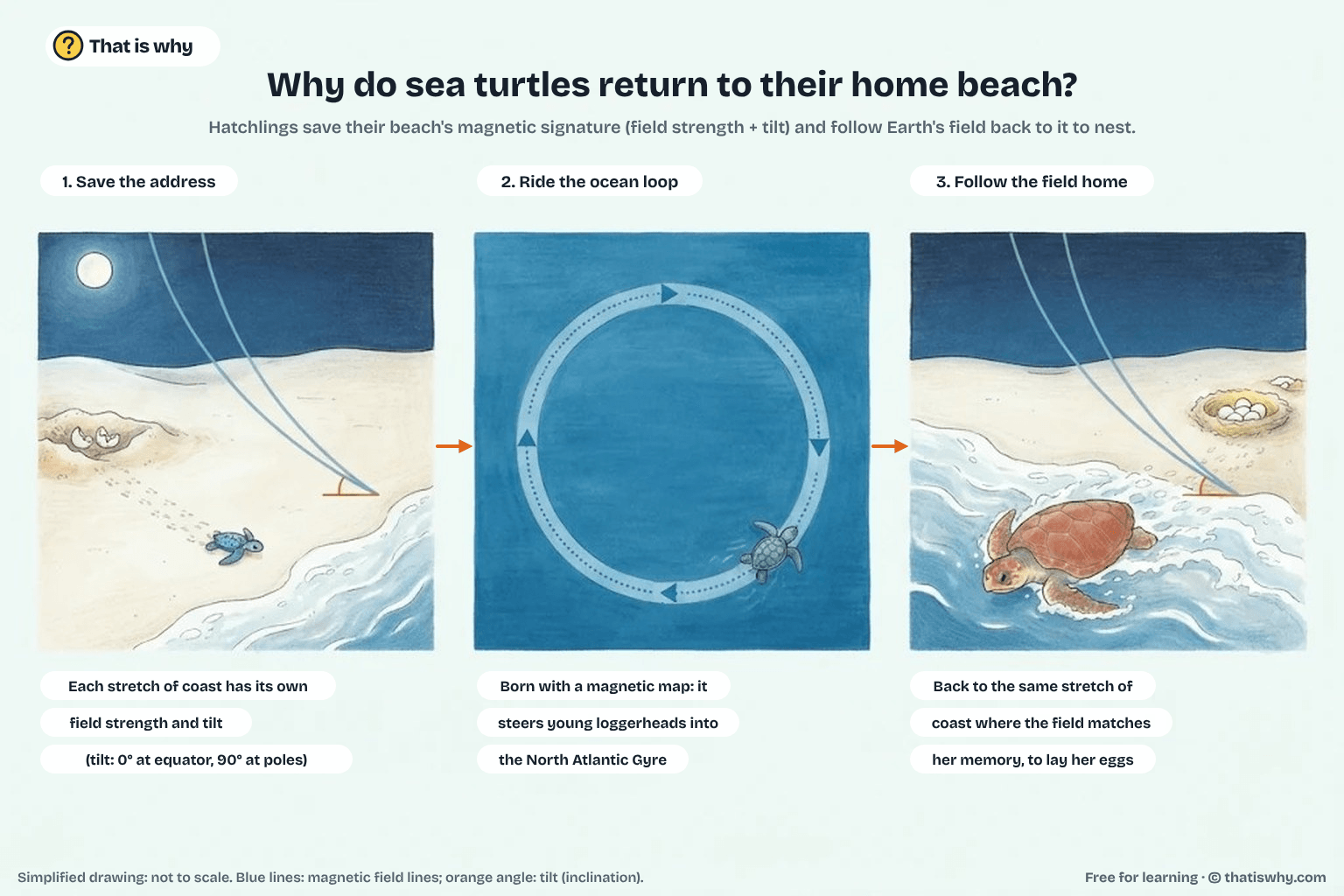
The detailed teaching diagram
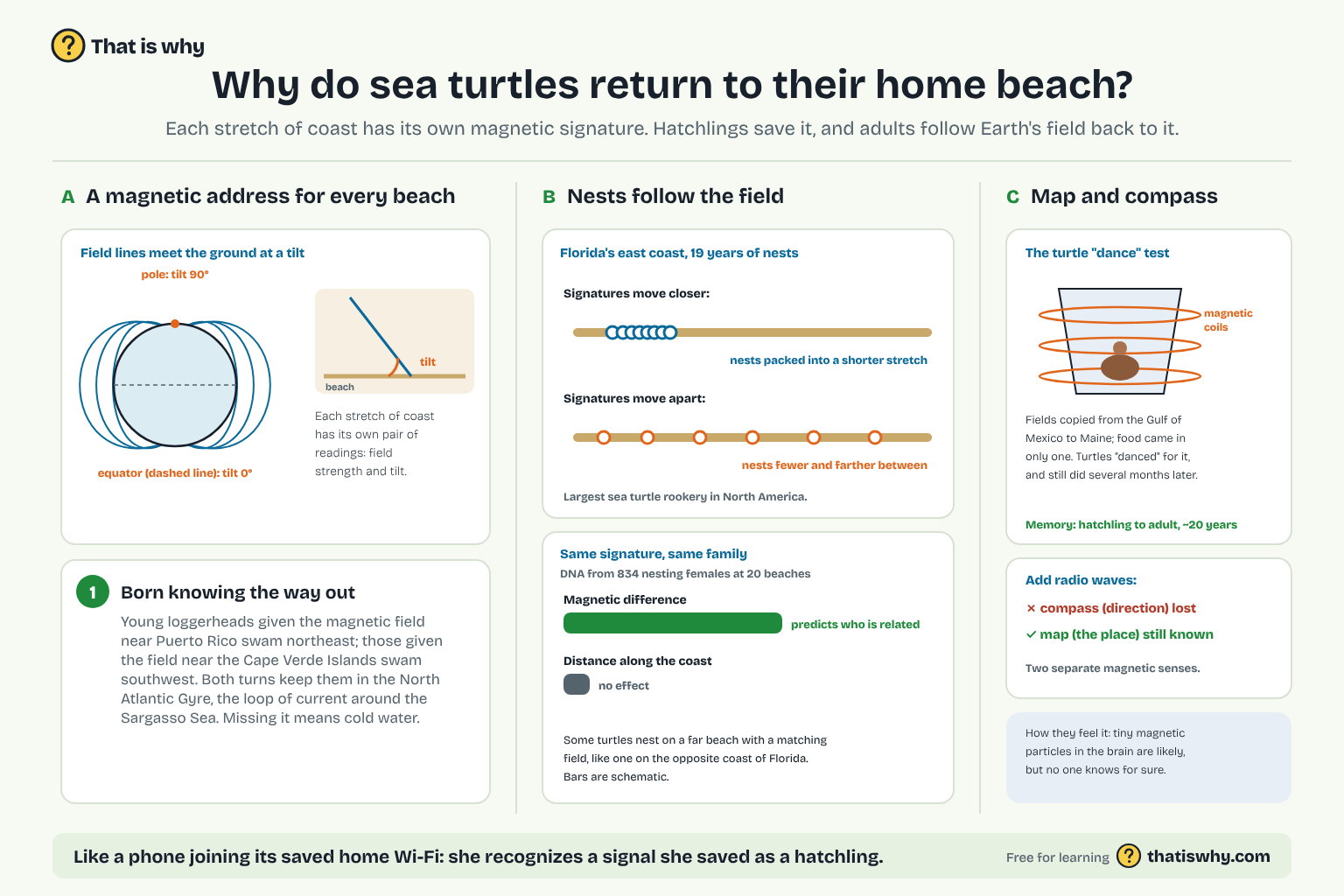
What the diagram shows
1. Save the address. Earth's geomagnetic field meets the ground at a tilt called magnetic inclination, 0 degrees at the magnetic equator and 90 at the poles. Together with the field's strength, it gives each stretch of coast its own signature, and hatchlings seem to save it, a process called geomagnetic imprinting.
2. Ride the ocean loop. Young loggerheads are born with a magnetic map. In tests, turtles given the field near Puerto Rico swam northeast and those given the field near the Cape Verde Islands swam southwest, turns that keep them in the North Atlantic Gyre. This sense of the field is magnetoreception.
3. Follow the field home. Years later, females return to the stretch of coast where the field matches their memory to lay their eggs, a behavior called natal homing. Nests even shift as the field slowly drifts.
Key numbers
| Fact | Value |
|---|---|
| Magnetic tilt (inclination) | 0° at the magnetic equator, 90° at the poles |
| Years of Florida nest records studied | 19 |
| Nesting females in the DNA study | 834 |
| Nesting beaches in the DNA study | 20 |
| Effect of distance along the coast on relatedness | none, once magnetic difference is included |
| Magnetic memory in the dance test | several months, without reminders |
| Feeding memory in the wild (Goforth) | hatchling to adult, about 20 years |
Common misconceptions
Myth A sea turtle returns to the exact grain of sand where she hatched.
The truth Turtles come back to the same stretch of coastline, not one precise spot. Some even nest on a distant beach that shares their home's magnetic signature.
Myth Baby turtles learn the route by following their mothers.
The truth Loggerheads are born able to tell where they are from the magnetic field. Hatchlings tested one at a time in a tank still turned the right way for their part of the ocean.
Myth Scientists know exactly how turtles feel magnetism.
The truth Nobody knows for sure yet. One leading idea is that tiny magnetic particles in the turtle's brain respond to Earth's field.
Questions to use in class
Tap a question to reveal a model answer.
1How do sea turtles find the beach where they were born?
As hatchlings they seem to imprint on the magnetic signature of their home beach, its field strength and tilt. Years later, adults follow Earth's magnetic field back to the stretch of coast with the matching signature.
2What is magnetic inclination?
The angle at which Earth's magnetic field lines meet the surface. It is 0 degrees at the magnetic equator and 90 degrees at the magnetic poles.
3Do sea turtles always nest on their exact home beach?
No. A study of 834 nesting loggerheads at 20 beaches found that turtles sometimes nest at a different beach with a similar magnetic field, even one on the opposite coast of Florida.
4How long can sea turtles remember a magnetic field?
Young loggerheads still recognized a field several months later without reminders, and researcher Kayla Goforth notes wild turtles retain feeding information from hatchling to adult, a 20-year span.
Key terms
- Natal homing
- Returning as an adult to the place where an animal was born, usually to breed. Sea turtles come back to the same stretch of coastline where they hatched to lay their eggs.
- Geomagnetic imprinting
- Learning the magnetic field of a place early in life and remembering it for years. Sea turtles seem to imprint on the magnetic field of the beach where they hatch, then use that memory to come back as adults.
- Magnetic inclination
- The angle at which Earth's magnetic field lines meet the ground. It is 0 degrees at the magnetic equator and 90 degrees at the magnetic poles, so it changes as you travel north or south.
- Geomagnetic field
- The magnetic field around Earth, produced deep inside the planet. Its strength and direction shift slightly over time.
- Magnetoreception
- The ability to sense Earth's magnetic field. It is well known in many birds and sea turtles; in dogs it is suggested but not confirmed.
Sources
- For sea turtles, there's no place like magnetic home (Brothers & Lohmann, Current Biology 2015) University of North Carolina at Chapel Hill
- Evidence that Magnetic Navigation and Geomagnetic Imprinting Shape Spatial Genetic Variation in Sea Turtles (Brothers & Lohmann, Current Biology 2018) Lohmann Lab, University of North Carolina at Chapel Hill
- UNC-Chapel Hill study finds genetic evidence that magnetic navigation guides loggerhead sea turtles home University of North Carolina at Chapel Hill
- The Surprising Importance of This Adorable Sea Turtle Dance (Goforth et al., Nature 2025) Scientific American
- For Turtles, Earth's Magnetism Is A Built-In GPS NPR