Free teaching diagram
Salmon Homing Diagram: How Salmon Find Their Home Stream
Young salmon learn the smell of home, a magnetic sense guides them back across the ocean, and smell leads them up the right stream.
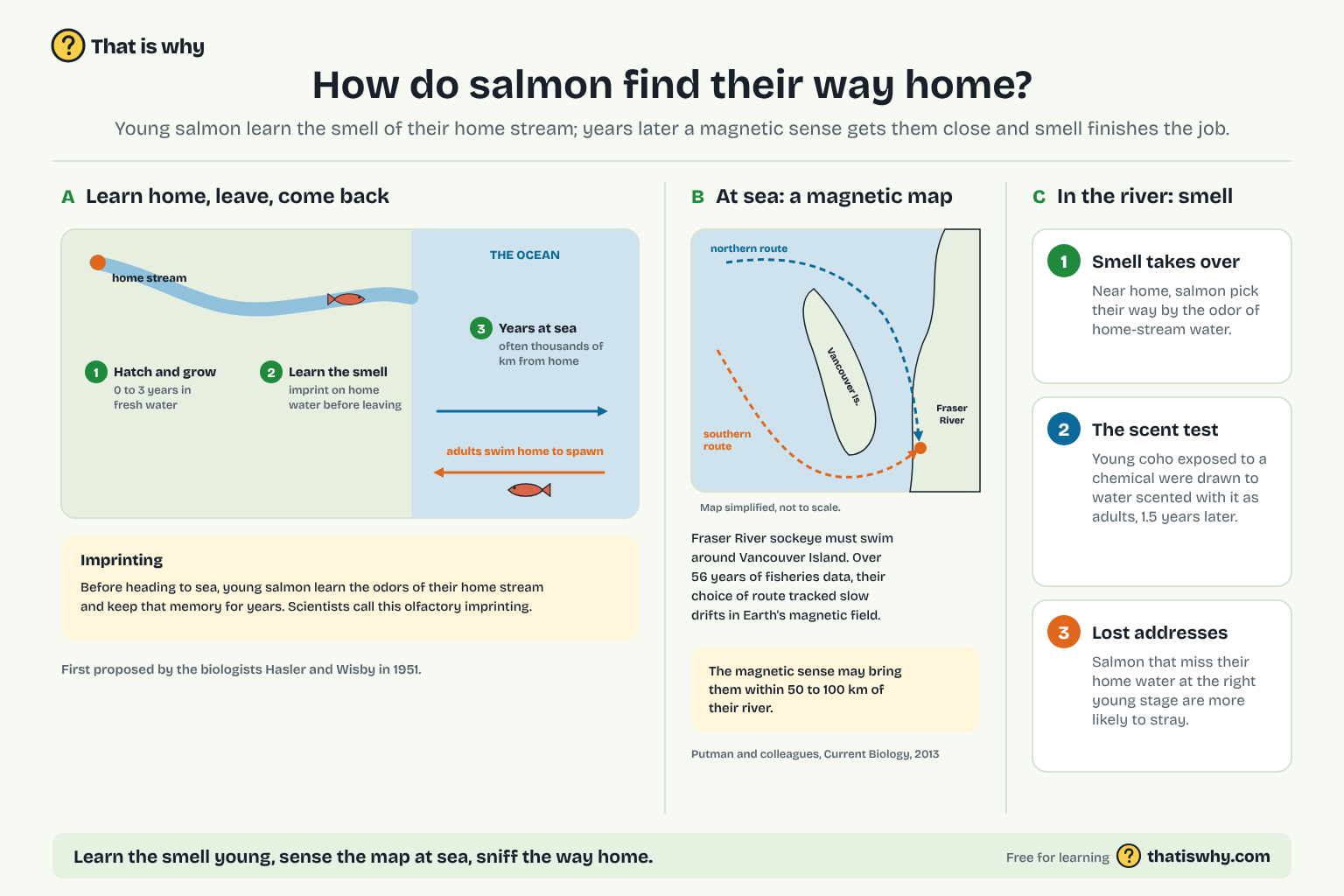
What the diagram shows
A. Learn home, leave, come back. Salmon hatch in a stream and spend 0 to 3 years in fresh water, depending on the species. Before heading to sea, young salmon learn the odors of their home stream and keep that memory for years, a process called olfactory imprinting, first proposed by the biologists Hasler and Wisby in 1951. Their journey home often begins thousands of kilometers from the mouth of their river.
B. At sea: a magnetic map. Sockeye returning to the Fraser River in British Columbia must swim around Vancouver Island, by a northern or a southern route. Over 56 years of fisheries data, their choice of route tracked slow drifts in Earth's magnetic field. Researchers suggest this magnetic sense, called magnetoreception, may bring salmon within 50 to 100 km of their river. The map is simplified and not to scale.
C. In the river: smell. Near home, salmon pick their way by the odor of their home-stream water. In one test, young coho exposed to a chemical were drawn to water scented with it as adults, 1.5 years later. Salmon that miss their home water at the right young stage are more likely to stray to other streams.
Key numbers
| Fact | Value |
|---|---|
| Time in fresh water before the sea | 0 to 3 years, by species |
| Years of fisheries data on Fraser River sockeye routes | 56 |
| How close the magnetic sense may bring them | within 50 to 100 km |
| Coho drawn back by a learned scent | 1.5 years later |
| Olfactory imprinting first proposed | 1951 (Hasler and Wisby) |
Common misconceptions
Myth Salmon follow Earth's magnetic field all the way to their stream.
The truth The magnetic sense may bring them within 50 to 100 km of their river; smell guides the final stretch.
Myth Salmon remember the route they swam as young fish.
The truth They remember the smell of their home water, learned before they left for the sea.
Myth Any salmon can find its way back to any river.
The truth Salmon that miss their home water at the right young stage are more likely to stray to other streams.
Questions to use in class
Tap a question to reveal a model answer.
1When do salmon learn the smell of home?
As young fish, before they head out to sea.
2How do salmon find their way across the ocean?
Research on Fraser River sockeye suggests they use Earth's magnetic field: over 56 years, their choice of route around Vancouver Island tracked slow drifts in the field.
3How close can the magnetic sense bring them?
Within about 50 to 100 km of their river, where smell takes over.
4How do we know smell guides them home?
Young coho exposed to a chemical were drawn to water scented with it as adults, 1.5 years later.
Key terms
- Olfactory imprinting
- Learning the smell of a place at a young age and remembering it for years. Young salmon learn the odors of their home stream before heading to sea, then use that memory to find it again as adults.
- Magnetoreception
- The ability to sense Earth's magnetic field. It is well known in many birds and sea turtles; in dogs it is suggested but not confirmed.
Sources
- Homing in Pacific salmon: mechanisms and ecological basis (Dittman & Quinn, Journal of Experimental Biology 1996) Journal of Experimental Biology
- OSU study: Salmon may use magnetic field as navigational aid Oregon State University
- Fish olfaction and homing research NOAA Fisheries