Free teaching diagram
Bat Echolocation Diagram: How Bats See With Sound
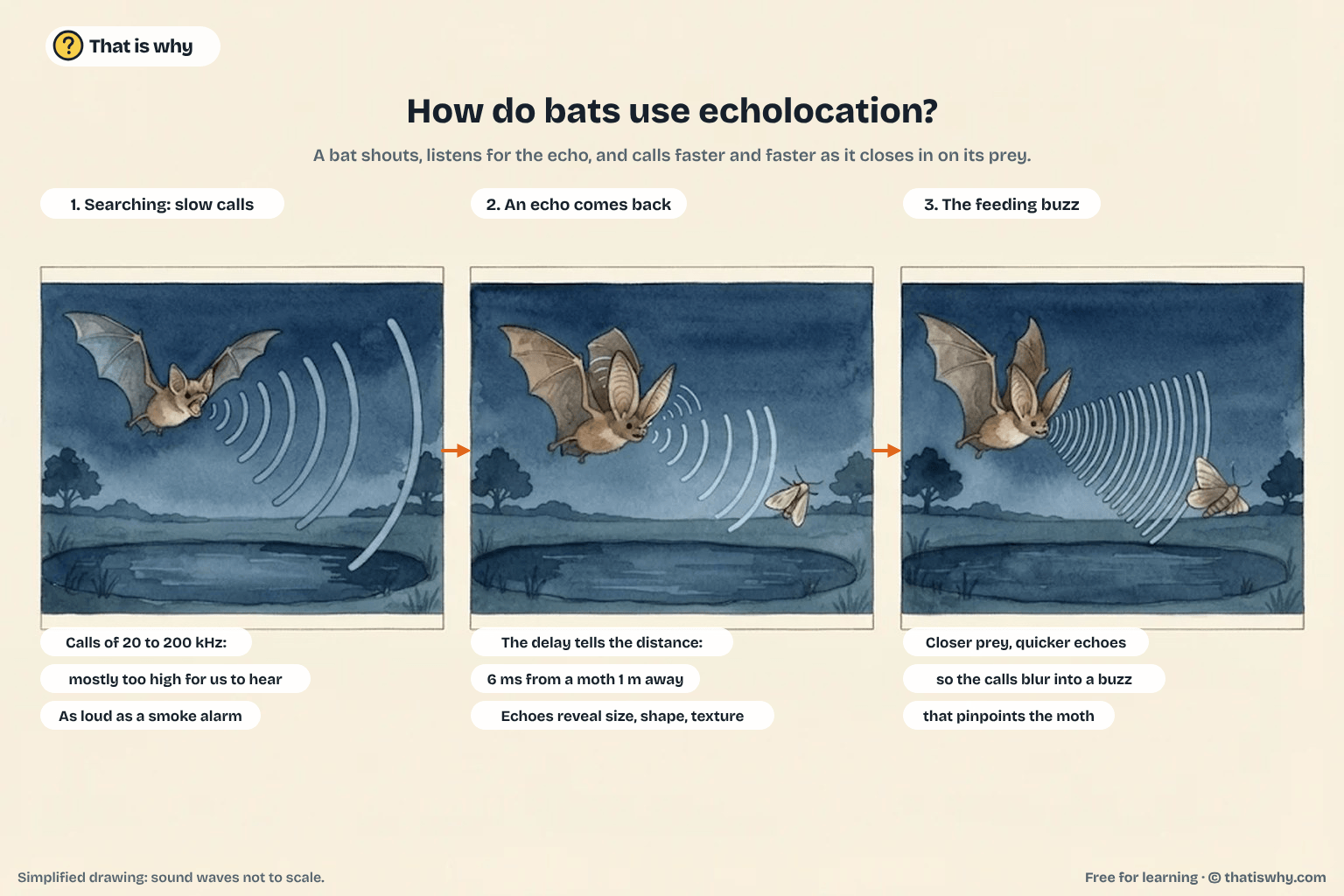
A bat shouts, listens for the echo, and calls faster and faster as it closes in on its prey.
The detailed teaching diagram
What the diagram shows
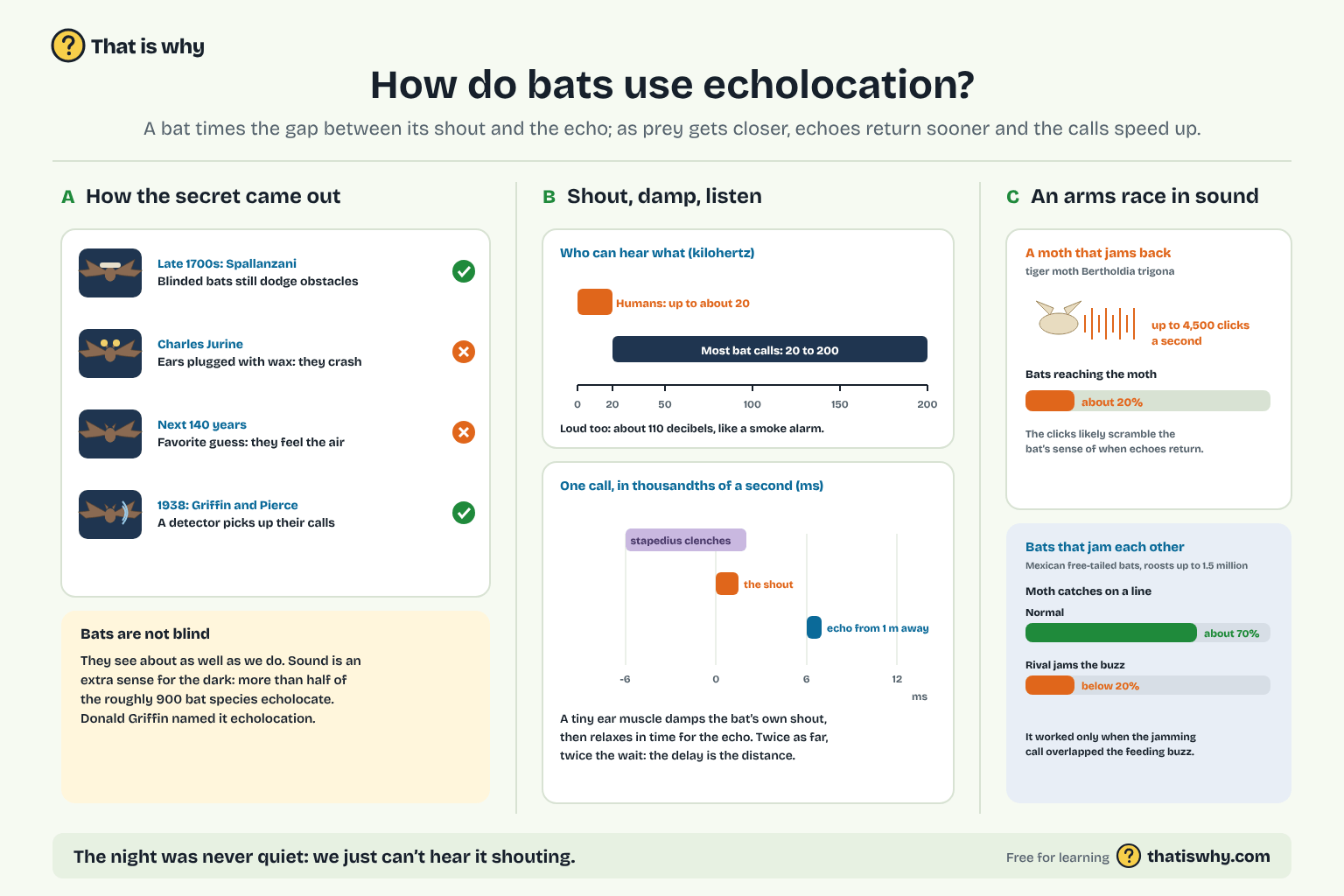
1. Searching with slow calls. A hunting bat sends out calls through its mouth or nose, mostly ultrasound pitched between 20 and 200 kilohertz, far above the roughly 20,000 hertz that human ears can reach. Just before each call, the stapedius muscle in its middle ear clenches so the bat doesn't deafen itself.
2. An echo comes back. When a call hits a moth, part of it bounces back. The delay tells the bat how far away the moth is: an echo from one meter away returns in about 6 milliseconds. The echo also reveals the moth's size, shape and texture. Finding things this way is echolocation.
3. The feeding buzz. As the bat closes in, echoes return sooner and it can call again sooner. In the last moment, its calls blur into a rapid series called the feeding buzz, which pinpoints exactly where the moth is.
Key numbers
| Fact | Value |
|---|---|
| Usual range of bat calls | 20 to 200 kHz |
| Top of human hearing | about 20 kHz |
| Loudness of big brown and little brown bats | about 110 decibels |
| Echo time from an insect 1 m away | about 6 ms |
| Bat species that echolocate | more than half of about 900 |
| Clicks per second from a jamming tiger moth | up to 4,500 |
Common misconceptions
Myth Bats are blind.
The truth Bats can see about as well as humans can. Echolocation is an extra sense for hunting in the dark.
Myth Bats fly silently.
The truth Big brown and little brown bats call at about 110 decibels, about as loud as a smoke alarm. Most of it is simply too high-pitched for us to hear.
Myth Every bat uses echolocation.
The truth Of the roughly 900 bat species, more than half rely on it.
Questions to use in class
Tap a question to reveal a model answer.
1How do bats use echolocation?
A bat sends out high-pitched calls and listens for the echoes. The time an echo takes to return tells it how far away something is, and the echo also reveals its size, shape and texture.
2Why do bats call faster when they hunt?
As a bat closes in, echoes come back sooner, so it can call again sooner. In the last moment, its calls blur into a fast series called the feeding buzz, which pinpoints the prey.
3Why don't bats deafen themselves?
Just before each call, a tiny middle-ear muscle called the stapedius contracts to damp the bat's hearing, then relaxes in time to catch the echo.
4Can moths fight back against bat sonar?
Yes. The tiger moth Bertholdia trigona clicks up to 4,500 times a second, and in tests bats reached the clicking moths only about 20 percent of the time.
Key terms
- Echolocation
- Finding things by making sounds and listening to the echoes. Bats, dolphins and sperm whales use it to hunt where they cannot see.
- Ultrasound
- Sound too high-pitched for humans to hear, above about 20,000 hertz (20 kHz). Dolphin and bat clicks reach well into this range.
- Hertz (Hz)
- The number of vibrations or cycles per second. A cat's purr sits at about 25 to 150 Hz, a very low hum.
- Feeding buzz
- The rapid burst of echolocation calls a bat makes in the last moments of an attack, helping it pinpoint exactly where its prey is.
- Stapedius
- A tiny muscle in the middle ear that tightens to damp down loud sounds. Bats clench it just before each call so their own shouts don't deafen them.
Sources
- Discovering sonar in bats American Association for the Advancement of Science (AAAS)
- How do bats echolocate and how are they adapted to this activity? Scientific American
- Bat Echolocation Maryland Department of Natural Resources
- Bats Jam Each Other's Sonar National Geographic
- Moths Use Sonar-Jamming Defense to Fend Off Hunting Bats Scientific American