Free teaching diagram
Dolphin Echolocation Diagram: How Dolphins See With Sound
Dolphins see with sound: clicks go out through the melon, and echoes come back through the lower jaw.
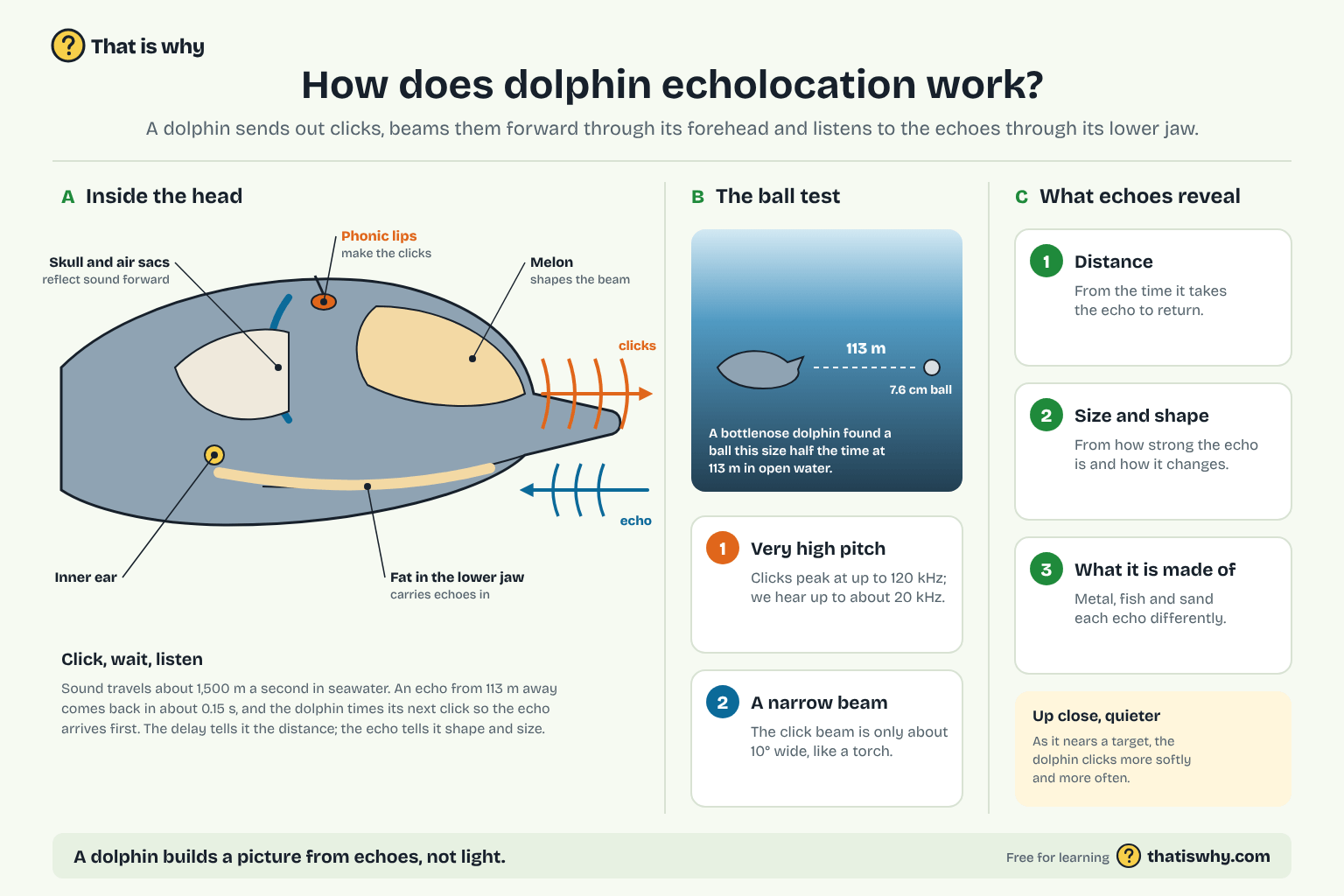
What the diagram shows
A. Inside the head. A dolphin makes clicks at the phonic lips, a pair of tissue lips in the nasal passage below the blowhole. Sound traveling backwards is reflected forward by the skull and air sacs. In front sits the melon, a fatty organ in the forehead that helps channel the clicks into a beam. Returning echoes are picked up mainly through the thin bone and fat of the lower jaw, which carry them to the inner ear.
Click, wait, listen. Sound travels about 1,500 m a second in seawater, so an echo from an object 113 m away comes back after about 0.15 seconds. Dolphins time their clicks so that each echo arrives before the next click goes out. The delay tells them the distance; the strength and pattern of the echo tell them about size, shape and material.
B. The ball test. In a classic open-water experiment, a bottlenose dolphin detected a 7.6 cm metal sphere, a little bigger than a golf ball, half of the time at 113 m. Its clicks peaked at up to 120 kHz, far above the roughly 20 kHz limit of human hearing (ultrasound), in a beam only about 10° wide.
C. What echoes reveal. Distance comes from the echo's timing, size and shape from its strength and how it changes, and material from how different objects reflect sound. As a dolphin closes in on a target, it clicks more quietly and more often.
Key numbers
| Fact | Value |
|---|---|
| Target detected | 7.6 cm sphere at 113 m |
| Peak click frequency | up to 120 kHz |
| Click loudness | about 227 dB (peak to peak) |
| Beam width | about 10° |
| Speed of sound in seawater | about 1,500 m/s |
Common misconceptions
Myth Dolphins make clicks with their throat, like we use our voice box.
The truth Clicks are made by the phonic lips in the nasal passages, just below the blowhole.
Myth Dolphins hear echoes through ear openings like ours.
The truth Their ear openings are tiny. Echoes are picked up mainly through the thin bone and fat of the lower jaw, which carry sound to the inner ear.
Myth Echolocation gives dolphins a picture in color.
The truth Echoes carry information about distance, size, shape and material, not color.
Questions to use in class
Tap a question to reveal a model answer.
1Sound travels about 1,500 m a second in seawater. How long does an echo from a fish 75 m away take to return?
The sound travels 150 m in total (there and back), so about 150 ÷ 1,500 = 0.1 seconds.
2Why does a dolphin wait for one echo before sending the next click?
If clicks and echoes overlapped, it could not tell which echo belonged to which click, so it would lose track of distance.
3Why might a narrow beam be more useful than sound spreading in all directions?
A narrow beam puts more energy in one direction, so echoes are stronger, and the dolphin knows exactly which direction each echo came from.
4Why do dolphins click more quietly as they get close to a target?
Close up, echoes return strongly and quickly. Softer clicks avoid overwhelming their hearing, and faster clicking keeps track of the target.
Key terms
- Echolocation
- Finding things by making sounds and listening to the echoes. Bats, dolphins and sperm whales use it to hunt where they cannot see.
- Phonic lips
- A pair of lips of tissue in the nose passage of toothed whales. Air pushed between them makes the clicks used in echolocation.
- Melon
- The rounded, fatty organ in a dolphin's forehead. It helps channel the clicks made in the nasal passages into a forward beam for echolocation.
- Ultrasound
- Sound too high-pitched for humans to hear, above about 20,000 hertz (20 kHz). Dolphin and bat clicks reach well into this range.
- Sonar
- A way of finding things underwater by sending out pulses of sound and timing the echoes that come back.
Sources
- History of dolphin biosonar research Acoustics Today
- Long-range target detection in open waters by an echolocating Atlantic bottlenose dolphin (Au & Snyder, 1980) Journal of the Acoustical Society of America
- Echolocation in dolphins with a dolphin-bat comparison (Au, 1997) Bioacoustics