Free teaching diagram
Sperm Whale Head Anatomy: Spermaceti Organ Diagram
Most of a sperm whale's head is a sound machine: a click bounces back and forth through oil and air to leave as a focused beam.
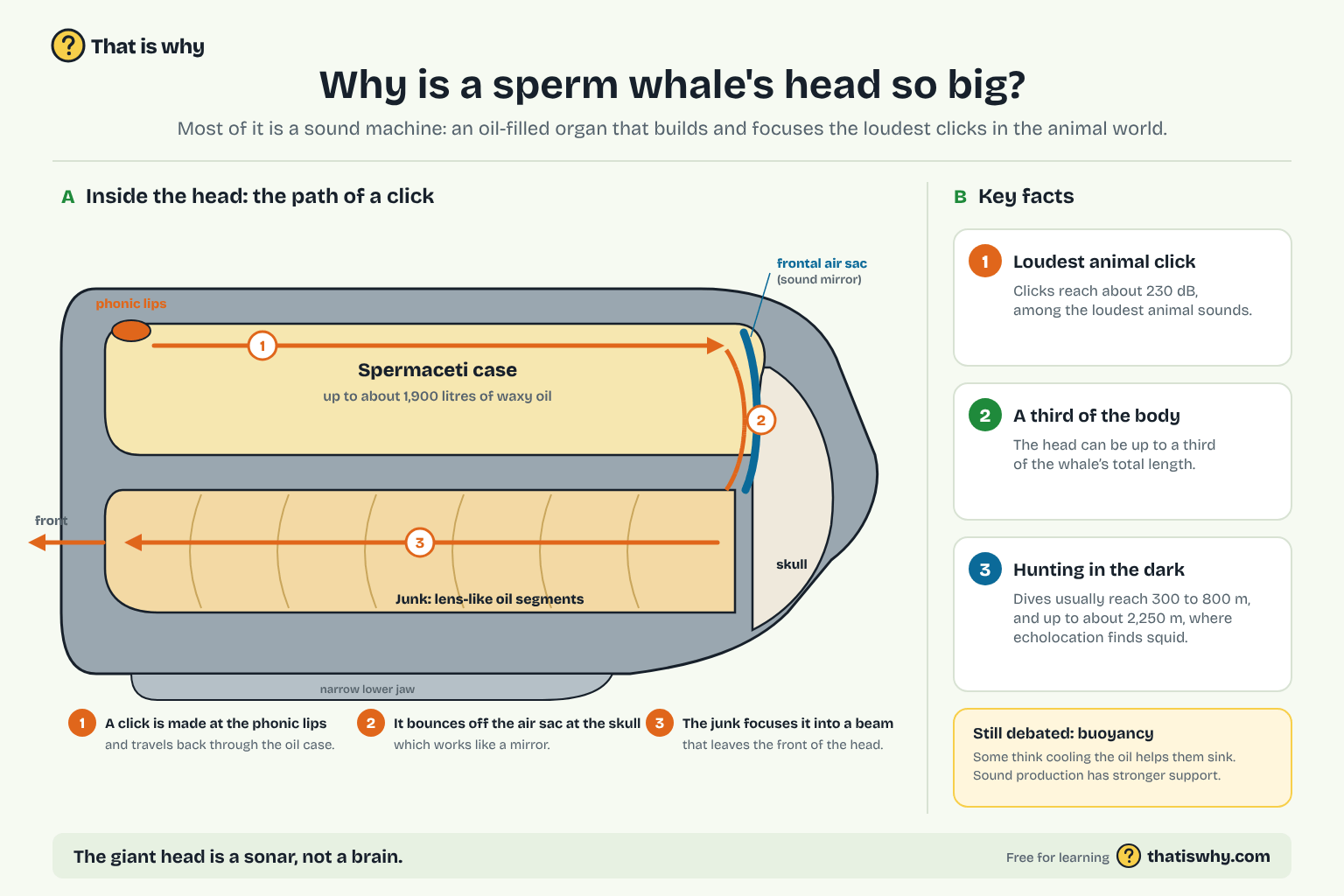
What the diagram shows
A. Inside the head: the path of a click. A sperm whale's head can be up to a third of its body length. Most of it is two oil-filled structures stacked on top of each other: the spermaceti case, holding up to about 1,900 liters of waxy oil, and below it the junk, a series of lens-like oil segments.
- The click is made at the phonic lips, near the front of the head, and travels backwards through the spermaceti case.
- It reflects off the frontal air sac in front of the skull. Sound bounces strongly where oil meets air, so the sac acts as a mirror.
- It is focused as it travels forwards through the junk, and leaves the front of the head as a narrow beam.
B. Key facts. The clicks reach about 230 decibels, among the loudest sounds made by any animal. Sperm whales usually dive to 300 to 800 m, and sometimes to about 2,250 m, where it is completely dark. They find squid there by echolocation: listening for the echoes of their own clicks.
The buoyancy question. An older idea is that the whale cools the spermaceti oil to make it denser and help it sink, then warms it to rise. It is still debated; the sound-making role is much more widely accepted.
Key numbers
| Fact | Value |
|---|---|
| Spermaceti oil in the case | up to about 1,900 liters |
| Head length | up to about a third of the body |
| Click loudness | about 230 dB |
| Typical dive depth | 300 to 800 m (up to about 2,250 m) |
Common misconceptions
Myth The sperm whale's huge head is mostly brain.
The truth Its brain is the largest of any animal, but most of the head is the spermaceti case and the junk, oil-filled structures used to make sound.
Myth Spermaceti is sperm.
The truth No. Whalers named it because they mistook the milky oil for sperm. It is a waxy oil held in the whale's head.
Myth Scientists know the spermaceti organ controls diving.
The truth The buoyancy idea, cooling the oil to sink and warming it to rise, is still debated. Its role in making and focusing sound has much stronger support.
Questions to use in class
Tap a question to reveal a model answer.
1Why does a click bounce off the frontal air sac instead of passing through it?
Sound travels well through oil and water but reflects strongly where it meets air, so the air sac works like a mirror.
2Why would a focused beam of sound help a whale hunting at 1,000 m?
It is dark at that depth. A focused beam travels further and returns clearer echoes, so the whale can locate squid it cannot see.
3Follow the click: name the four parts it passes in order.
Phonic lips, spermaceti case, frontal air sac (where it reflects), and the junk, before it leaves the front of the head.
4Butter is hard in the fridge and soft when warm. How does that relate to the buoyancy idea?
Some scientists suggested that cooling the oil makes it denser, like hard butter, helping the whale sink, and warming it helps it rise. This idea is still debated.
Key terms
- Spermaceti
- A waxy oil held in a large case in a sperm whale's head, up to about 1,900 liters. Whalers named it because they mistook it for sperm.
- Phonic lips
- A pair of lips of tissue in the nose passage of toothed whales. Air pushed between them makes the clicks used in echolocation.
- Echolocation
- Finding things by making sounds and listening to the echoes. Bats, dolphins and sperm whales use it to hunt where they cannot see.
- Junk
- The lower of the two oil-filled structures in a sperm whale's head, made of lens-like segments. It is thought to focus clicks into a beam, much like the melon of a dolphin.
- Sonar
- A way of finding things underwater by sending out pulses of sound and timing the echoes that come back.
- Buoyancy
- The upward push a liquid or gas gives to an object in it. An animal less dense than the water around it floats; one that is denser sinks.
Sources
- Sperm whale Wikipedia
- Spermaceti organ Wikipedia