Free teaching diagram
Blobfish Diagram: Why It Only Looks Ugly Out of Water
Deep down, water pressure holds the blobfish's soft body in shape. At the surface, the support is gone and it sags.
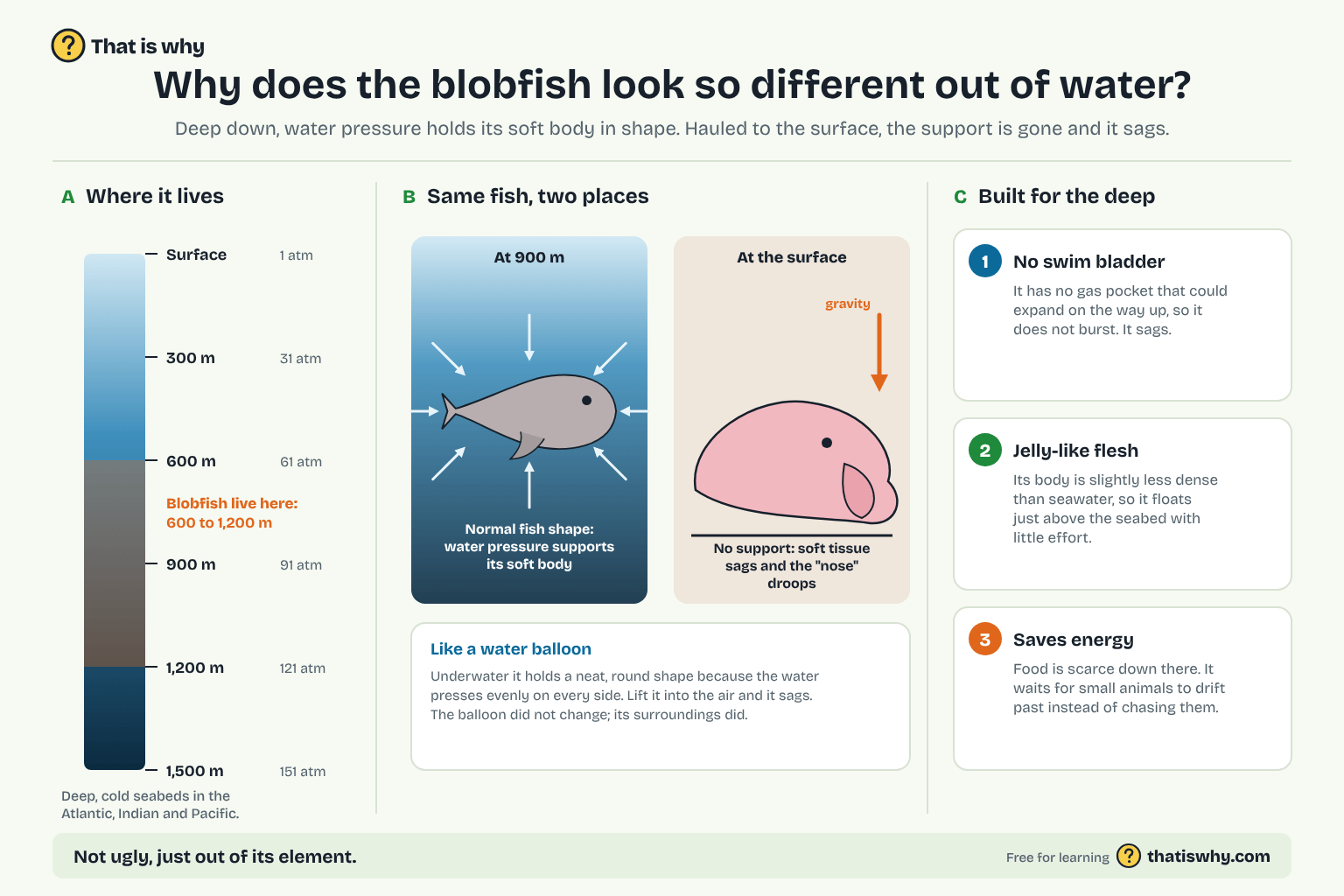
What the diagram shows
A. Where it lives. Blobfish live on deep, cold seabeds, roughly 600 to 1,200 m down. Every 10 m of seawater adds about one atmosphere (1 atm) of hydrostatic pressure, so at 900 m the fish is under about 91 atm, more than 90 times the pressure we feel at the surface.
B. Same fish, two places. At its home depth, water presses evenly on every side of the blobfish's soft body and holds it in a normal fish shape. When it is hauled up in a net, that support disappears. Its loose skin and jelly-like flesh sag under gravity, and the rapid change in pressure (decompression) damages the tissue. The droopy "nose" in famous photos is the result.
C. Built for the deep. Three features explain the shape:
- No swim bladder. There is no gas pocket that could be squeezed at depth or swell on the way up.
- Jelly-like flesh. It makes the fish slightly less dense than seawater, giving it near-perfect buoyancy just above the seabed.
- Saves energy. Food is scarce in the deep, so the blobfish waits for small animals and scraps to drift past instead of chasing them.
Key numbers
| Fact | Value |
|---|---|
| Depth range | about 600 to 1,200 m |
| Pressure at 900 m | about 91 atm |
| Length | about 30 cm (1 foot) |
| Swim bladder | none |
Common misconceptions
Myth The blobfish looks like a pink blob in the wild.
The truth Underwater, at its normal depth, it looks like a fairly ordinary fish with a big head and a tapering tail. The famous droopy face comes from being pulled up to the surface.
Myth Blobfish explode when they are brought up.
The truth They have no gas-filled swim bladder, so there is nothing to swell up and burst. Their soft tissue sags and is damaged instead.
Myth The blobfish is ugly because it is badly built.
The truth Its soft bones and jelly-like flesh are well suited to the deep sea. They let it hover just above the seabed using little energy.
Questions to use in class
Tap a question to reveal a model answer.
1Using the rule "about 1 atm for every 10 m", what is the pressure where a blobfish lives at 1,000 m?
About 100 atm from the water, plus 1 atm of air at the surface: roughly 101 atm.
2Why doesn't a blobfish burst like some fish that have a swim bladder?
A swim bladder is full of gas, which expands a lot as pressure drops. The blobfish has no swim bladder, so there is no gas pocket to expand.
3How does the blobfish stay just above the seabed without swimming hard?
Its jelly-like flesh makes it slightly less dense than seawater, so it floats with very little effort.
4A water balloon looks round underwater but sags on a table. How is that like the blobfish?
In both cases the object did not change. Water pushing evenly from every side holds the soft shape; in air that support is gone, so gravity pulls it down.
Key terms
- Hydrostatic pressure
- The pressure a liquid at rest exerts because of the weight of the liquid above. It grows steadily with depth and pushes equally from every direction.
- Atmosphere (atm)
- A unit of pressure equal to the average air pressure at sea level (about 101 kilopascals, or 14.7 pounds per square inch). In the sea, pressure rises by about 1 atm for every 10 m of depth.
- Swim bladder
- A gas-filled pouch inside many bony fish that lets them float at a chosen depth without swimming. Because it holds gas, it shrinks under pressure and swells when pressure drops.
- Decompression
- A drop in surrounding pressure. When a deep-sea animal is pulled up quickly, the sudden decompression can make gases expand and soft tissues lose their shape.
- Buoyancy
- The upward push a liquid or gas gives to an object in it. An animal less dense than the water around it floats; one that is denser sinks.
Sources
- Blobfish National Geographic
- 'World's ugliest animal' contest took a blobfish out of water Science News
- How does pressure change with ocean depth? NOAA Ocean Service