Free teaching diagram
Fish Barotrauma Diagram: Why Fish "Explode" When Reeled Up
Nothing explodes: the gas in the swim bladder was already there, squeezed small, and expands as the pressure drops.
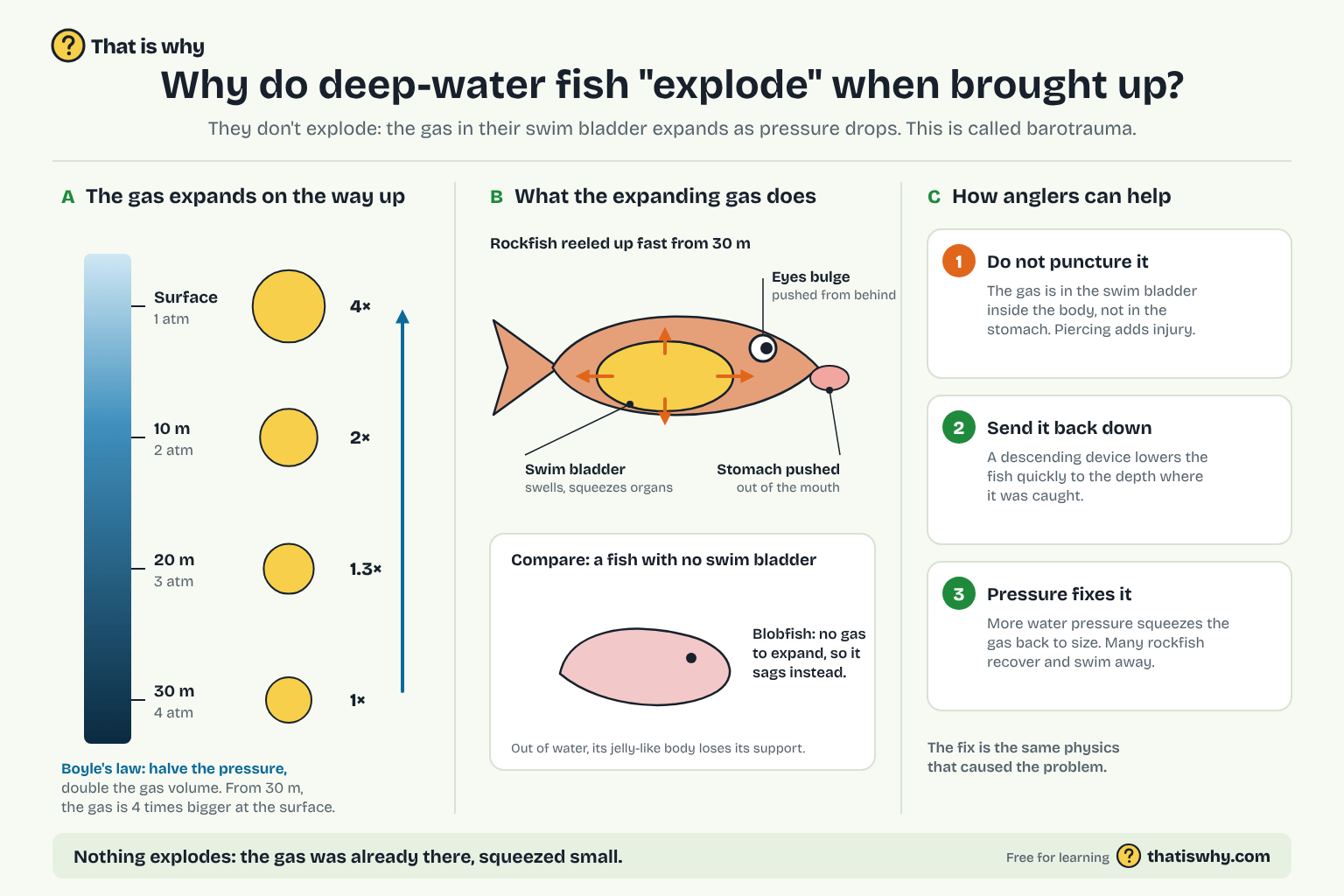
What the diagram shows
A. The gas expands on the way up. Many fish have a swim bladder, a pouch of gas that keeps them buoyant. Water pressure rises by about 1 atmosphere for every 10 m of depth, so a fish at 30 m feels about 4 atm. By Boyle's law, gas volume goes up as pressure goes down: the same gas takes 1.3 times the space at 20 m, twice the space at 10 m and 4 times the space at the surface.
B. What the expanding gas does. Inside a fish there is no empty room for that extra gas. The swelling bladder squeezes the organs, pushes the eyes forward so they bulge, and can push the stomach out through the mouth. The fish also becomes too buoyant to swim back down. This injury is called barotrauma. A fish with no swim bladder, like the blobfish, reacts differently: it has no gas to expand, so it sags instead.
C. How anglers can help. Puncturing the fish doesn't work, because the gas is in the swim bladder inside the body cavity, not in the stomach. The fix is to use a descending device to lower the fish quickly back to the depth where it was caught. The higher pressure there squeezes the gas back to size, and many rockfish recover.
Key numbers
| Depth | Pressure | Swim-bladder gas volume |
|---|---|---|
| 30 m | about 4 atm | 1× |
| 20 m | about 3 atm | about 1.3× |
| 10 m | about 2 atm | 2× |
| Surface | 1 atm | 4× |
Common misconceptions
Myth The fish literally explodes.
The truth Nothing bursts or detonates. The gas in the swim bladder expands as pressure drops, and the swelling pushes on the eyes and stomach.
Myth You should pop the bloated stomach to let the air out.
The truth The gas is in the swim bladder inside the body cavity, not in the stomach. Puncturing adds injury; returning the fish to depth is the effective fix.
Myth All deep-sea fish blow up when brought to the surface.
The truth Fish without a gas-filled swim bladder, like the blobfish, don't inflate. They sag instead, because their jelly-like bodies lose the support of the water.
Questions to use in class
Tap a question to reveal a model answer.
1A fish's swim bladder holds 1 liter of gas at 20 m (3 atm). What volume would it be at the surface (1 atm)?
About 3 liters. By Boyle's law, a third of the pressure means three times the volume.
2Why does reeling a fish up quickly make barotrauma worse?
Some fish can slowly release or absorb gas to adjust, but a fast ascent gives them no time, so the gas expands faster than the body can cope.
3How does a descending device help the fish?
It takes the fish back down to depth, where higher water pressure squeezes the expanded gas back to a safe volume.
4Why doesn't a blobfish swell up the same way?
It has no gas-filled swim bladder, so there is no pocket of compressed gas to expand. Without water pressure supporting it, its soft body sags instead.
5What do barotrauma in fish and 'the bends' in divers have in common?
Both are caused by gas behaving differently when pressure drops quickly: in fish, swim-bladder gas expands; in divers, gas dissolved in the blood forms bubbles.
Key terms
- Barotrauma
- Injury caused by a quick change in pressure. In fish hauled up from deep water, gas in the swim bladder expands and can push the stomach out of the mouth or make the eyes bulge.
- Swim bladder
- A gas-filled pouch inside many bony fish that lets them float at a chosen depth without swimming. Because it holds gas, it shrinks under pressure and swells when pressure drops.
- Boyle's law
- At a constant temperature, the volume of a gas goes down as the pressure on it goes up, in the same proportion: double the pressure and the gas takes up half the space.
- Atmosphere (atm)
- A unit of pressure equal to the average air pressure at sea level (about 101 kilopascals, or 14.7 pounds per square inch). In the sea, pressure rises by about 1 atm for every 10 m of depth.
- Descending device
- A weighted clip or cage that anglers use to lower a fish with barotrauma back to the depth it came from, where water pressure shrinks the expanded gas again.
- Decompression sickness
- An illness in divers who rise too quickly: gas dissolved in the blood under pressure forms bubbles as the pressure drops.
Sources
- What is barotrauma? RecFIN (Pacific States Marine Fisheries Commission)
- How does pressure change with ocean depth? NOAA Ocean Service